
Cardinal (bird)
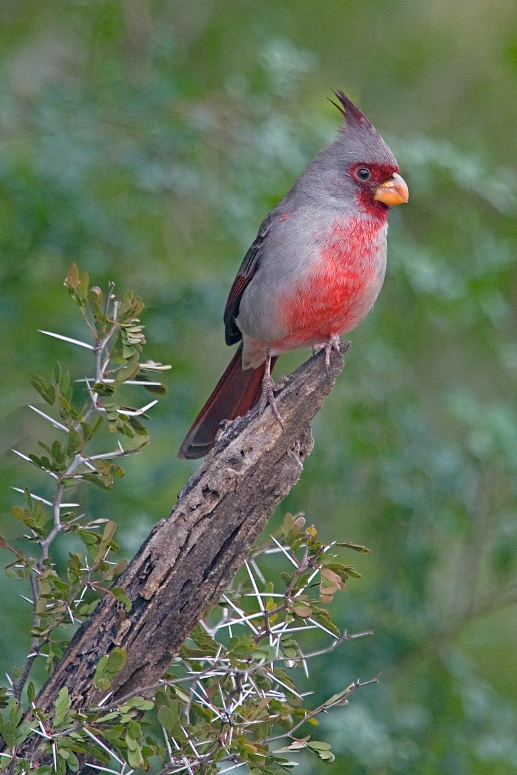
Credit: www.naturespicsonline.com · Copyrighted free use
The cardinal is a songbird found across much of North and South America. The most famous kind is the northern cardinal, which lives in the eastern and central United States, Mexico, and parts of Central America. Males are bright red with a black mask around the beak. Females are a softer brown with red on their wings, tail, and crest. Both have a pointed crest of feathers on top of the head and a thick orange beak.
Cardinals got their name from Catholic cardinals, who wear bright red robes. Early settlers in America thought the bird looked like the churchmen they knew back home. The name stuck.
A northern cardinal is about nine inches long from beak to tail. That is a little bigger than a robin. Cardinals do not migrate. They stay in the same area all year, which is part of why they are so loved. A flash of red against winter snow is one of the reasons people put out bird feeders. Cardinals eat mostly seeds, but they also eat fruit, insects, and small snails. Their strong beak can crack open tough sunflower seeds with ease.
Cardinals are known for their songs. Unlike many songbirds, both the male and the female sing. Females sometimes sing from the nest, maybe to tell the male what food to bring. A pair usually stays together for life. They build a small cup-shaped nest in a thick bush, and the female lays two to five eggs. The eggs hatch in about 12 days.
Here is something strange. Once in a while, people spot a cardinal that is red on one side of its body and brown on the other, split right down the middle. These rare birds are called bilateral gynandromorphs. They are male on one side and female on the other. Scientists think the condition starts when two sets of genes end up in a single egg. Only a handful have ever been photographed in the wild.
The cardinal is also a popular symbol. It is the state bird of seven states, including Ohio, Virginia, and Illinois. Sports teams, including the St. Louis Cardinals and the Arizona Cardinals, are named after it. In many folk stories, a cardinal sighting is said to be a message from a lost loved one. No science backs that up, but the belief is common enough that plenty of people still pause when a red bird lands nearby.
Last updated 2026-04-22