
Humpback Whale
Credit: Unknown · Public domain
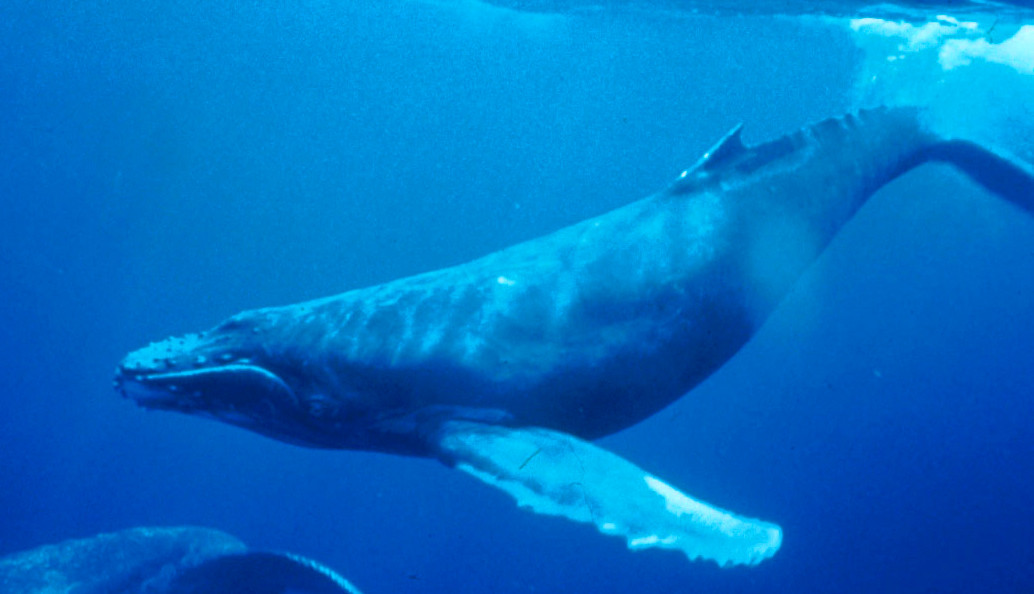
The humpback whale is a large ocean mammal found in every ocean on Earth. It gets its name from the small hump on its back, in front of its dorsal fin. Adult humpbacks grow 45 to 55 feet long, about the length of a school bus. They weigh around 40 tons, as much as 10 elephants. Even though they are huge, humpbacks are famous for being graceful. They leap almost fully out of the water, a move called breaching.
Humpbacks have the longest flippers of any whale. Each flipper can reach 16 feet, which is nearly a third of the whale's body. The flippers are mostly white on the underside, and the pattern is different on every whale. Scientists use these patterns like fingerprints to tell individual whales apart.
Like other whales, humpbacks are mammals. They breathe air through a blowhole on top of the head. They give birth to live babies, called calves, and feed them milk. A newborn calf is already about 15 feet long. It drinks up to 150 gallons of its mother's milk every day.
Humpbacks do not have teeth. Instead, their mouths are lined with hundreds of stiff plates called baleen, which hang down like the bristles of a comb. The whale takes a huge gulp of water full of small fish and tiny shrimp called krill, then pushes the water out through the baleen. The food gets trapped inside. Humpbacks also hunt in a clever way called bubble-net feeding. A group of whales swims in a circle below a school of fish, blowing bubbles from their blowholes. The bubbles rise and form a ring that traps the fish. Then the whales swim up through the middle with mouths wide open.
Humpbacks travel farther than almost any other mammal. Every year they swim between cold waters, where they feed in summer, and warm tropical waters, where they give birth in winter. Some humpbacks travel more than 5,000 miles in each direction. That is like swimming from New York to California and back.
For many years, humpbacks were hunted for their oil and meat. By the 1960s, fewer than 10,000 were left in the world. In 1966, countries agreed to stop hunting them. The whales have made a strong comeback. Today there are more than 80,000 humpback whales in the oceans. Scientists still worry about new dangers. Boats can hit them, fishing gear can tangle around them, and a warming ocean is changing the food they depend on.
Related
Last updated 2026-04-22