
English Language
Credit: User:Shardz · Public domain
The English language is a way of speaking and writing that began in England more than 1,500 years ago. Today, English is the most widely used language in the world. About 1.5 billion people speak it, though only about 400 million speak it as their first language. The rest learned it as a second language at school, at work, or online.
English started in the 400s CE, when groups called the Angles, Saxons, and Jutes sailed from what is now Germany and Denmark to the island of Britain. They brought their languages with them. Over time, those languages mixed together into something called Old English. The name "England" actually means "land of the Angles."
Old English would look like a foreign language to you today. Then, in 1066, an army from France called the Normans conquered England. The Normans spoke French. For the next 300 years, French was the language of kings, courts, and rich people in England. Regular people kept speaking English. The two languages slowly mixed. That is why English has so many pairs of words that mean almost the same thing. "Cow" comes from old English, but "beef" comes from French. "House" is English, but "mansion" is French.
By the 1500s, the language had changed enough to be called Modern English. The most famous writer of that time was William Shakespeare. He invented or first wrote down hundreds of words and phrases we still use, including "eyeball," "lonely," and "break the ice."
English uses an alphabet of 26 letters. Spelling is famously tricky because the language borrowed words from so many places and kept the old spellings. Words like "though," "through," "tough," and "thought" all look similar but sound very different. Even adults sometimes have to look up how to spell English words.
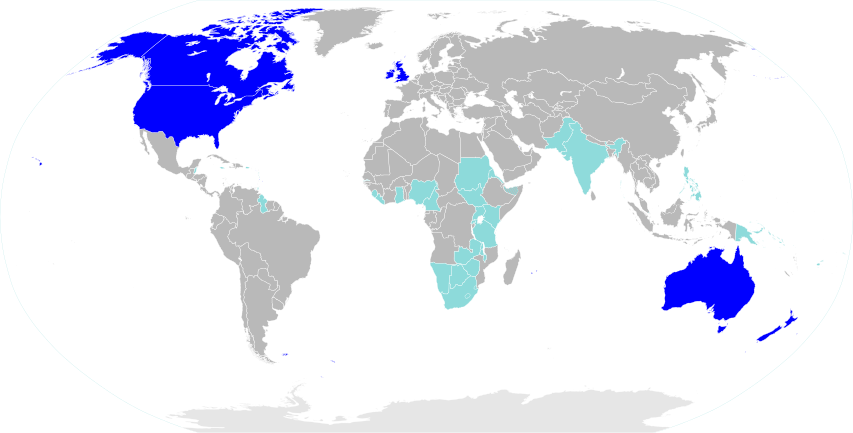
English spread around the world mostly through the British Empire. From the 1600s to the 1900s, British ships carried the language to North America, Australia, India, parts of Africa, and many islands. Later, the United States grew into a powerful country, and American movies, music, and the internet pushed English even further. Today it is the main language of science, airline pilots, and most of the world's websites.
English keeps changing. New words like "selfie," "emoji," and "podcast" did not exist when your grandparents were kids. Linguists, who study language, do not all agree on what counts as a "real" English word. Some say a word is real once people use it. Others want to wait until it appears in a dictionary. The language keeps moving, no matter who decides.
Related
Last updated 2026-04-26