
Queen Elizabeth I
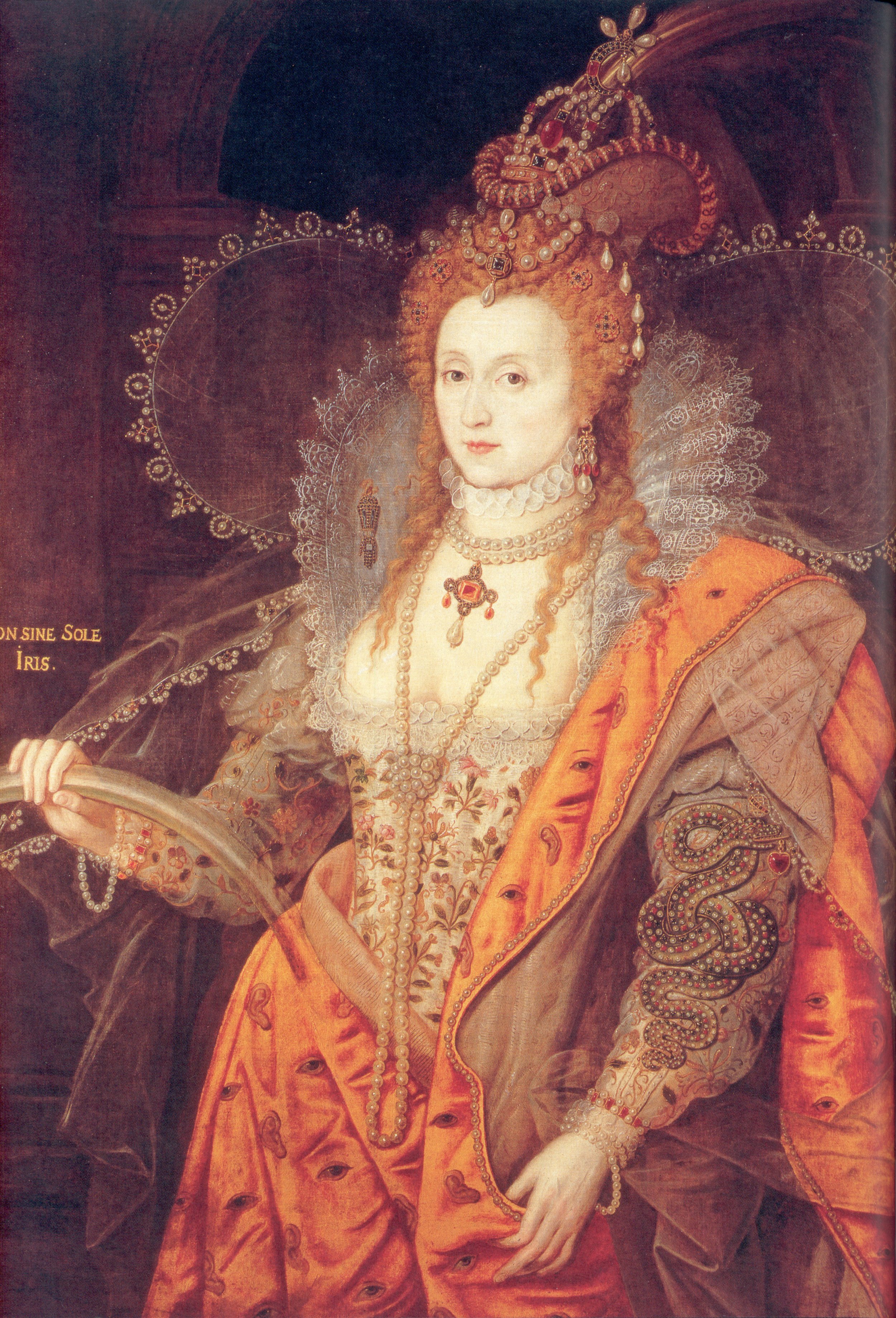
Credit: Attributed to Isaac Oliver / Attributed to Marcus Gheeraerts the Younger · Public domain
Queen Elizabeth I was a queen of England who ruled from 1558 to 1603. She was the daughter of King Henry VIII and his second wife, Anne Boleyn. Her 45-year rule is called the Elizabethan Age. It was a time of bold sea voyages, famous plays, and a stronger England.
Elizabeth's early life was hard. When she was only two, her father had her mother executed. Henry then declared Elizabeth illegitimate, which meant she was no longer treated as a princess. After her father died, her younger half-brother Edward ruled, and then her older half-sister Mary. Mary was Catholic and Elizabeth was Protestant, so Mary saw her as a threat. In 1554, Mary locked Elizabeth in the Tower of London for two months. Elizabeth was sure she would be killed there, but she was set free.
Mary died in 1558. Elizabeth, just 25 years old, became queen. England was poor, divided over religion, and surrounded by stronger countries. Many people doubted that a young woman could lead.
Elizabeth proved them wrong. She made Protestant Christianity the official religion, but she did not punish most people for quietly being Catholic. "I have no desire to make windows into men's souls," she said. After years of religious killings under earlier rulers, this was a calmer path.
The most famous moment of her rule came in 1588. King Philip II of Spain sent a huge fleet of warships, called the Spanish Armada, to invade England. Spain had about 130 ships. England had fewer ships, but they were faster. English captains used fire ships to scatter the Armada, and a fierce storm wrecked many of the rest. The victory shocked Europe and made England a real sea power.
Elizabeth never married. Many kings and princes asked, but she always refused. She said she was married to her country. People called her the Virgin Queen, and the colony of Virginia in North America was named after her. Historians still debate why she stayed single. Some think she did not want to share power. Others point to the violent fates of her mother and stepmothers.
Her reign was also a golden age for English writing. William Shakespeare wrote many of his plays during her rule. Sailors like Francis Drake circled the globe and brought back maps and treasure. English explorers began the colonies that would later grow into the British Empire.
Elizabeth died in 1603 at age 69. She had no children, so the throne passed to her cousin's son, James. England never forgot her.
Related
Last updated 2026-04-26