
North America
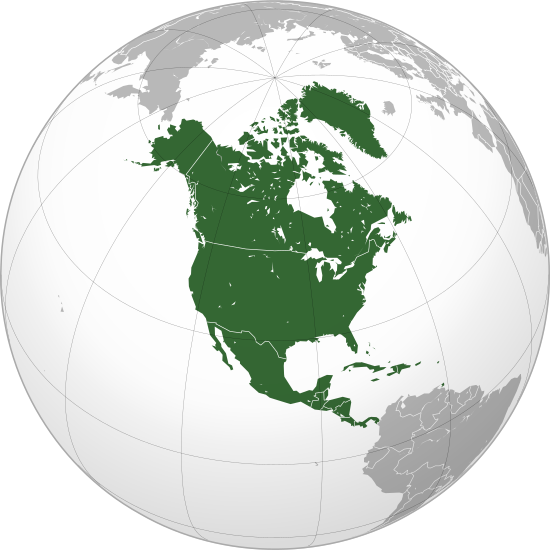
Credit: Bosonic dressing · CC BY-SA 3.0
North America is the third largest of Earth's seven continents. It sits in the Northern Hemisphere, between the Atlantic Ocean to the east and the Pacific Ocean to the west. To the north is the Arctic Ocean. To the south, a narrow strip of land called the Isthmus of Panama connects it to South America. North America covers about 9.5 million square miles. That is roughly one-sixth of all the land on Earth.
The continent includes 23 countries. The three largest by area are Canada, the United States, and Mexico. Together they make up most of the continent. The rest is made up of seven smaller countries in Central America and thirteen island nations in the Caribbean Sea. About 600 million people live in North America. That is less than one-tenth of the world's population.
Land and water
North America has almost every kind of landscape. In the far north, frozen tundra stretches across Canada and Alaska. Huge pine forests grow below the tundra. In the middle of the continent are the Great Plains, wide grasslands where bison once roamed in herds of millions. Two great mountain ranges run north to south. The Rocky Mountains line the western side. The older, smaller Appalachian Mountains run along the east.
The continent holds some of the world's biggest rivers and lakes. The Mississippi River flows more than 2,300 miles from Minnesota to the Gulf of Mexico. The Great Lakes, on the border of the United States and Canada, hold about one-fifth of all the fresh surface water on Earth. In the southwest, deserts stretch across Nevada, Arizona, and northern Mexico. The Grand Canyon, carved by the Colorado River, cuts a mile deep into the ground.
The first people
People have lived in North America for a very long time. Scientists think the first humans arrived at least 15,000 years ago, and possibly much earlier. Most researchers believe they crossed from Asia when sea levels were lower and a land bridge connected Siberia to Alaska. Others now argue that some people arrived by boat along the Pacific coast. The question is still being studied.
Over thousands of years, these first peoples spread across the continent and built many different societies. The Inuit lived in the Arctic. The Haudenosaunee, or Iroquois, formed a powerful union of nations in the northeast. The Lakota hunted bison on the plains. The Pueblo peoples built cliff villages in the southwest. Farther south, the Maya and Aztec built cities with pyramids, written languages, and calendars. The Aztec capital, Tenochtitlán, held more people than most European cities of its time.
Europeans arrive
In 1492, a Spanish expedition led by Christopher Columbus reached the Caribbean. Columbus was not the first European to reach North America. Viking sailors from Norway had landed in what is now Canada about 500 years earlier. But Columbus's voyages began a flood of European settlement and conquest.
Over the next three centuries, Spain, France, Britain, and the Netherlands all claimed parts of the continent. They brought new crops, new animals, and new tools. They also brought diseases that Indigenous peoples had no defense against. Illnesses like smallpox killed huge numbers of people. Some historians think the Native population dropped by as much as 90 percent in the first 150 years after contact.
Europeans also brought enslaved Africans to North America by force. Millions of people were shipped across the Atlantic to work on farms and plantations, especially in the Caribbean, the American South, and parts of Mexico. The slave trade shaped the language, food, music, and population of the whole continent.
Today
Most North Americans today live in cities. Mexico City is the largest, with more than 22 million people in its wider area. New York City, Los Angeles, and Toronto are also among the biggest. The continent produces a huge share of the world's food, especially corn, wheat, and beef. It is also a center of technology, film, and finance.
North America contains incredible wildlife, from polar bears in the Arctic to howler monkeys in the jungles of Central America. Grizzly bears, bison, and bald eagles live in the parks and forests of the north. Jaguars still roam the south. More than 30 countries and hundreds of Native nations share the continent, speaking English, Spanish, French, hundreds of Indigenous languages, and many others brought by immigrants over the past 500 years.
Related
Last updated 2026-04-22