
Decimal
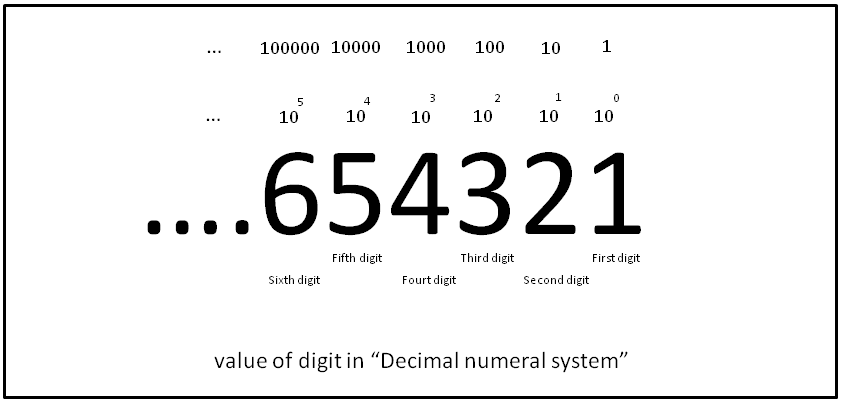
Credit: User:Hr.hanafi · CC BY-SA 3.0
A decimal is a way of writing numbers that are not whole. The word comes from the Latin word for ten, because the decimal system is built on tens. A decimal uses a small dot, called a decimal point, to separate the whole part of a number from the part that is less than one. In the number 4.7, the 4 is the whole part and the 7 stands for seven tenths.
The decimal system works by place value. Each spot in a number is worth ten times the spot to its right. To the left of the decimal point you have ones, tens, hundreds, and so on. To the right of the decimal point you have tenths, hundredths, thousandths, and so on. Each step to the right makes the value ten times smaller.
Take the number 12.345. The 1 means one ten. The 2 means two ones. The 3 means three tenths. The 4 means four hundredths. The 5 means five thousandths. Read out loud, it sounds like "twelve and three hundred forty-five thousandths."
Decimals and fractions are two ways of writing the same idea. The fraction 1/2 is the same as the decimal 0.5. The fraction 1/4 is the same as 0.25. Some fractions turn into decimals that go on forever. The fraction 1/3 is 0.3333… with the 3 repeating without end. The number pi starts 3.14159 and never stops or repeats at all.
You see decimals every day. Money uses them. A price of $2.75 means two whole dollars and seventy-five hundredths of a dollar, which is 75 cents. Sports scores use them. A gymnast might earn a score of 9.85. Rulers, scales, and thermometers use them too.
People have not always written numbers this way. Ancient Romans used letters like V and X, which made it hard to show parts of a number. The decimal system we use now came from India more than 1,500 years ago. Arab mathematicians spread it across the world. A Persian mathematician named al-Kashi worked out clear rules for decimal fractions in the 1400s. By the late 1500s, European traders and scientists had adopted decimals because they made math much faster.
Today almost every country uses decimals for money, science, and measurement. They turn hard problems into ones you can solve with a few simple steps.
Last updated 2026-04-26