
Lever
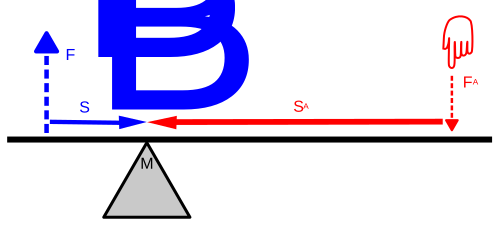
Credit: https://commons.wikimedia.org/wiki/User:Iainf · CC BY-SA 3.0
A lever is a simple machine made of a stiff bar that turns on a fixed point. The fixed point is called the fulcrum. Levers help people lift, move, or pry things that would otherwise be too heavy. They are one of the six classic simple machines, along with the pulley, wheel and axle, inclined plane, wedge, and screw.
A lever works by trading distance for force. If you push down on the long end of a bar, the short end pushes up hard on the load. The farther your end is from the fulcrum, the less force you need. This is why a crowbar can pop nails out of wood that your fingers cannot budge.
Scientists group levers into three classes based on where the fulcrum, the load, and the push are placed. A seesaw is a first-class lever, with the fulcrum in the middle. A wheelbarrow is a second-class lever, with the load in the middle. A fishing rod is a third-class lever, with your hands in the middle.
Levers are everywhere, often hiding in plain sight. Scissors are two levers joined together. A bottle opener is a lever. Even your arm is a lever, with your elbow as the fulcrum and your muscles doing the pulling. Every time you lift a spoon to your mouth, you are using one of the oldest machines humans ever figured out.
Last updated 2026-04-23