
Ancient Rome
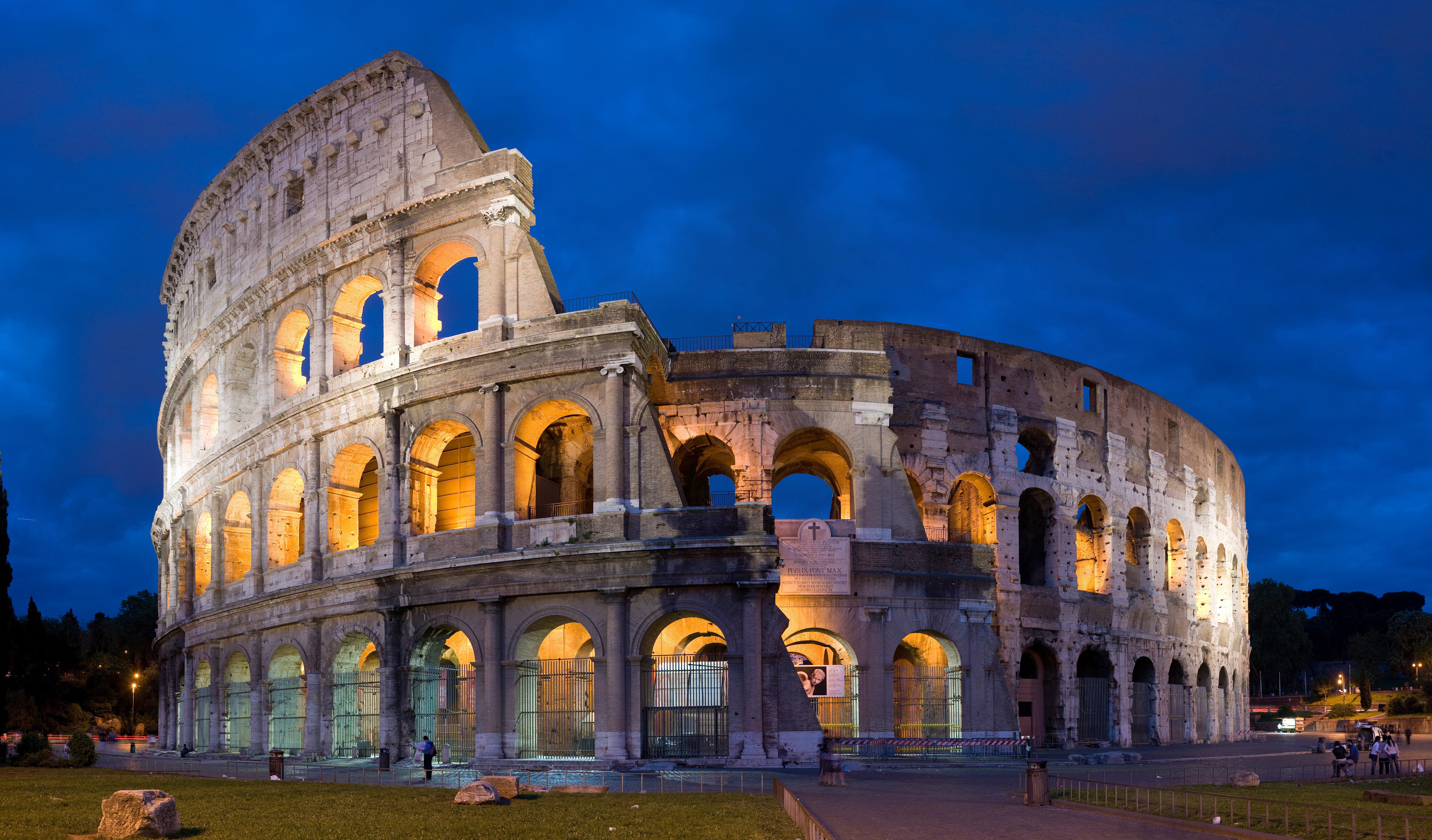
Credit: Diliff · CC BY-SA 2.5
Ancient Rome was a civilization that grew from a small village in Italy into one of the largest empires in history. It lasted for more than a thousand years. The story usually starts in 753 BCE, when the city of Rome was founded, and ends in 476 CE, when the western half of the empire fell. At its biggest, around 117 CE, Rome ruled about 60 million people across three continents.
From village to republic
According to legend, Rome was founded by twin brothers named Romulus and Remus, who were raised by a wolf. Most historians think the real story is less dramatic. Small farming villages along the Tiber River in central Italy slowly grew together into a city.
For its first 240 years, Rome was ruled by kings. Then, in 509 BCE, the Romans threw out their last king and created a republic. In a republic, citizens vote for leaders instead of being ruled by a king. Two leaders called consuls were elected each year. A group of older, wealthy men called the Senate gave them advice. The Roman Republic became the model that later inspired the United States government, which also has a Senate and elected leaders.
Not everyone could vote. Women, enslaved people, and most poor people had no political power. Slavery was a huge part of Roman life. By some estimates, one in three people in Italy during the late Republic was enslaved.
The empire grows
Rome's army was the secret to its power. Roman soldiers, called legionaries, trained constantly and fought in tight, disciplined groups. Over hundreds of years, Rome conquered most of Italy, then defeated the powerful North African city of Carthage in three long wars, then took Greece, Egypt, Spain, France, and parts of Britain and the Middle East.
In 49 BCE, a famous general named Julius Caesar marched his army into Rome itself and took control. He was murdered in the Senate in 44 BCE by senators who feared he wanted to be king. After more years of civil war, his adopted son Augustus became the first Roman emperor in 27 BCE. The Republic was over. From then on, emperors ruled.
Some emperors were thoughtful leaders, like Marcus Aurelius. Others were cruel or unstable, like Nero and Caligula. Power often passed through murder. Of the first 50 emperors, more than half were killed by their own soldiers, family members, or political rivals.
Daily life
Rome itself was huge for its time. By around 100 CE, more than a million people lived inside the city. Most lived in tall apartment buildings called insulae, which were often crowded and dangerous. Rich families lived in big houses with gardens, painted walls, and indoor running water.
Romans loved public entertainment. The Colosseum, finished in 80 CE, could hold about 50,000 people. Crowds watched chariot races, plays, and gladiator fights. Gladiators were usually enslaved people or prisoners forced to fight, sometimes to the death. Many Romans saw this as normal entertainment, the way people today watch sports.
Romans also loved bathing. Public bath houses were free or very cheap. People went there to wash, exercise, eat, gossip, and do business. Some baths could hold thousands of bathers at once.
Engineering and ideas
The Romans were brilliant builders. They invented a type of concrete that was so strong it is still standing today, two thousand years later. Modern engineers are still studying Roman concrete to learn its secrets. Romans built long stone channels called aqueducts to carry fresh water into their cities, sometimes from mountains 50 miles away. They built more than 50,000 miles of roads across the empire, enough to circle the Earth twice.
Latin, the Roman language, became the parent of Spanish, French, Italian, Portuguese, and Romanian. English borrowed thousands of Latin words too. Roman law, with ideas like "innocent until proven guilty," still shapes courts around the world.
The fall and what came after
Why did Rome fall? Historians have argued about this for centuries. There are dozens of theories. The empire grew too big to defend. Tax money ran short. Diseases swept through cities. Powerful generals fought each other instead of protecting the borders. Groups from outside the empire, often called barbarians, invaded again and again. The last western emperor was forced from his throne in 476 CE.
But Rome did not really vanish. The eastern half of the empire, called the Byzantine Empire, lasted almost another thousand years. Roman buildings, laws, languages, and stories are still around us. When you see a domed government building, read a Latin word, or watch a movie about gladiators, you are looking at a piece of ancient Rome that never really ended.
Related
Last updated 2026-04-26