
Napoleonic Wars
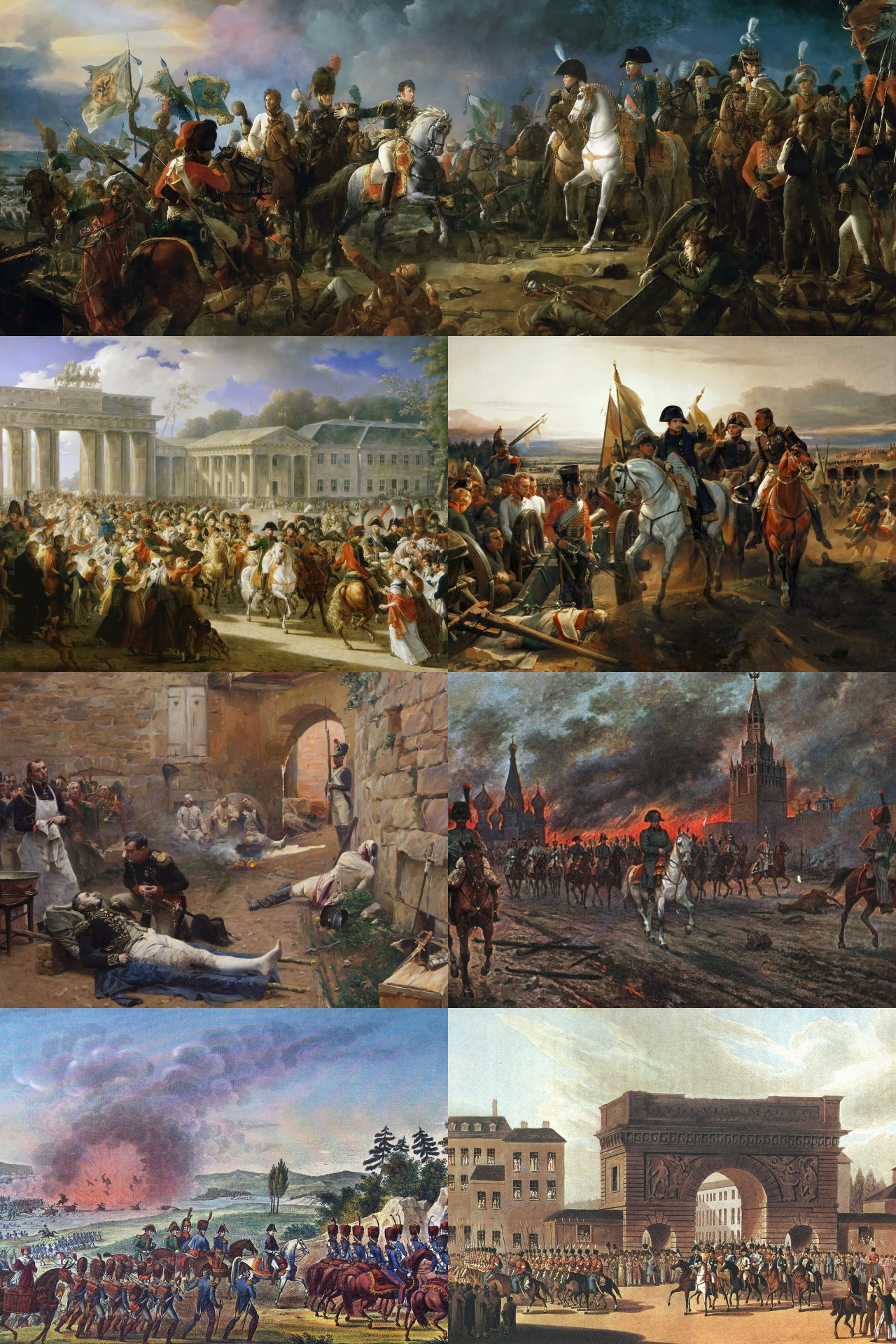
Credit: Ruedi33a · CC BY-SA 4.0
The Napoleonic Wars were a series of huge wars fought across Europe from 1803 to 1815. They were named after Napoleon Bonaparte, the French general who became emperor of France. On one side was France and the countries it controlled. On the other side were changing groups of enemies, including Britain, Russia, Austria, and Prussia. The wars reshaped the map of Europe.
The fighting grew out of the French Revolution. After the revolution, France's neighbors tried to crush its new government. Napoleon rose through the army during these earlier wars. By 1799 he had taken power in France. In 1804 he crowned himself emperor.
Napoleon was one of the most successful generals in history. He moved his armies fast and surprised his enemies. He won famous battles at Austerlitz in 1805 and Jena in 1806. By 1812, France or its allies controlled most of Europe, from Spain to Poland.
But Napoleon could not beat Britain. Britain had the strongest navy in the world. In 1805, Admiral Horatio Nelson destroyed the French and Spanish fleets at the Battle of Trafalgar. After that, Napoleon gave up trying to invade Britain. Instead, he tried to hurt its economy by blocking British trade with Europe.
The wars turned against him in Russia. In 1812, Napoleon marched into Russia with about 600,000 soldiers. The Russians retreated and burned their own crops and villages so the French would have nothing to eat. Then the Russian winter arrived. By the time Napoleon's army limped home, fewer than 100,000 men were left. The losses were so heavy that Napoleon's enemies sensed weakness.
Britain, Russia, Prussia, and Austria joined together one more time. They beat Napoleon in 1814 and forced him to give up his throne. He was sent to a small island called Elba. Less than a year later, he escaped, returned to France, and raised another army. His comeback lasted just 100 days. On June 18, 1815, British and Prussian forces defeated him at the Battle of Waterloo in what is now Belgium.
The wars killed somewhere between three and six million people. That made them the deadliest wars Europe had seen up to that time. They would not be matched until World War I a century later.
The Napoleonic Wars also changed the world in lasting ways. Napoleon's legal code, called the Napoleonic Code, became the basis for laws in many countries that still use it today. Old kingdoms broke apart, and new ideas about nations and citizens spread across Europe. After Waterloo, the great powers met in Vienna to redraw the map. The peace they built lasted, mostly, for almost 100 years.
Related
Last updated 2026-04-26