
Armadillo
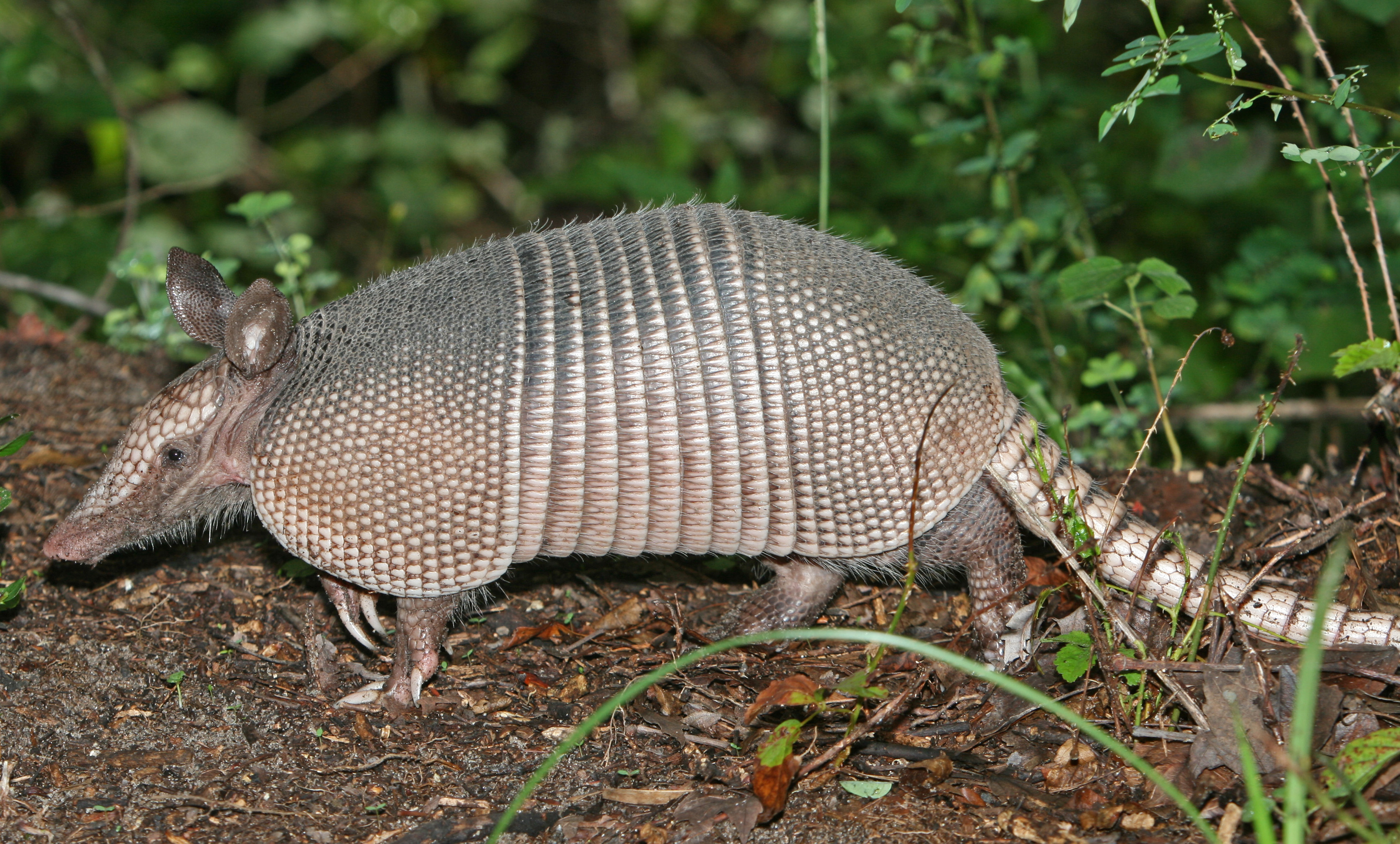
Credit: http://www.birdphotos.com · CC BY 3.0
The armadillo is a small mammal covered in a hard shell of bony plates. Armadillos live in North, Central, and South America. The name "armadillo" comes from a Spanish word that means "little armored one." There are about 20 different species. They range in size from the tiny pink fairy armadillo, which fits in your hand, to the giant armadillo, which can grow five feet long and weigh over 100 pounds.
The armadillo's shell is unlike any other in the animal world. It is made of tough plates of bone covered by hard skin. Most mammals have fur, but armadillos have armor instead. Bands of flexible skin between the plates let the animal bend and move. Only one kind, the three-banded armadillo, can roll itself into a complete ball when scared. Other species run for their burrows or dig fast to get away.
Armadillos are excellent diggers. Their front claws are long and strong, perfect for tearing into dirt, logs, and ant hills. A single armadillo may dig several burrows across its home range. These burrows can be 15 feet long and become homes for other animals too, like snakes, rabbits, and burrowing owls.
Most armadillos eat insects. Ants, termites, beetles, and grubs make up most of their diet. A sticky tongue pulls bugs out of the dirt and logs. Armadillos have poor eyesight but a strong sense of smell. They can sniff out insects buried eight inches underground.
The nine-banded armadillo is the only species found in the United States. It started crossing the Rio Grande from Mexico in the 1800s and has been spreading north ever since. Today it lives as far north as Nebraska and as far east as North Carolina. When startled, this armadillo does something strange: it jumps straight up into the air. This trick works against predators in the wild, but it often gets the animal hit by cars on American roads.
Armadillos are one of the few animals besides humans that can catch leprosy, a bacterial disease. Scientists study them to learn how the disease works and how to treat it. This research has helped doctors develop better medicines for people.
Armadillos are also very old, in an evolutionary sense. Their ancestors lived alongside giant armadillo relatives called glyptodonts. Glyptodonts were the size of small cars and had tail clubs. They went extinct about 10,000 years ago, but the armadillo kept its armor and quietly kept going.
Last updated 2026-04-22