
Iguana
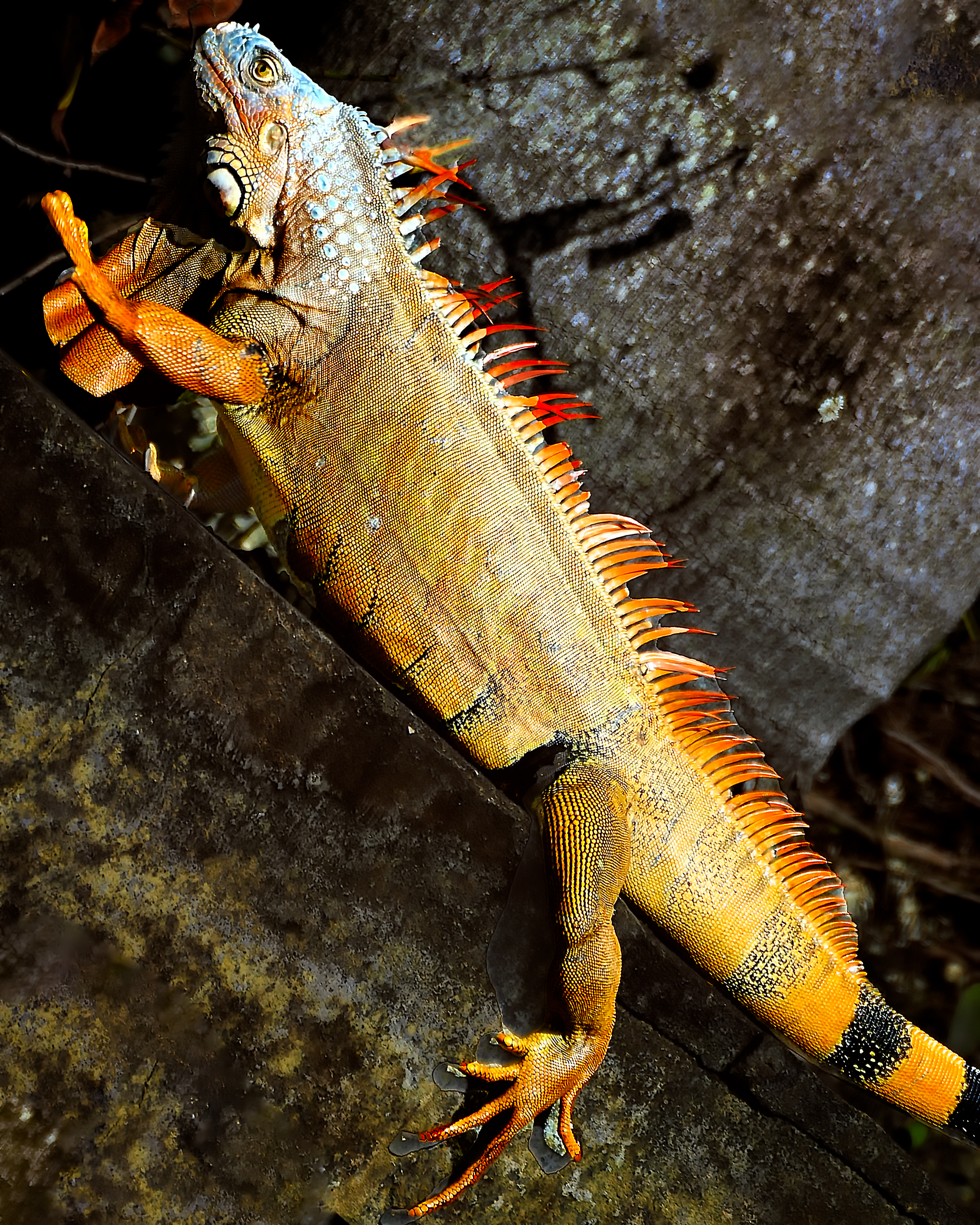
Credit: Ajoshi54 · CC BY-SA 4.0
An iguana is a large lizard that lives in warm parts of North America, Central America, South America, and the Caribbean. There are about 45 different species of iguana. The most famous is the green iguana, a long, spiny reptile found in tropical forests. Iguanas are reptiles, which means they have scaly skin, lay eggs, and need the sun to stay warm.
Green iguanas are not always green. Young ones are bright green, but adults can be gray, brown, or even orange. A full-grown green iguana can reach six feet long from nose to tail. Most of that length is the tail. They weigh up to 20 pounds, about as much as a small dog. A row of sharp spines runs down their back, and a flap of skin called a dewlap hangs under their chin.
Iguanas are mostly plant eaters. They munch on leaves, flowers, and fruit. This makes them different from most big lizards, which hunt other animals. Their teeth are small and shaped like tiny leaves, perfect for tearing up plants. Green iguanas spend most of their time high in trees, sunbathing on branches near rivers. If a predator comes close, they drop straight into the water and swim away. An iguana can hold its breath underwater for almost 30 minutes.
The marine iguana, found only on the Galápagos Islands, is even stranger. It is the only lizard in the world that swims in the ocean and eats seaweed off underwater rocks. When Charles Darwin visited the Galápagos in 1835, he called marine iguanas "imps of darkness" because he thought they looked ugly. Today scientists find them fascinating. They sneeze out extra salt from special glands in their noses.
Iguanas have an unusual way to escape danger. If a predator grabs an iguana by the tail, the tail snaps off and keeps wiggling. The iguana runs away while the predator is distracted. A new tail slowly grows back, though it is never quite as long as the first one.
Some iguanas are in serious trouble. The blue iguana of the Cayman Islands nearly went extinct in the early 2000s, with fewer than 25 left in the wild. Scientists started a breeding program and have released hundreds back into protected areas. Green iguanas face a different problem. Pet green iguanas set loose in Florida have multiplied so fast that they are now considered an invasive species there, eating native plants and digging holes in sea walls.
Last updated 2026-04-22