
Porcupine
Credit: The Cosmonaut · CC BY-SA 2.5 ca
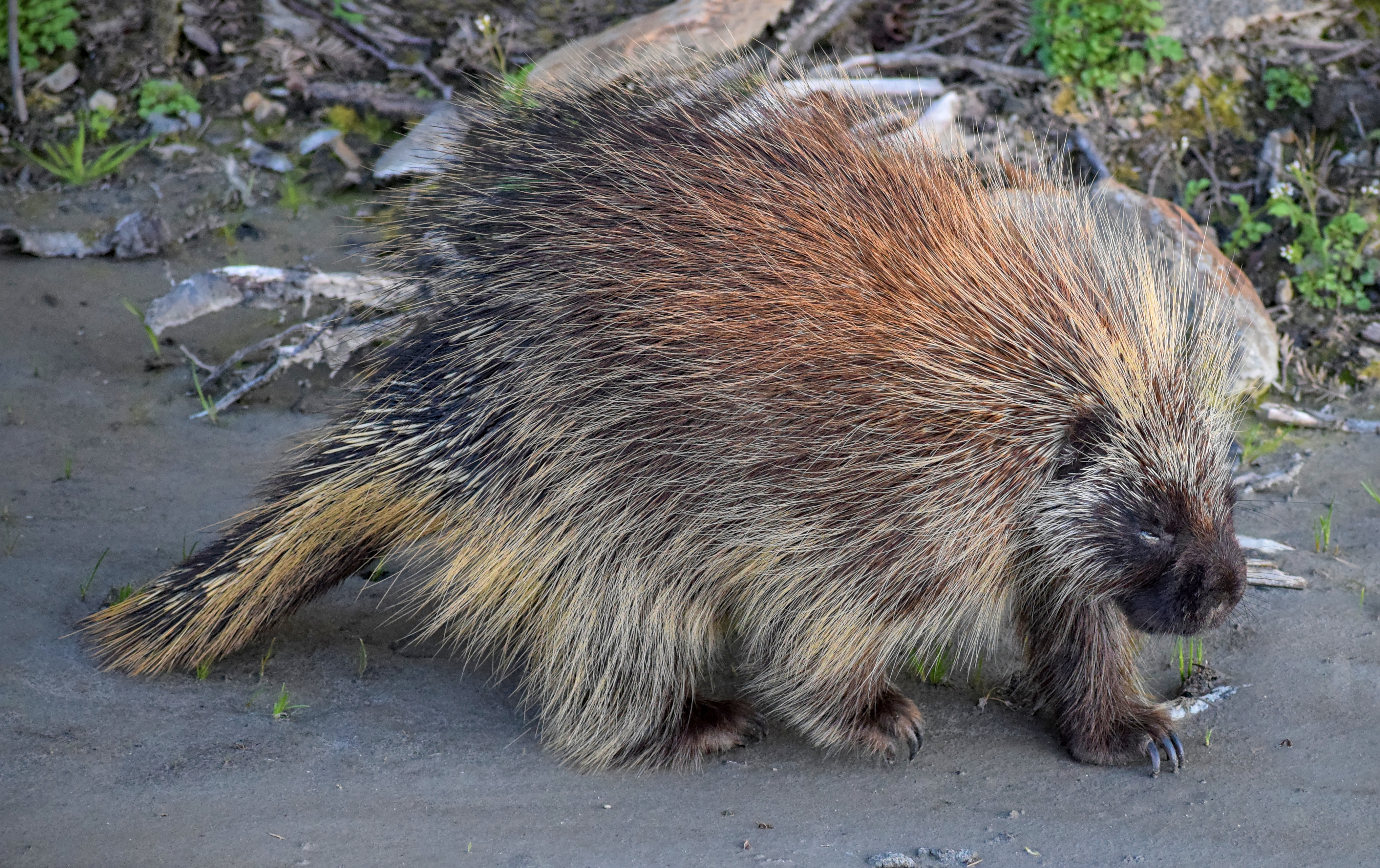
The porcupine is a large rodent covered in sharp spines called quills. Porcupines live in forests, deserts, and grasslands on almost every continent except Antarctica and Australia. There are about 25 different species. They are split into two main groups: Old World porcupines, which live in Africa, Europe, and Asia, and New World porcupines, which live in North and South America. Most porcupines are between 2 and 3 feet long and weigh 10 to 35 pounds. That makes them one of the biggest rodents in the world, after the capybara and the beaver.
A porcupine's quills are really just stiff, hollow hairs. A single North American porcupine has about 30,000 of them. The quills lie flat against the body most of the time. When the porcupine feels scared, special muscles under the skin pull the quills up, making the animal look twice as big and very pointy.
Here is a common myth worth clearing up. Porcupines cannot shoot their quills. The quills come loose easily, so if a predator touches a porcupine, the quills stick into that predator and pull right out of the porcupine. The tips have tiny backward-facing barbs. These barbs catch under the skin and work their way deeper as the predator's muscles move. A face full of quills can keep an animal from eating and sometimes kills it.
Porcupines are plant eaters. They munch on leaves, bark, twigs, roots, and fruit. Old World porcupines spend most of their time on the ground. New World porcupines are great climbers and often sleep high up in trees. Their feet have rough pads and strong claws that grip the bark.
Baby porcupines are called porcupettes. A porcupette is born with soft quills, which is a relief for its mother. Within a few hours the quills dry out and harden.
Porcupines are mostly solitary, though some species gather in small groups in winter to stay warm. They are active at night and have poor eyesight, but a strong sense of smell helps them find food in the dark. In the wild, a porcupine can live 15 to 20 years, which is a long life for a rodent. Most rodents its size live only a few years. Scientists are studying porcupine quills to design better medical needles, because the barbed tips slide into skin easily but resist coming back out.
Last updated 2026-04-22