
Red Panda
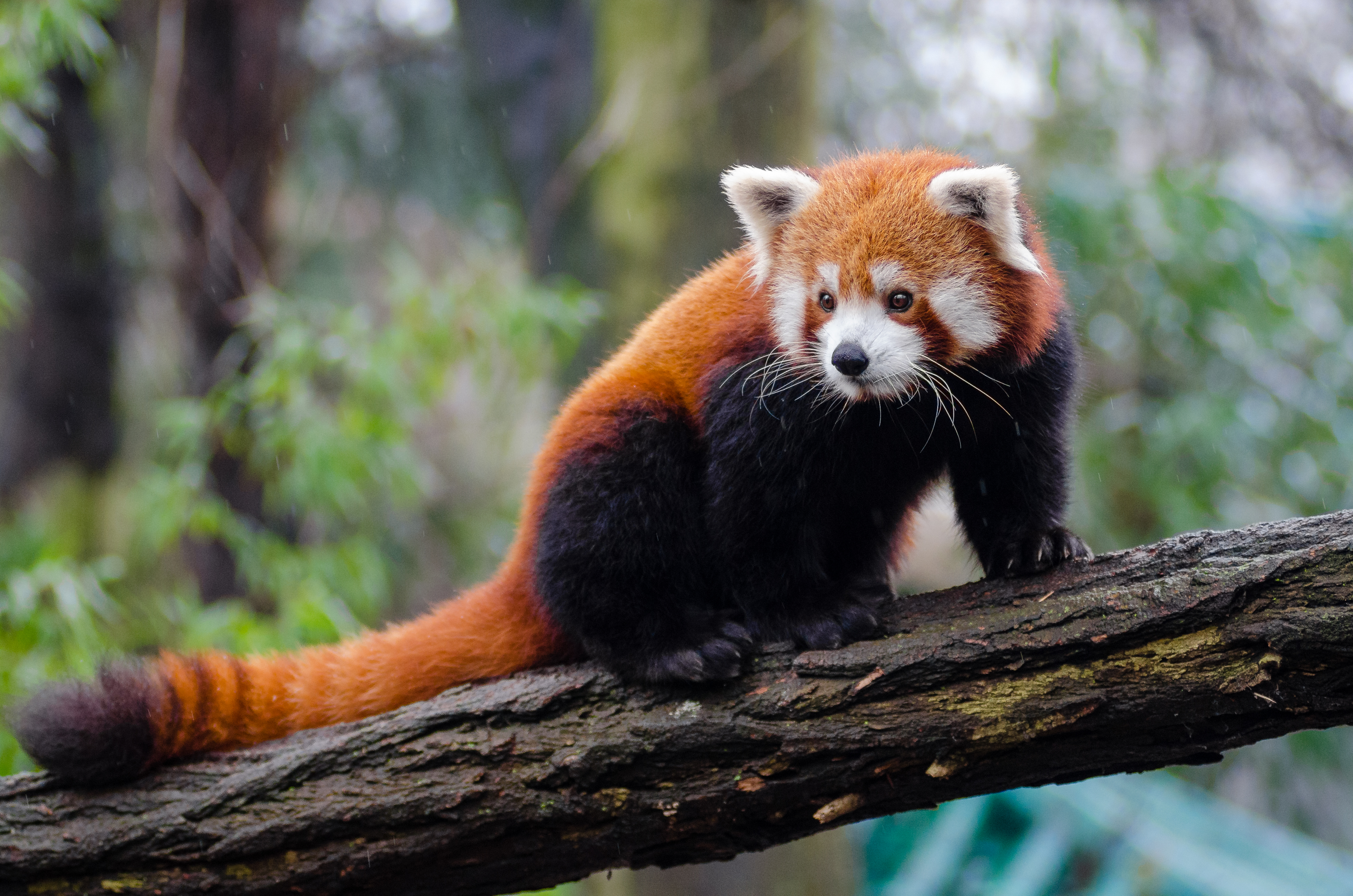
Credit: Mathias Appel · CC0
The red panda is a small, furry mammal that lives in the mountain forests of Asia. It is found in parts of Nepal, India, Bhutan, Myanmar, and China, mostly in the eastern Himalayas. A red panda is about the size of a house cat, with a long, bushy, ringed tail that is almost as long as its body. Its fur is a deep rust-red on top and black underneath, with a white face and pointed ears.
Red pandas spend most of their lives in trees. Their sharp claws and flexible ankles help them climb up and down trunks headfirst. During the day, they often curl up on high branches to sleep, wrapping that long tail around themselves like a scarf for warmth. At dawn and dusk, they come out to eat.
Their main food is bamboo. That is strange for an animal in their family, because red pandas are mostly meat-eaters by design. Their stomachs are built for digesting animals, not plants. To get enough energy out of tough bamboo leaves, a red panda has to eat for up to 13 hours a day. They also eat fruit, acorns, eggs, and small animals when they can find them.
Despite the shared name, the red panda is not closely related to the giant panda. Scientists once grouped red pandas with raccoons, and later with bears. Today they know red pandas belong to their very own family, called Ailuridae. The red panda is the only living species in that family. Its closest relatives, like weasels and skunks, are not very close at all.
Red pandas have a few clever features. They have a small extra bone in their wrist that works like a thumb, helping them grip bamboo stalks. Giant pandas evolved a nearly identical "thumb" on their own, even though the two animals are not close cousins. Scientists call this a surprising case of two different animals solving the same problem in the same way.
Fewer than 10,000 red pandas are believed to live in the wild today, and the number keeps dropping. Forests are being cut down for farms and roads, which breaks their habitat into small pieces. Poachers also hunt them for their fur. The International Union for Conservation of Nature lists the red panda as endangered. Zoos around the world breed them carefully, and countries across the Himalayas have set up protected forests to try to keep this quiet, tree-climbing animal from disappearing.
Related
Last updated 2026-04-22