
Orchestra
Credit: Yeugene · CC BY-SA 3.0
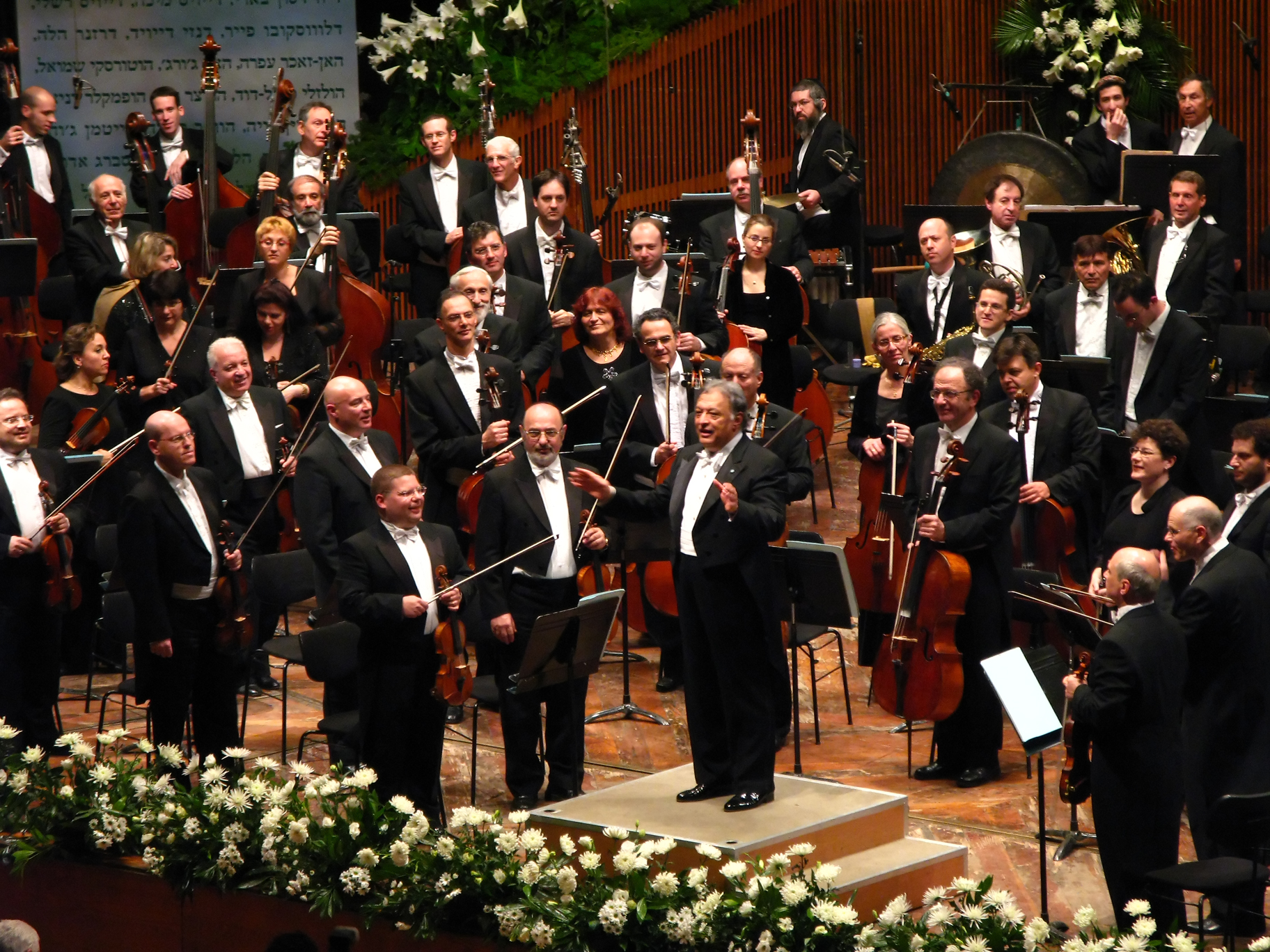
An orchestra is a large group of musicians who play different instruments together. A full orchestra usually has between 70 and 100 players. They perform classical music, music for movies, and music for ballets and operas. Most orchestras are led by one person called a conductor, who stands in front and keeps everyone playing in time.
The instruments of an orchestra are sorted into four families. Each family sits in its own area on the stage.
The string family is the biggest. It includes the violin, viola, cello, and double bass. These instruments make sound when a player draws a bow across their strings. A full orchestra can have 60 string players, more than half the group.
The woodwind family sits behind the strings. It includes the flute, clarinet, oboe, and bassoon. Most woodwinds were once made of wood, though flutes today are usually metal. Players blow air across or through a small opening to make the sound.
The brass family sits behind the woodwinds. It includes the trumpet, trombone, French horn, and tuba. Brass instruments are long metal tubes coiled into shapes. Players buzz their lips into a mouthpiece to make the air inside the tube vibrate.
The percussion family sits at the back. It includes drums, cymbals, the triangle, and the xylophone. The piano and harp often sit near percussion too. Percussion players hit, shake, or scrape their instruments.
The conductor stands on a small platform called a podium. The conductor waves a thin stick called a baton to set the speed and signal when each section should play louder or softer. Conductors do not make any sound themselves. Their job is to shape how everyone plays together.
Orchestras have been around for about 400 years. The first ones formed in Italy in the early 1600s, mostly to play for operas. They were small, with maybe 20 players. Over time, composers like Mozart, Beethoven, and Tchaikovsky wrote bigger and bigger pieces, and orchestras grew to match. By the late 1800s, some pieces called for more than 100 musicians on stage at once.
Today, almost every major city in the world has at least one orchestra. They play in concert halls, on movie soundtracks, and at outdoor festivals. The next time you watch a big movie, listen carefully to the music behind the action. There is a good chance an orchestra recorded every note.
Last updated 2026-04-26