
Grassland
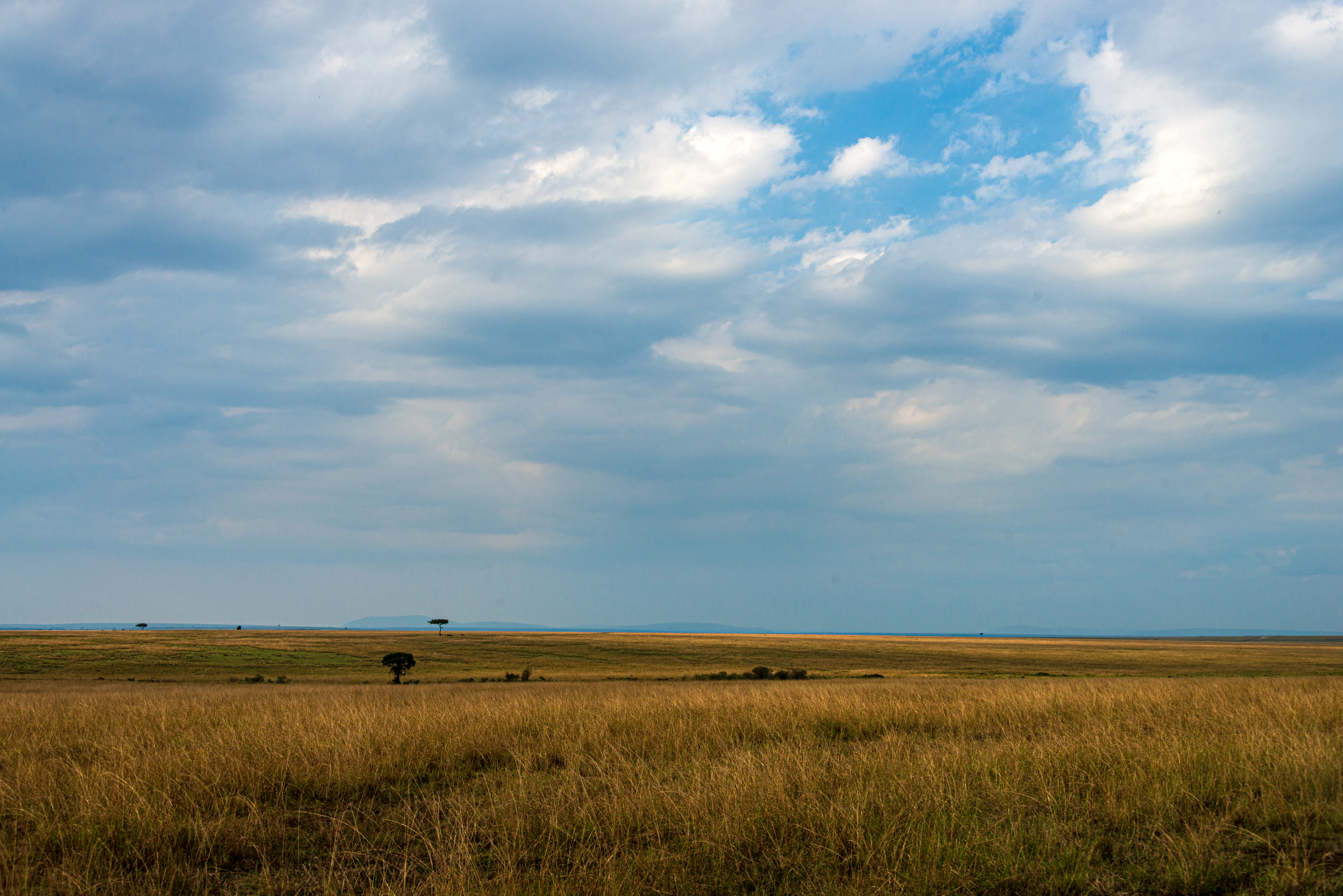
Credit: Daniel Case · CC BY-SA 4.0
A grassland is a wide, open biome where grasses are the main plants. Trees are rare, and the ground is mostly covered in grasses, wildflowers, and small plants. Grasslands cover about one-fourth of the land on Earth. They are found on every continent except Antarctica.
Grasslands form in places that get too little rain for forests but too much rain for deserts. Most grasslands get between 10 and 35 inches of rain each year. The weather is often dry in summer and cold or wet in winter. Strong winds sweep across the open land. Wildfires are common, started by lightning or by people. Fire actually helps grasslands stay healthy. It burns away small trees and dead plants but leaves the deep roots of grasses unharmed.
There are two main kinds of grasslands. Tropical grasslands, called savannas, are found near the equator in places like Africa, South America, and northern Australia. They are warm all year and have a wet season and a dry season. Temperate grasslands are cooler. They include the prairies of North America, the steppes of Asia, the pampas of South America, and the veld of southern Africa.
Grasslands are full of animals, even though there are few places to hide. Many large grazers live there, like bison, zebras, antelope, and wild horses. These animals travel in big herds for safety. Predators like lions, cheetahs, and wolves hunt the grazers. Smaller animals dig burrows under the soil. Prairie dogs in North America build huge underground towns where thousands of them live together.
The soil under a grassland is some of the richest on Earth. Grasses grow back every year, and their roots reach deep into the ground. When the roots die, they add nutrients to the soil. Some grassland soils are 20 feet thick and dark black. Because of this, much of the world's wheat, corn, and cattle come from land that used to be wild grassland.
That is also why grasslands are in trouble. Farmers have plowed up most of the world's prairies and steppes to grow crops. The North American tall-grass prairie once covered an area larger than Texas. Today, less than 4 percent of it is left. Without the grasses, the rich soil can blow away in the wind. In the 1930s, this caused the Dust Bowl, when huge dust storms swept across the central United States and forced thousands of families from their homes.
Last updated 2026-04-25