
George Washington
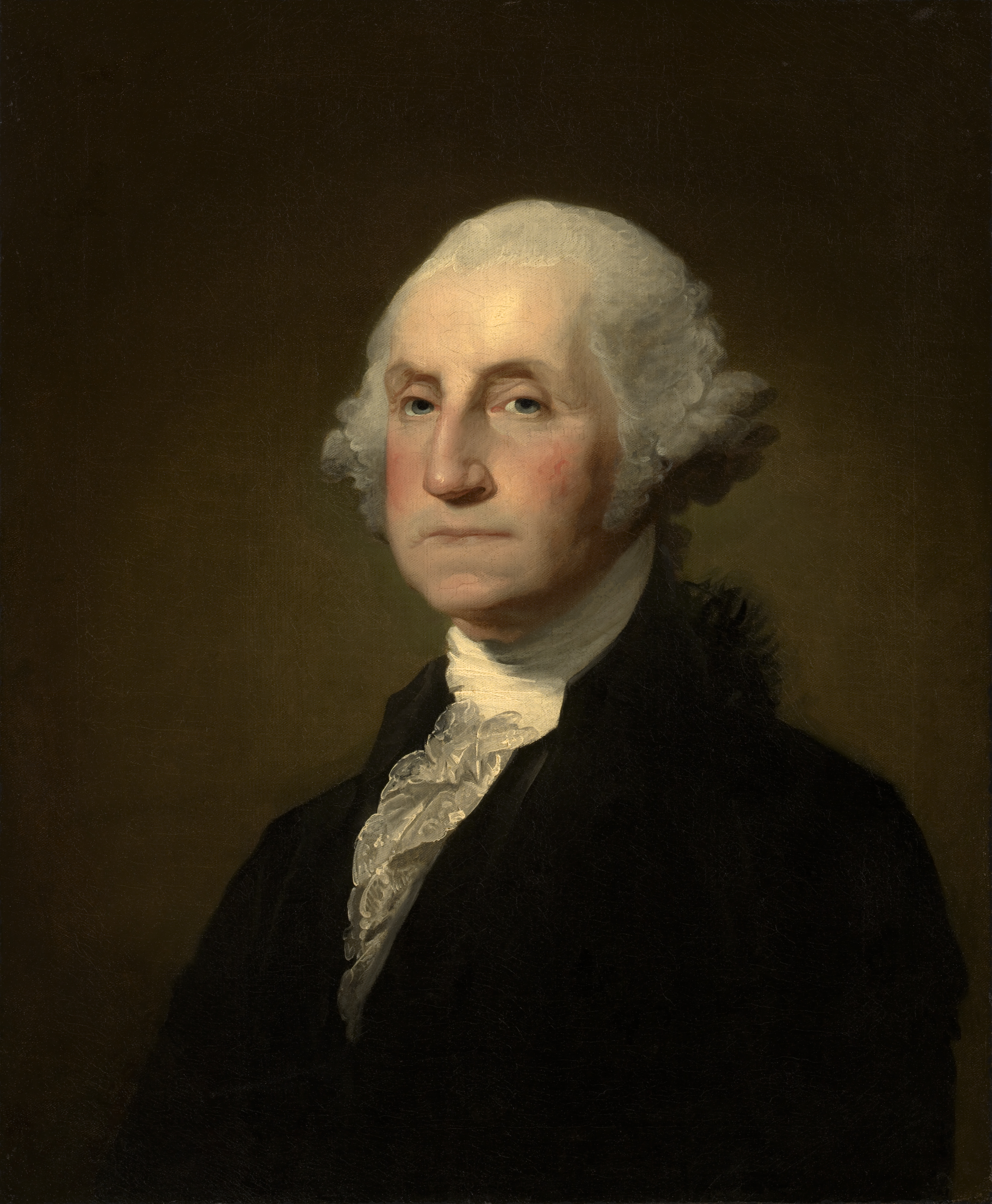
Credit: Gilbert Stuart · Public domain
George Washington was an American general and the first president of the United States. He lived from 1732 to 1799. He led the American army to victory in the Revolutionary War against Britain. Then he helped create the new country's government and served as its first president from 1789 to 1797. People often call him the "Father of His Country."
Early life
Washington was born on a farm in the colony of Virginia. His family was wealthy by colonial standards, but they were not among the richest families. His father died when George was 11. He had little formal schooling and never went to college. Instead, he learned to be a surveyor, someone who measures land. As a teenager, he traveled into the western frontier with measuring tools and made detailed maps. The work paid well, and he used the money to buy land of his own.
Soldier on the frontier
When he was 21, Washington joined the Virginia militia. Britain and France were both trying to control the Ohio River valley. In 1754, Washington led a small group of soldiers in a fight that helped start the French and Indian War. He made mistakes early on, but he learned quickly. He once had two horses shot out from under him and four bullet holes in his coat, and still walked away unharmed. Soldiers began to talk about his calm under fire.
After the war, Washington went home to Virginia. He married a wealthy widow named Martha Dandridge Custis and became a tobacco farmer at his estate, Mount Vernon. He was elected to Virginia's lawmaking body, where he watched anger toward Britain grow.
Slavery at Mount Vernon
It is important to be honest about one part of Washington's life. He owned enslaved people. By the end of his life, more than 300 enslaved Black people lived and worked at Mount Vernon. They cleared his fields, cooked his meals, and built his fortune. Washington's views on slavery shifted over time, and he came to think it was wrong. In his will, he ordered that the people he owned be freed after his wife's death. But for most of his life, he profited from slavery, and the people he held in bondage had no choice in the matter.
Leading the Revolution
In 1775, the American colonies went to war with Britain. The Continental Congress chose Washington to lead the new American army. The job was almost impossible. His soldiers were poorly trained, poorly fed, and often went without shoes. The British had the strongest army and navy in the world.
Washington lost more battles than he won. But he kept the army together, which was the hardest part. The winter of 1777 to 1778 at Valley Forge in Pennsylvania nearly destroyed the army. Soldiers froze in thin tents while Washington begged Congress for supplies. Around 2,000 men died that winter, more than in many battles. The army that came out of Valley Forge in the spring was tougher and better trained.
In 1781, with help from the French navy and army, Washington trapped the main British force at Yorktown, Virginia. The British surrendered. The war was over, and the United States was free.
A surprising choice
What Washington did next surprised the world. After the victory, he gave up command of the army and went home to his farm. Many people, including King George III of Britain, had expected him to make himself king or dictator. Most generals throughout history had done exactly that. When the king heard that Washington had simply stepped down, he reportedly said it made Washington "the greatest man in the world."
First president
In 1787, leaders met in Philadelphia to write the U.S. Constitution. Washington led the meetings. Two years later, the country held its first presidential election. Every elector voted for him. He is the only U.S. president ever elected without opposition, and it happened twice.
As president, Washington had to invent the job. There was no example to follow. He chose to be called "Mr. President" rather than something grander. He set up the first cabinet of advisers. He kept the country out of a war between Britain and France.
After two terms, he refused to run again. By stepping aside, he set a tradition that lasted almost 150 years, until Franklin D. Roosevelt was elected four times in the 1940s.
Washington died at Mount Vernon in 1799, at age 67. His face appears on the one-dollar bill, the quarter, and Mount Rushmore. The capital city of the United States carries his name.
Related
Last updated 2026-04-26