
US Constitution
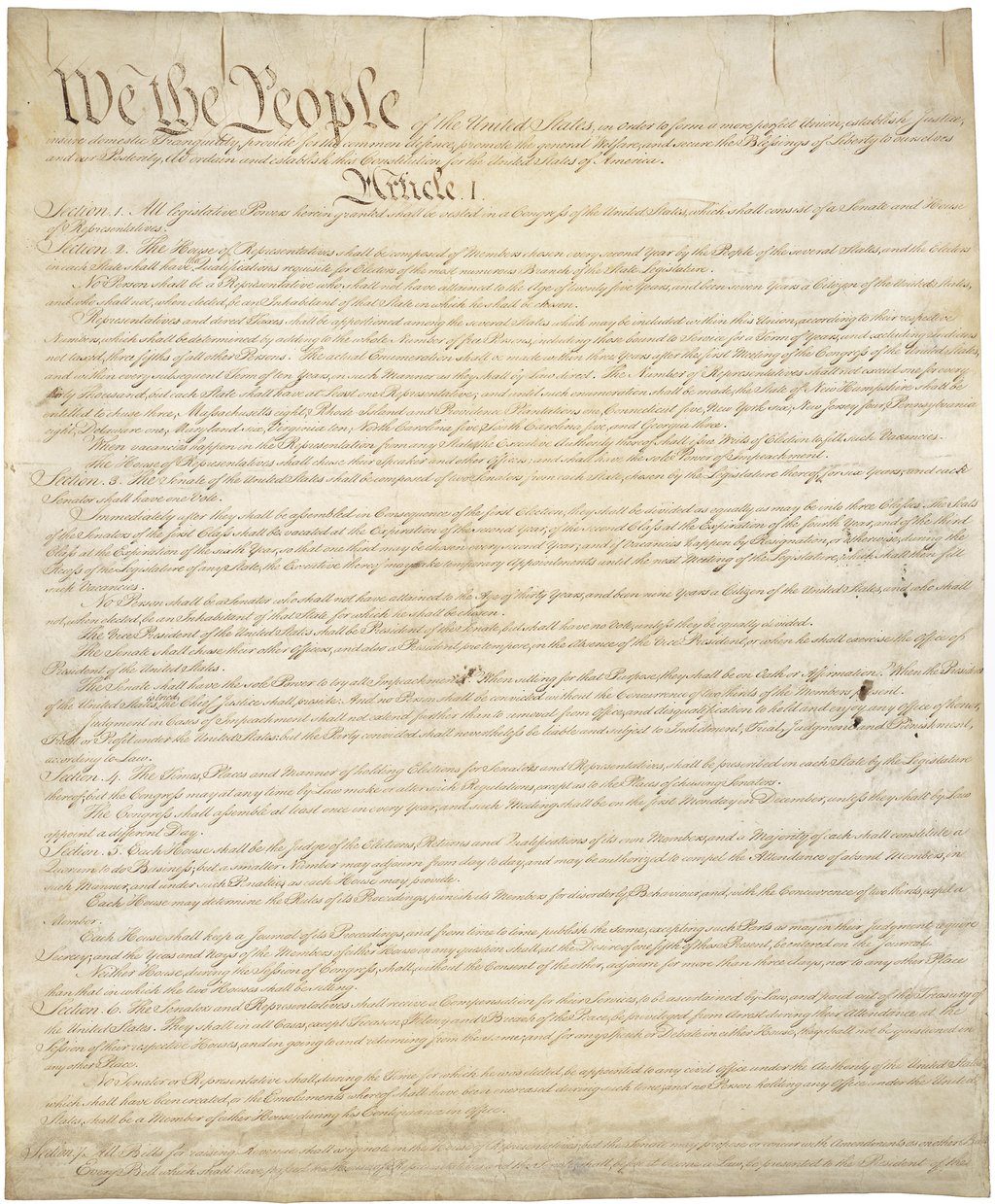
Credit: Constitutional Convention, United States · Public domain
The US Constitution is the document that sets up the government of the United States. It explains who has power, how laws are made, and what rights the government cannot take away. It was written in 1787 and went into effect in 1789. It is the highest law in the country. Every other law, state or federal, has to agree with it.
Why it was written
The Constitution was not the first plan for the United States government. The first plan was called the Articles of Confederation. It was used after the American Revolution, starting in 1781. But it had a big problem. It made the national government too weak. The government could not collect taxes. It could not pay soldiers or settle fights between the states. By 1787, many leaders thought the country might fall apart.
So 55 men met in Philadelphia in the summer of 1787. They came from 12 of the 13 states. Rhode Island refused to send anyone. The meeting is now called the Constitutional Convention. The men who wrote the Constitution are often called the Framers. George Washington was chosen to lead the meeting. James Madison took such careful notes that he is now known as the "Father of the Constitution." Benjamin Franklin, at 81 years old, was the oldest delegate.
What it says
The Constitution splits the federal government into three branches. Each branch has its own job, and each branch can check the others. This idea is called the separation of powers.
- The legislative branch is Congress. Congress writes the laws. It has two parts: the Senate and the House of Representatives.
- The executive branch is led by the President. The President carries out the laws and leads the military.
- The judicial branch is the Supreme Court and other federal courts. Judges decide what the laws mean and whether they follow the Constitution.
If one branch tries to grab too much power, the other two can stop it. This is called checks and balances. Congress can pass a law, but the President can veto it. The President can be removed by Congress for serious wrongdoing. The Supreme Court can strike down a law if it goes against the Constitution.
The Constitution also splits power between the federal government and the states. Some powers belong only to the national government, like printing money and declaring war. Other powers belong to the states. This system is called federalism.
A hard compromise
Writing the Constitution was not easy. The biggest fights were about how to share power and about slavery. Big states wanted more votes in Congress because they had more people. Small states wanted equal votes. The answer was the Great Compromise. The House would be based on population, and the Senate would give every state two senators no matter its size.
The fight over slavery was uglier. Southern states wanted enslaved people counted toward their population so they would get more votes in Congress, even though those people were not free and could not vote. The Framers agreed to count each enslaved person as three-fifths of a person. This is now called the Three-Fifths Compromise. It allowed slavery to continue and gave slaveholding states extra power for decades. Historians today see it as one of the worst parts of the Constitution. It was finally erased after the Civil War.
The Bill of Rights
When the Constitution was first written, many Americans worried it gave the government too much power over people. So in 1791, ten amendments were added. These ten are called the Bill of Rights. They protect things like freedom of speech, freedom of religion, the right to a fair trial, and the right to be safe from unfair searches.
A living document
The Constitution can be changed. A change is called an amendment. But amendments are hard to pass on purpose. Two-thirds of Congress and three-fourths of the states have to agree. In more than 230 years, the Constitution has only been amended 27 times. The 13th Amendment ended slavery in 1865. The 19th Amendment gave women the right to vote in 1920.
People still argue about what the Constitution means. Some judges and lawyers say its words should be read the way the Framers meant them in 1787. Others say the Constitution is a living document, and its meaning should grow as the country grows. The Supreme Court hears these arguments all the time. The original four pages of the Constitution are kept at the National Archives in Washington, DC, sealed in cases filled with special gas to protect the paper.
Related
Last updated 2026-04-26