
Louis Armstrong
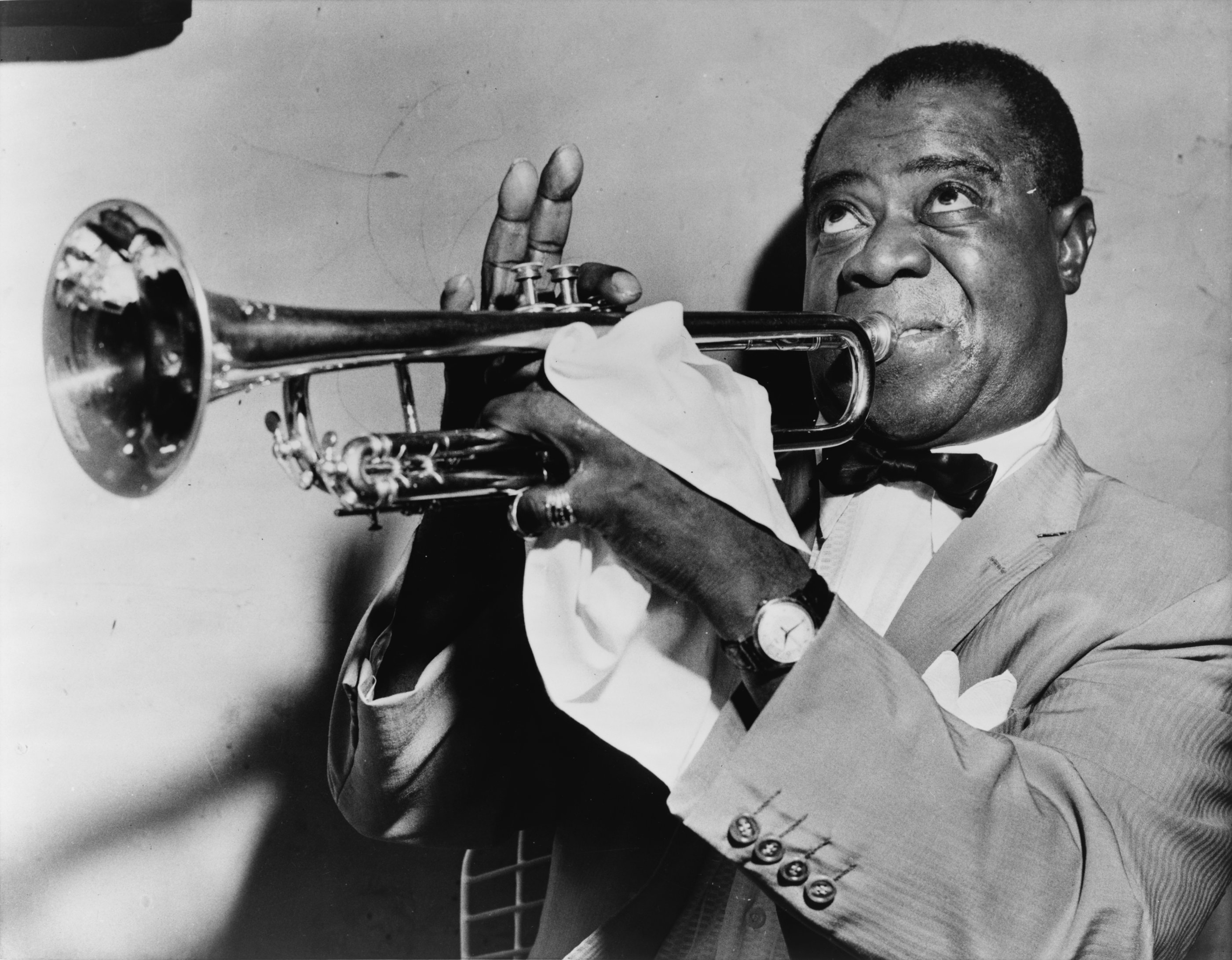
Credit: World-Telegram staff photographer · Public domain
Louis Armstrong was an American musician who became one of the most important figures in the history of jazz. He lived from 1901 to 1971. Armstrong played the trumpet and the cornet, and he sang in a deep, gravelly voice that fans around the world recognized instantly. People called him "Satchmo" and "Pops." Many musicians today still consider him the most influential jazz player who ever lived.
Armstrong grew up poor in New Orleans, Louisiana. His father left the family when Louis was a baby. As a young boy, he sold newspapers and coal on the streets to help his mother pay rent. On New Year's Eve in 1912, when he was eleven, he fired a borrowed pistol into the air to celebrate. The police arrested him and sent him to a home for boys in trouble. There, a music teacher put a cornet in his hands. That moment changed his life.
By his late teens, Armstrong was playing on riverboats and in clubs in New Orleans. In 1922, he moved to Chicago to join a famous band led by his mentor, King Oliver. A few years later, he made a series of recordings called the Hot Fives and Hot Sevens. These recordings changed jazz forever. Before Armstrong, jazz was mostly group music. He showed that one player could step forward and improvise, making up a solo on the spot. Almost every jazz solo since then owes something to him.
Armstrong was also a star singer. He helped make "scat" singing famous. Scat is when a singer uses nonsense sounds instead of words. He had hits with songs like "What a Wonderful World," "Hello, Dolly!," and "When the Saints Go Marching In." In 1964, "Hello, Dolly!" knocked the Beatles off the top of the pop charts. Armstrong was 62 years old at the time.
Armstrong toured the world for most of his life. The U.S. State Department even sent him to other countries as a goodwill ambassador, which is how he got the nickname "Ambassador Satch." But his life was not always easy. He grew up under Jim Crow laws, and many hotels and restaurants refused to serve him even when he was famous. In 1957, he publicly criticized President Eisenhower for being slow to protect Black students who were trying to attend a school in Arkansas. Speaking out cost him some bookings, but he refused to take it back.
When Armstrong died in 1971, flags in New Orleans flew at half-mast. The trumpet he played as a boy in the home for troubled kids is now on display in a museum in his hometown.
Last updated 2026-04-26