
Europe
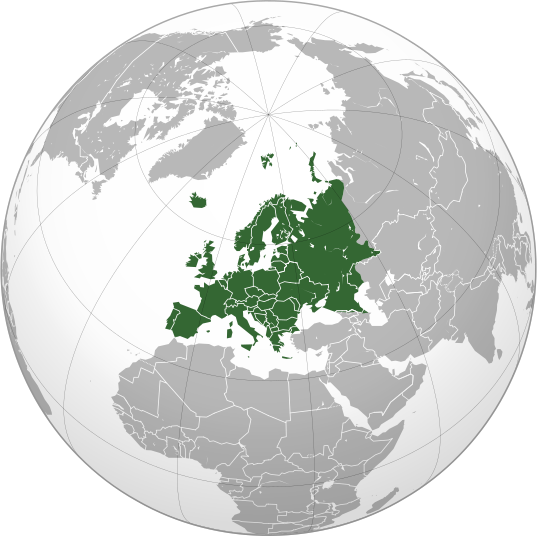
Credit: Rob984 · Public domain
Europe is a continent in the Northern Hemisphere, west of Asia and north of Africa. It is the sixth largest continent by land area, but the third most crowded. About 750 million people live there. Europe is made up of around 44 countries, including Russia, France, Germany, Italy, Spain, and the United Kingdom.
Europe is not actually a separate piece of land from Asia. The two share one giant landmass that scientists call Eurasia. People have treated Europe as its own continent for thousands of years, mostly because of culture and history. The line between Europe and Asia runs along the Ural Mountains in Russia.
Land and water
Europe has almost every kind of landscape. The Alps cut across the middle, with jagged peaks and ski villages. Mont Blanc, the tallest Alpine peak, rises almost 16,000 feet, nearly three times the height of most skyscrapers. In the far north, the fjords of Norway are deep valleys carved by glaciers and flooded by the sea. In the south, warm beaches line the Mediterranean Sea.
Europe is famous for its rivers. The Danube flows through ten countries, more than any other river in the world. The Volga, in Russia, is the longest river in Europe. Barges still carry goods along the Rhine, just as boats did hundreds of years ago.
The continent has a long, twisty coastline. No part of Europe is more than about 400 miles from the ocean. That is why seafaring has been part of European life for thousands of years.
Climate
Most of Europe has mild weather, thanks to a warm ocean current called the Gulf Stream. It carries warm water from the Caribbean across the Atlantic. Without it, places like London and Paris would be much colder in winter. Southern Europe has hot, dry summers and soft winters. Northern Europe, especially Scandinavia, gets long, snowy winters and cool summers. In parts of Lapland, the sun does not set for weeks in June.
A long history
Europe has one of the longest written histories of any continent. Ancient Greece, starting around 800 BCE, gave the world early ideas about democracy, science, and theater. Ancient Rome later built a huge empire that stretched from Britain to the Middle East. Roman roads, laws, and Latin words still shape Europe today.
After Rome fell, the Middle Ages began. Kings, queens, knights, and castles ruled the land. Then came the Renaissance, which started in Italy around the 1300s. Artists like Leonardo da Vinci and Michelangelo changed painting forever. Writers like William Shakespeare changed how stories were told. Scientists like Galileo changed how people saw the universe.
In the 1700s and 1800s, the Industrial Revolution began in Britain and spread across Europe. Factories, steam engines, and railroads replaced farms and horses in many places. European countries also built huge empires in Africa, Asia, and the Americas. These empires brought wealth to Europe and great harm to the people they ruled.
The twentieth century brought two world wars to Europe. Both started there, and both killed tens of millions of people. After World War II ended in 1945, Europe was split in half. The western part was free and tied to the United States. The eastern part was controlled by the Soviet Union. This split, called the Iron Curtain, lasted about 45 years. It ended when the Berlin Wall fell in 1989.
Many languages, many cultures
More than 200 languages are spoken in Europe. The most common are Russian, German, French, English, Italian, and Spanish. Most European languages belong to a big family called Indo-European. They share ancient roots even when they sound very different today. A few languages, like Basque in Spain and Finnish in Finland, do not fit this family and puzzle historians.
Europe is known for its food traditions. Italian pasta, French cheese, Spanish paella, German sausages, and Greek olives all come from here. So does chocolate, which Europeans first brought back from the Americas in the 1500s.
Europe today
In 1993, many European countries joined together to form the European Union, or EU. Today 27 countries are members. The EU lets people move freely between member countries to work, study, and travel. Most EU countries share a single money, called the euro.
Europe remains one of the richest and most visited parts of the world. Tourists come to see the Eiffel Tower, the Colosseum, and the canals of Venice. They also come for quiet villages, mountain trails, and the kind of history you can walk through on an ordinary afternoon.
Related
Last updated 2026-04-22