
Mount Everest
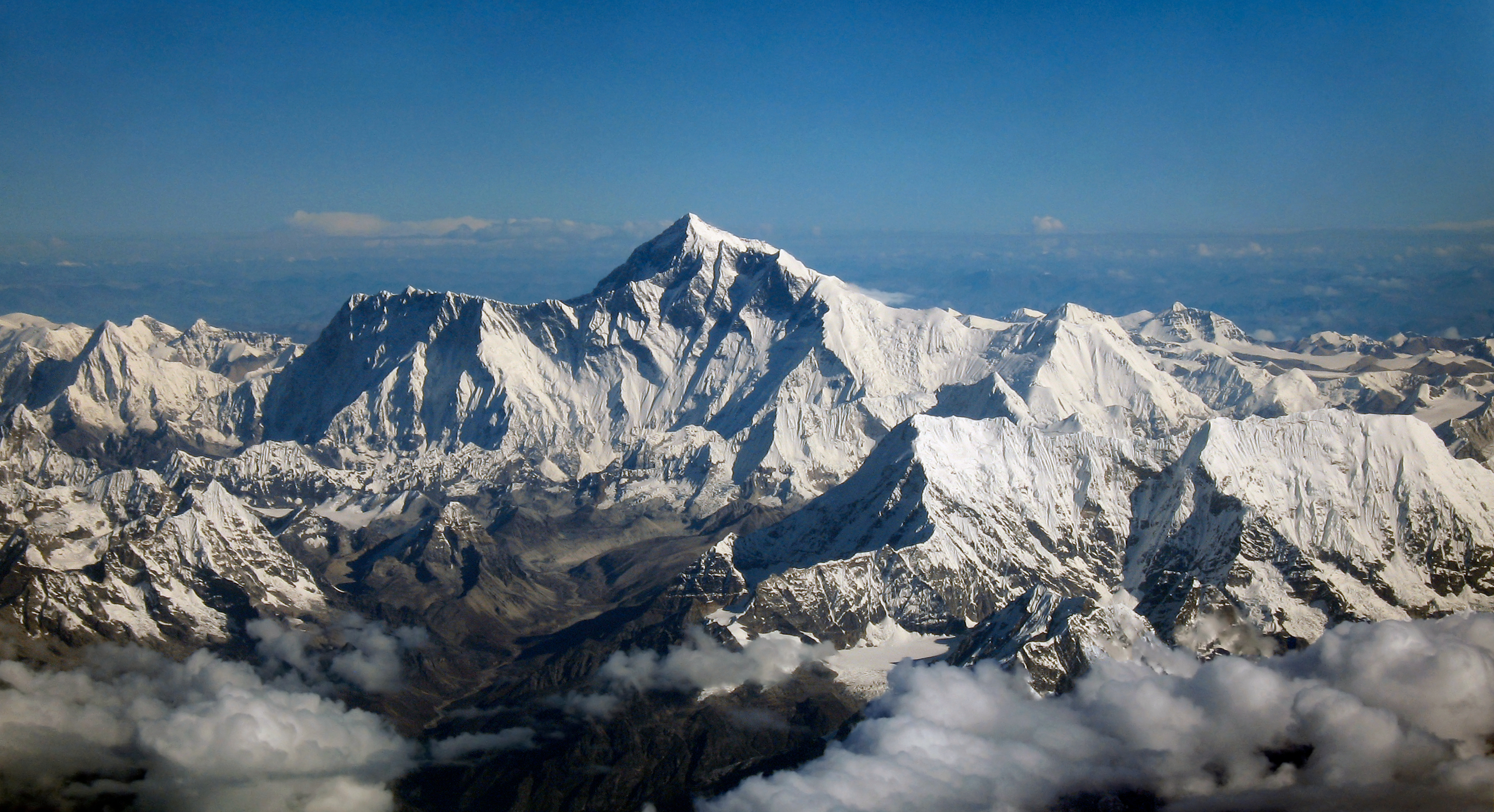
Credit: Mount_Everest_as_seen_from_Drukair2.jpg: shrimpo1967 derivative work: Papa Lima Whiskey 2 (talk) · CC BY-SA 2.0
Mount Everest is the highest mountain on Earth, measured from sea level. It stands on the border between Nepal and Tibet, in a range of mountains called the Himalayas. The top of Everest reaches 29,032 feet above sea level. That is about five and a half miles straight up, higher than most airplanes fly.
Everest formed because of plate tectonics. About 50 million years ago, the piece of Earth's crust carrying India crashed into the piece carrying Asia. The land between them had nowhere to go but up. That slow-motion crash pushed up the entire Himalayan range. The crash is still happening today. Everest grows a tiny bit taller each year as India keeps pushing north.
The mountain has two main names, both much older than the English one. In Nepali, it is called Sagarmatha, meaning "goddess of the sky." In Tibetan, it is Chomolungma, meaning "goddess mother of the world." British surveyors renamed it Mount Everest in 1865, after a former head of the Survey of India named George Everest.
Near the top, Everest is one of the deadliest places on the planet. The air holds only about one-third as much oxygen as the air at sea level. Most climbers carry tanks of extra oxygen to breathe. Temperatures can drop to negative 75 degrees Fahrenheit. Winds sometimes blow faster than 175 miles per hour. Climbers call the zone above 26,000 feet the "death zone," because the human body slowly starts to shut down there.
For a long time, no one had ever reached the summit. Dozens of climbers tried in the early 1900s, and some died trying. In 1953, a New Zealand beekeeper named Edmund Hillary and a Sherpa mountaineer named Tenzing Norgay became the first two people to stand on the top. They stayed for only 15 minutes before starting the long climb down.
Since then, more than 6,000 people have reached the summit. Hundreds have died on the mountain. Many of their bodies are still there, frozen in the ice, because it is too dangerous to bring them down. The Sherpa people, who live in the valleys below Everest, do most of the hardest work on climbs. They carry supplies, fix ropes, and guide climbers through the ice.
One question people still argue about is whether Hillary and Norgay were really the first. In 1924, two British climbers named George Mallory and Andrew Irvine disappeared near the top. Mallory's body was found in 1999, but no one knows if they reached the summit before they died.
Related
Last updated 2026-04-23