
Nile River
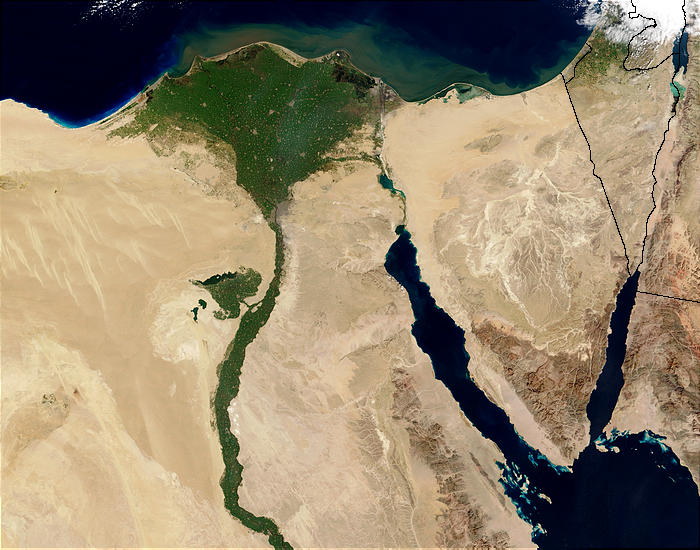
Credit: Jacques Descloitres, MODIS Rapid Response Team, NASA/sh · Public domain
The Nile River is a long river in northeast Africa that flows north into the Mediterranean Sea. It runs through eleven countries, including Uganda, South Sudan, Sudan, and Egypt. The Nile is about 4,130 miles long, which makes it one of the two longest rivers in the world. Scientists still argue whether the Nile or the Amazon River in South America is longer. The difference is small, and it depends on where you decide each river truly begins.
The Nile has two main branches that meet in the country of Sudan. The White Nile starts from lakes in central Africa, including Lake Victoria. The Blue Nile starts in the mountains of Ethiopia. The two branches join at the city of Khartoum. From there, the river flows as a single Nile through the desert all the way to the sea. Near the end of its journey, the Nile spreads into a wide, fan-shaped area called the Nile Delta before emptying into the Mediterranean.
For thousands of years, the Nile flooded its banks every summer. Melting snow and heavy rains in the Ethiopian mountains sent huge amounts of water downstream. When the flood pulled back, it left behind a thin layer of rich black soil called silt. This soil was perfect for growing wheat, barley, and flax. Without the Nile, ancient Egypt could not have existed. Most of Egypt is desert, and almost nobody can live there. Even today, about 95 percent of Egyptians live within a few miles of the Nile.
The ancient Egyptians treated the river as sacred. They worshiped a god named Hapi, who they believed brought the yearly flood. They built their greatest cities, temples, and pyramids along the Nile's banks. Boats on the river carried stone blocks, food, soldiers, and pharaohs.
The yearly flood stopped in 1970. That year, Egypt finished building the Aswan High Dam, a giant wall across the Nile in southern Egypt. The dam holds back the floodwaters and creates a huge artificial lake called Lake Nasser. The dam gives Egypt steady water and electric power. But it also traps the black silt behind it, so farmers downstream now have to use fertilizer to keep their fields rich.
The Nile is still the lifeline of the region. More than 400 million people depend on its water for drinking, farming, and fishing. Countries along the river sometimes argue about who gets to use how much of it. As the climate warms and more people are born, those arguments are getting harder.
Related
Last updated 2026-04-23