
Sahara Desert
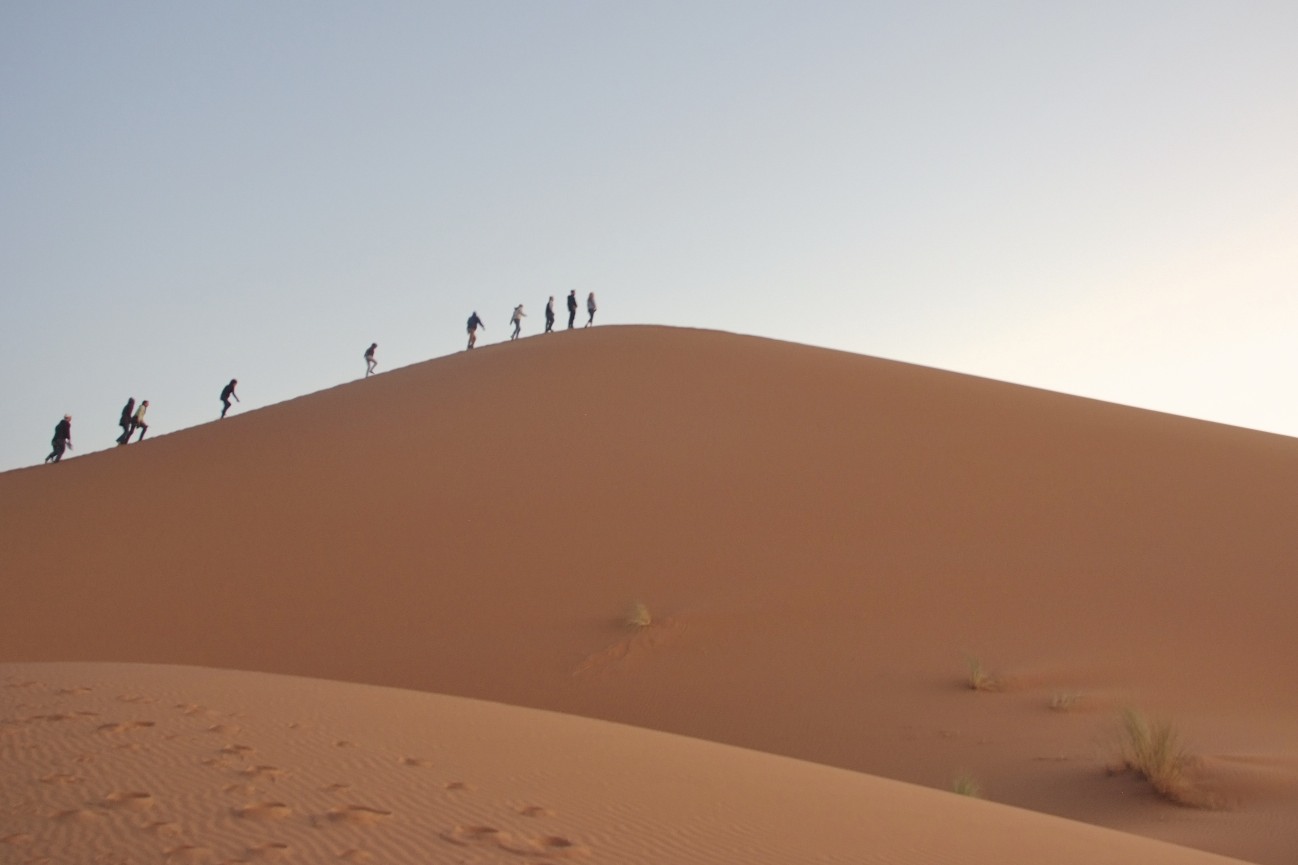
Credit: Beatriz Posada Alonso · CC BY-SA 3.0
The Sahara is the largest hot desert on Earth. It stretches across the top of Africa, covering parts of eleven countries from the Atlantic Ocean to the Red Sea. The Sahara is about 3.6 million square miles in size. That is almost as big as the entire United States. A desert is any place that gets very little rain, and the Sahara gets less than four inches a year in most spots.
Most people picture the Sahara as endless sand dunes. Some parts do look like that. But sand actually covers only about a quarter of the desert. The rest is rocky plains, gravel fields, dry valleys, and even mountains. The tallest peak, Emi Koussi in Chad, rises more than 11,000 feet. Some of its neighbors are old volcanoes.
The Sahara is a land of extremes. Summer temperatures often climb above 120 degrees Fahrenheit. At night, the heat rushes back out into the dry air, and the temperature can drop close to freezing. Strong winds pick up fine sand and carry it for thousands of miles. Dust from the Sahara regularly crosses the Atlantic Ocean and falls on the Amazon rainforest, where it helps fertilize the soil.
Even in such a harsh place, life finds a way. Camels can go more than a week without drinking water. Fennec foxes have huge ears that let off heat. Scorpions, lizards, and small rodents hide underground during the day and come out when the sand cools. In scattered spots called oases, underground water reaches the surface. Palm trees grow there, and people farm and trade.
People have lived in and around the Sahara for a very long time. The ancient Egyptians built their cities along the Nile River at the desert's eastern edge. For over a thousand years, trading caravans crossed the Sahara carrying salt, gold, cloth, and books. Today, about four million people still live in the desert, including groups like the Tuareg and the Bedouin.
The Sahara has not always been a desert. Scientists have found rock paintings deep in the sand that show giraffes, elephants, and people swimming. About 11,000 years ago, the region was green, with rivers and lakes. Slow changes in Earth's tilt shifted the rains south, and the land dried out. Scientists still debate exactly how fast the change happened. Some think it took thousands of years. Others believe the Sahara dried out in just a few centuries, turning a living landscape into sand.
Last updated 2026-04-23