
Muscular System
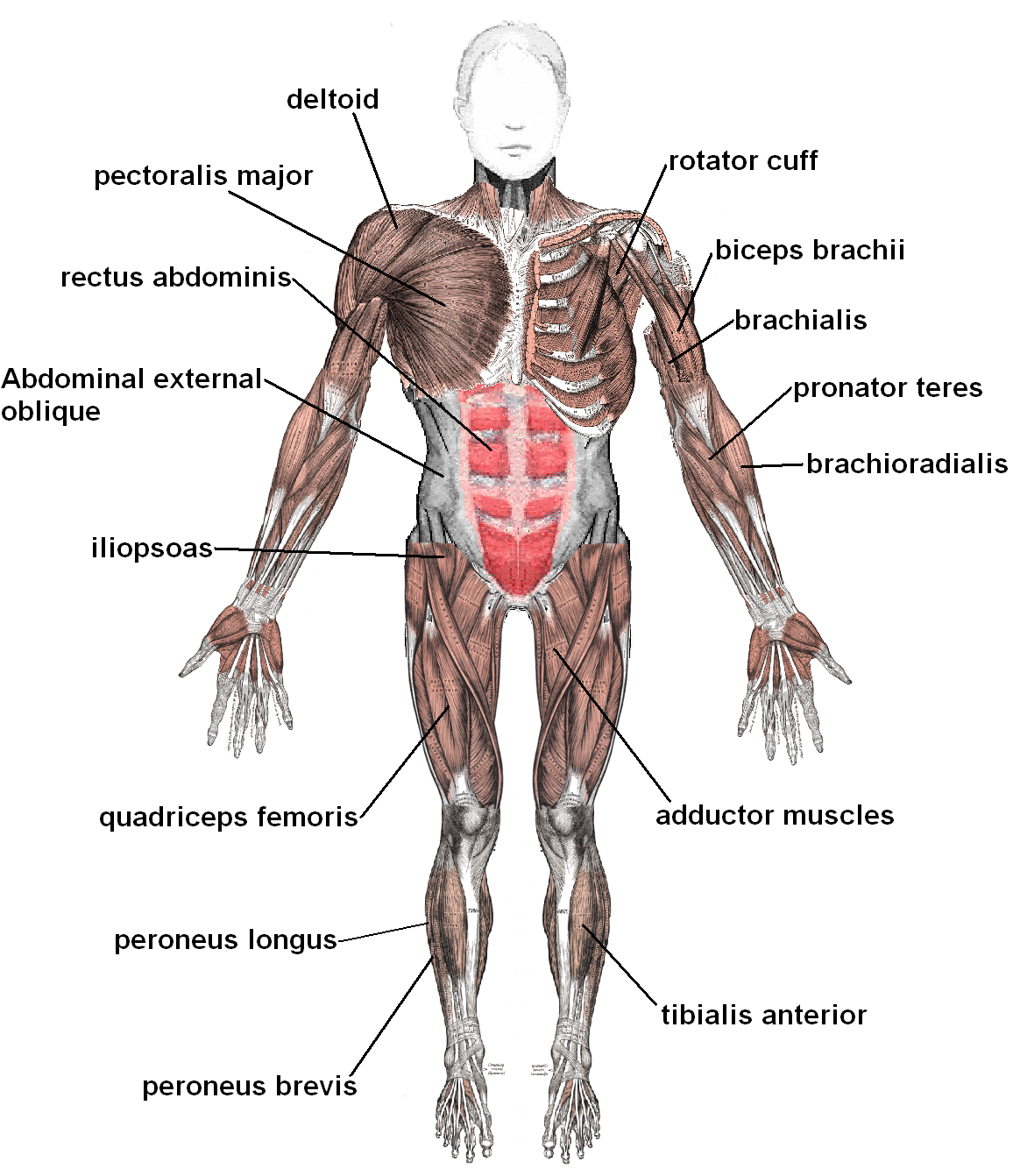
Credit: Mikael Häggström. When using this image in external works, it may be cited as: Häggström, Mikael (2014). "Medical gallery of Mikael Häggström 2014". WikiJournal of Medicine 1 (2). DOI:10.15347/wjm/2014.008. ISSN 2002-4436. Public Domain. or By Mikael Häggström, used with permission. · Public domain
The muscular system is the group of muscles in your body that lets you move. It also keeps your heart beating, pushes food through your stomach, and helps you stand up straight. An adult human body has more than 600 muscles. Together, they make up about 40 percent of a person's body weight.
Your body has three kinds of muscles, and each kind has its own job.
The first kind is skeletal muscle. These muscles attach to your bones with tough cords called tendons. When a skeletal muscle pulls, it tugs on a bone and your body part moves. You control these muscles on purpose, which is why they are also called voluntary muscles. Walking, smiling, lifting a backpack, and writing your name all use skeletal muscles.
The second kind is smooth muscle. These muscles line the inside of your stomach, intestines, blood vessels, and other organs. They squeeze in slow waves to push food through your gut or move blood through your body. You cannot control them. They work on their own, even while you sleep.
The third kind is cardiac muscle, and it is found in only one place: your heart. Cardiac muscle never gets tired. It beats more than 100,000 times every day for your entire life.
Most skeletal muscles work in pairs. Muscles can only pull, not push. So to bend your arm, the biceps muscle on the front shortens while the triceps muscle on the back stretches. To straighten your arm, the triceps pulls and the biceps stretches. Almost every movement you make uses two muscles taking turns.
Your muscles get their orders from your brain. A signal travels down a nerve, reaches the muscle, and tells it to squeeze. This happens in less than a tenth of a second. That is why you can yank your hand away from a hot pan before you even feel the heat.
Muscles need fuel. They burn sugar from your food and oxygen from your blood to make energy. When you exercise hard, your muscles use up oxygen faster than your blood can deliver it. That burning feeling in your legs after running is a chemical called lactic acid building up.
Exercise makes muscles stronger. When you lift, run, or climb, you cause tiny tears in your muscle fibers. Your body fixes the tears while you rest, and the muscle grows back a little bigger and stronger than before. That is why athletes need rest days as much as workout days.
Related
Last updated 2026-04-25