
Atom
Credit: MikeRun · CC BY-SA 4.0
An atom is the smallest piece of a chemical element that still acts like that element. Everything around you is made of atoms. Your body, the air, this book, the stars in the sky. Atoms are so small that a single drop of water holds more than a billion trillion of them.
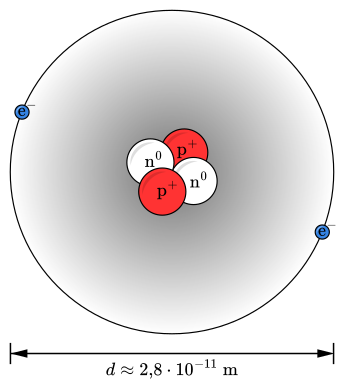
Every atom has three kinds of smaller parts inside it. These parts are called protons, neutrons, and electrons. Protons have a positive electric charge. Electrons have a negative charge. Neutrons have no charge at all.
At the center of an atom is a tight cluster called the nucleus. The nucleus holds the protons and neutrons. Electrons zip around the nucleus in a kind of cloud. Most of an atom is actually empty space. If the nucleus were the size of a marble, the whole atom would stretch out as wide as a football stadium.
The number of protons in an atom decides what element it is. One proton means hydrogen. Six protons mean carbon. Eight protons mean oxygen. The periodic table lists all the known elements in order of their proton count, from 1 to 118.
Atoms can join together to make larger groups called molecules. Two hydrogen atoms plus one oxygen atom make one molecule of water. Carbon atoms can link into long chains that build every living thing. When atoms swap or share electrons, they form chemical bonds, and these bonds hold all matter together.
The idea of atoms is very old. A Greek thinker named Democritus guessed they existed more than 2,400 years ago. He called them atomos, meaning "cannot be cut." But scientists did not prove atoms were real until the early 1900s. That is also when they learned atoms have parts inside them after all.
It turns out atoms can be split. When the nucleus of a heavy atom like uranium breaks apart, it releases a huge burst of energy. This is how nuclear power plants make electricity. It is also how atomic bombs work. Even smaller pieces live inside protons and neutrons, called quarks. Scientists still do not fully understand how quarks behave, and new particles are being studied in giant machines called particle colliders.
Once you know about atoms, the world looks different. A rock, a cloud, a sleeping cat, and a distant galaxy are all built from the same tiny building blocks.
Related
Last updated 2026-04-23