
Deforestation
Credit: Jami Dwyer · Public domain
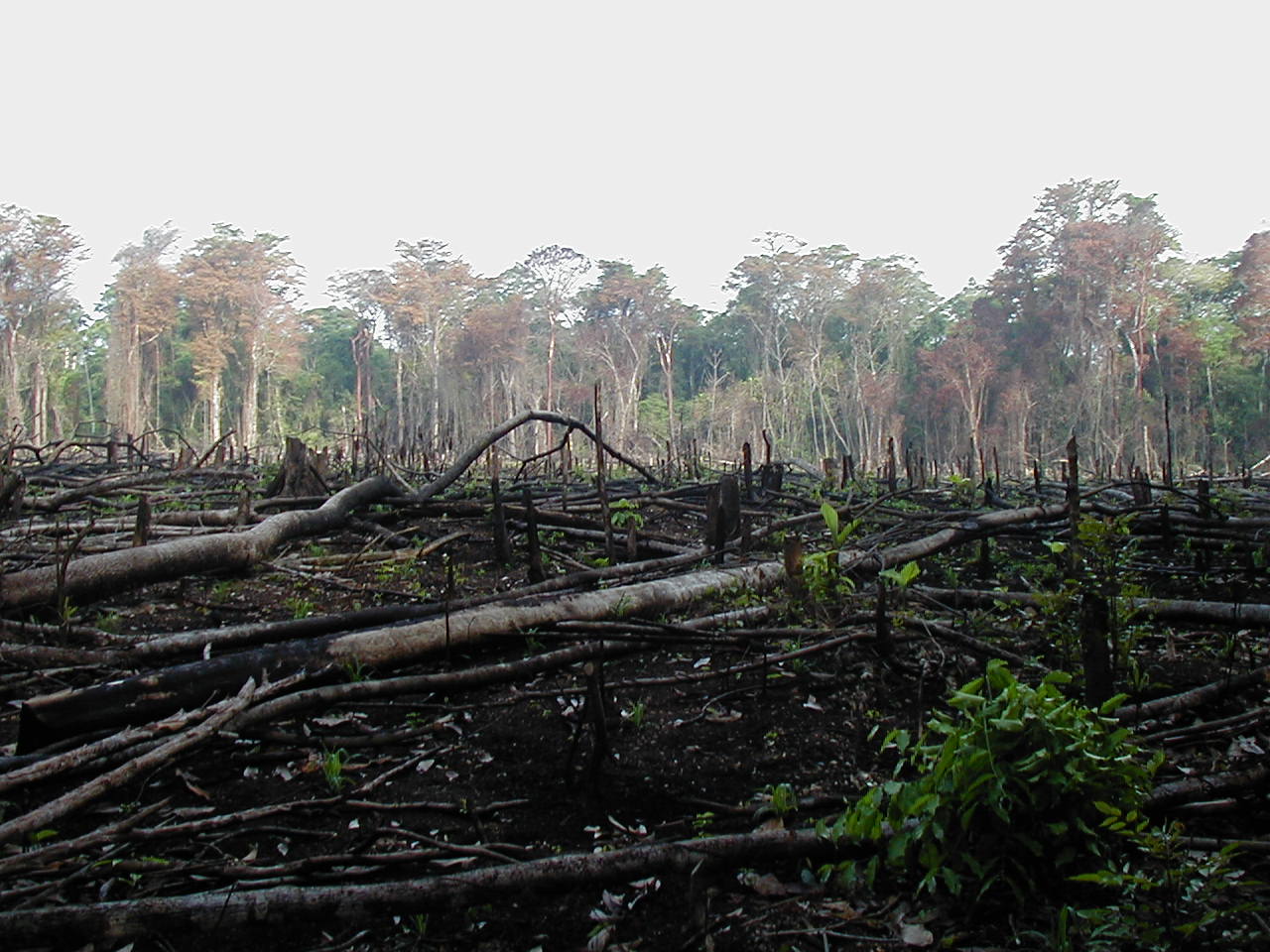
Deforestation is the cutting down or burning of large areas of forest. It happens all over the world, but the biggest losses today are in tropical places like the Amazon rainforest in South America, the Congo Basin in Africa, and parts of Southeast Asia. People have cleared forests for thousands of years, but the speed has gotten much faster in the last hundred years.
Why do people cut down forests? Most of the time, the land is cleared to make room for farms. Big cattle ranches, soybean fields, and palm oil plantations take up much of the space where rainforests used to stand. Trees are also cut for wood, for paper, and to build roads, towns, and mines. Sometimes forests are burned on purpose to clear the land quickly. Fires can spread farther than planned and destroy even more.
Forests do a lot of work for the planet. A single big tree can soak up thousands of gallons of water from the soil and breathe it out through its leaves. Forests pull carbon dioxide, a gas that warms the planet, out of the air and lock it inside their wood. Tropical rainforests hold more than half of all land animal and plant species, even though they cover only about six percent of Earth's surface. When a forest is cleared, the animals that lived there lose their home. Many die. Some species go extinct.
Deforestation also speeds up climate change. When trees are cut or burned, the carbon stored inside them goes back into the air as carbon dioxide. About ten percent of the greenhouse gases humans add to the atmosphere each year come from cutting down forests. Without tree roots to hold it, soil washes away in heavy rain. Rivers get muddy, and crops fail on the bare land within a few years.
Scientists track forest loss using satellites that take pictures of Earth every day. Between 1990 and 2020, the world lost about 420 million acres of forest, an area larger than India. The rate has slowed in some places and sped up in others. Brazil, Indonesia, and several African countries have tried different laws to protect their forests, with mixed results.
There is some good news. Forests can grow back if given the chance. Groups around the world are planting millions of new trees each year. A young forest is not the same as an old one, though. It can take hundreds of years for a cleared rainforest to return to what it was.
Related
Last updated 2026-04-23