
Hypothesis
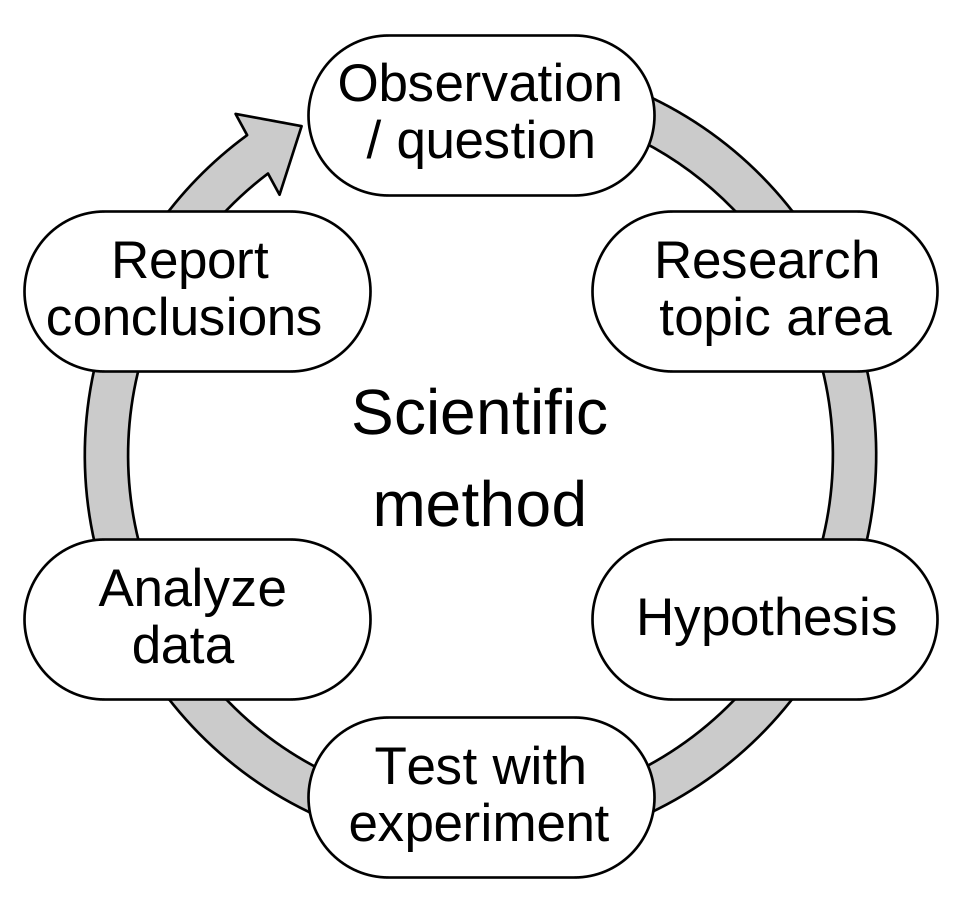
Credit: Efbrazil · CC BY-SA 4.0
A hypothesis is an educated guess that scientists test with experiments. It is a clear statement about what might happen or why something happens. A good hypothesis can be checked. That means a scientist can design a test to see if the guess is right or wrong.
Scientists do not just pull hypotheses out of thin air. They start by watching the world closely. They notice something strange or interesting. Then they ask a question. Finally, they come up with a hypothesis that tries to answer the question. Every step builds on the one before it.
Here is an example. Imagine a kid notices that her tomato plants on the sunny side of the yard grow faster than the ones in the shade. That is her observation. Her question is, "Why are those tomatoes growing faster?" Her hypothesis might be, "Tomato plants grow taller when they get more sunlight." Now she has something she can test.
A strong hypothesis has two important parts. First, it predicts what will happen. Second, it can be proven wrong. That second part sounds strange, but it matters a lot. If there is no way to show a hypothesis is wrong, then there is no way to show it is right either. Scientists call this idea falsifiability. "Unicorns exist somewhere in the universe" is a bad hypothesis because you cannot prove it wrong. "Plants grow taller with more sunlight" is a good one, because an experiment can show it.
After testing, a hypothesis might be supported by the results. Or it might be proven wrong. Both outcomes are useful. A wrong hypothesis still teaches the scientist something new. Many famous discoveries started as hypotheses that turned out to be partly wrong. Scientists then fixed them and tried again.
A hypothesis is not the same thing as a theory. People often mix these two words up. A hypothesis is a single guess that has not been tested much yet. A theory is a big explanation that has been tested many times by many scientists and holds up well. Gravity and evolution are theories. An idea you wrote down this morning is a hypothesis.
The next time you wonder why something happens, try writing your guess as a full sentence. Then think about how you could test it. You have just made a hypothesis, the same way real scientists do.
Last updated 2026-04-23