
Laser
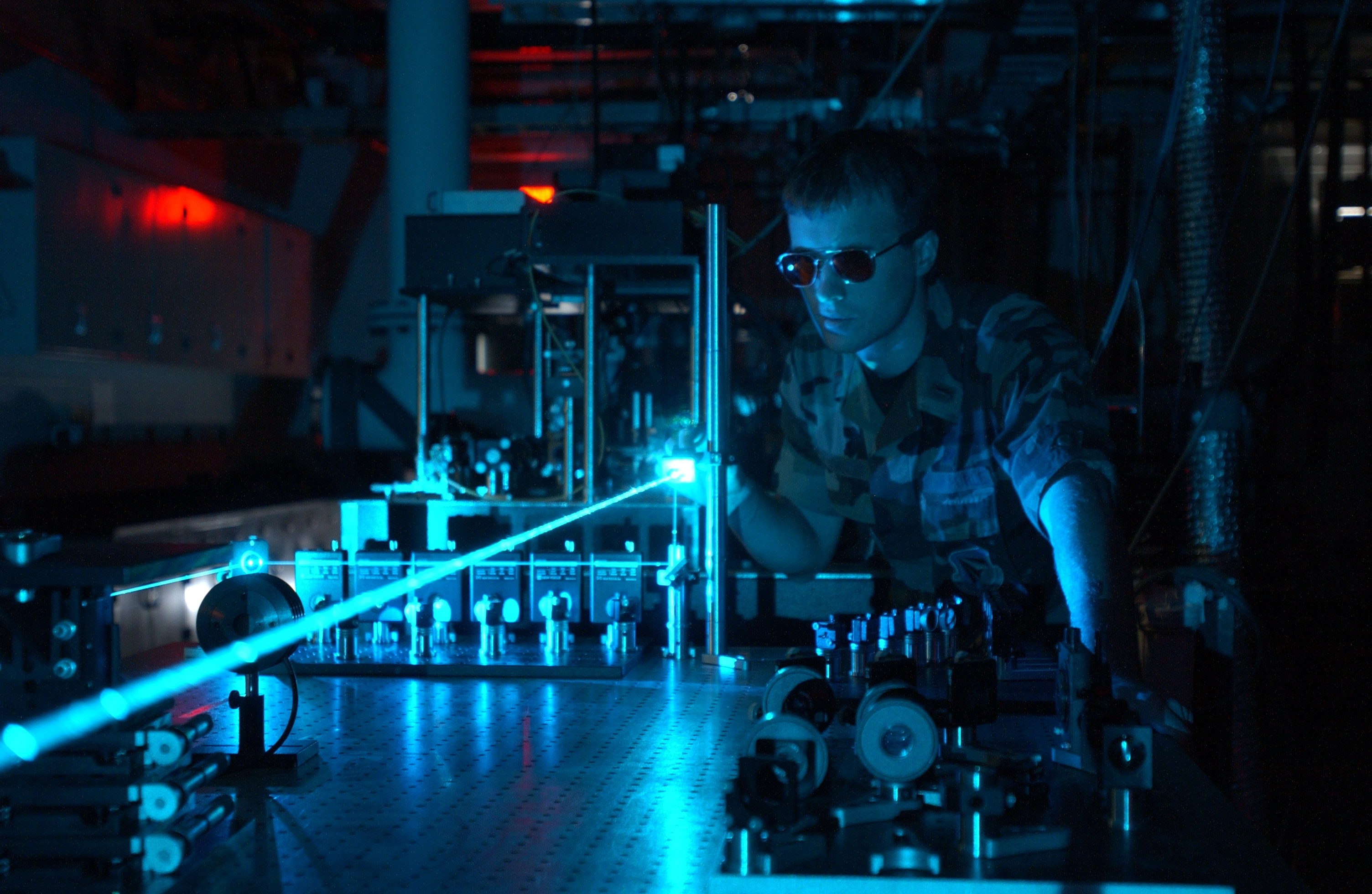
Credit: US Air Force · Public domain
A laser is a device that makes a very narrow, very straight beam of light. The word "laser" started as an acronym. It stands for Light Amplification by Stimulated Emission of Radiation. The first working laser was built in 1960 by an American scientist named Theodore Maiman. Today, lasers are used in hospitals, factories, stores, schools, and even inside the computer or phone you might be reading this on.
Regular light, like the light from a flashlight, spreads out as it travels. It is also a mix of many colors jumbled together. Laser light is different. All the light waves march in step, like soldiers in a parade. They are all the same color, and they travel in almost the same direction. That is why a laser beam stays narrow even over long distances.
To make a laser, you need three things: a power source, a special material, and two mirrors. The power source pumps energy into the atoms of the material. When an atom takes in energy, one of its tiny parts called an electron jumps to a higher level. When the electron falls back, the atom spits out a bit of light. The two mirrors bounce this light back and forth through the material, making more and more atoms release light in step. One of the mirrors lets a little light leak out. That leaking light is the laser beam.
Different materials make different colors of laser. Some lasers use a ruby crystal. Some use special gases. Most small lasers today, like the one in a grocery store scanner, use a tiny chip called a laser diode.
Lasers do many jobs. Doctors use them to cut tissue or fix eyesight, because a laser beam can be thinner than a human hair. Factories use powerful lasers to cut metal. Cash registers use weak lasers to read barcodes. DVD and Blu-ray players use lasers to read the tiny pits on a disc. Fiber-optic cables, which carry most of the world's internet traffic, send information as flashes of laser light through glass threads.
Lasers can also reach across huge distances. Scientists have bounced laser pulses off mirrors on the Moon, about 239,000 miles away. The light takes about 2.5 seconds to make the round trip. Not bad for a beam small enough to fit through a keyhole.
Last updated 2026-04-23