
Magnetism
Credit: Newton Henry Black · Public domain
Magnetism is a force that pulls certain metals together or pushes them apart. It is one of the basic forces in nature. You can feel it when two magnets click together or resist each other in your hand. Magnetism is invisible, but its effects are easy to see.
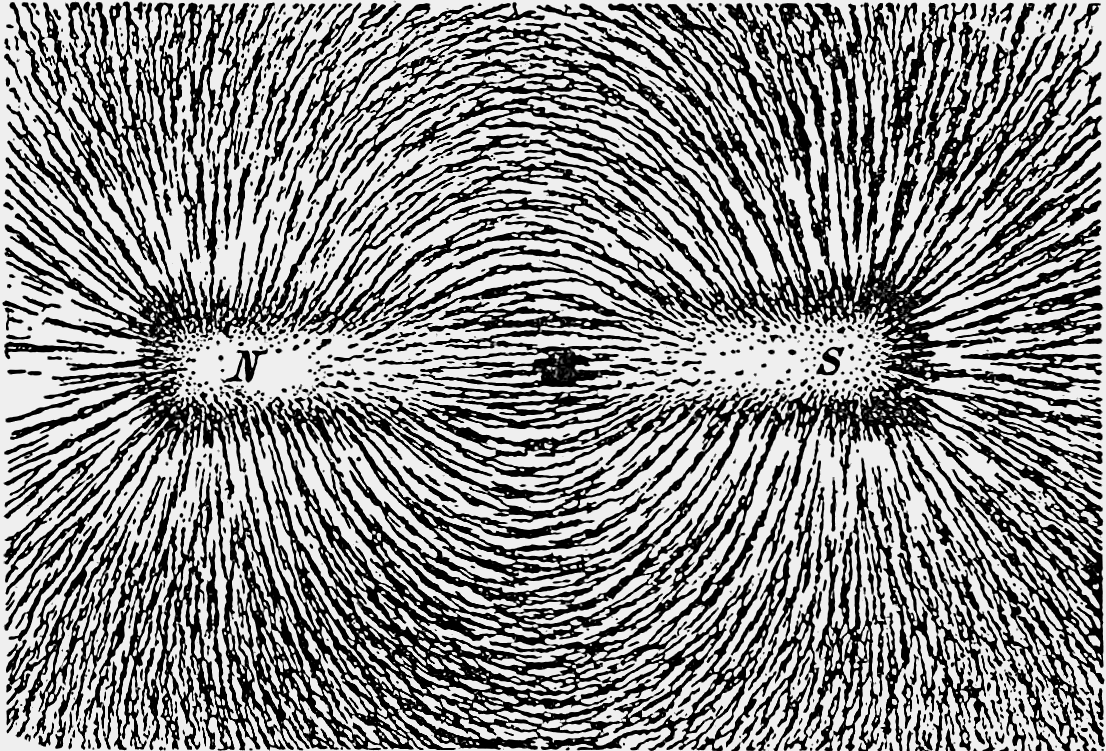
A magnet has two ends, called poles. One is the north pole, and the other is the south pole. Opposite poles pull toward each other. Two north poles or two south poles push apart. This rule is the heart of how magnets work. No matter how many times you cut a magnet in half, each piece still has a north pole and a south pole.
Only a few materials are strongly magnetic. The main ones are iron, nickel, and cobalt. Most other things, like wood, plastic, water, and glass, are not affected by magnets at all. That is why a magnet on your fridge sticks to the metal door but not to a wooden cabinet.
Around every magnet is an invisible area called a magnetic field. The field is what actually does the pulling and pushing. You can see the shape of the field by sprinkling iron filings on paper and holding a magnet underneath. The filings line up in curved paths that loop from one pole to the other.
Earth itself is a giant magnet. Deep inside our planet, hot liquid iron moves around the core, and that movement creates a magnetic field that stretches far out into space. This field is why a compass needle always points north. It also blocks harmful particles from the Sun. When those particles hit the field near the poles, they glow and make the northern and southern lights.
Magnetism and electricity are closely linked. When electricity flows through a wire, it creates a small magnetic field around the wire. When a magnet moves near a wire, it pushes electricity through the wire. Scientists call this combined force electromagnetism. It powers almost every machine with a motor, from electric toothbrushes to subway trains.
Some animals can sense magnetic fields, and scientists are still working out exactly how. Sea turtles, salmon, and many birds seem to use Earth's field like a built-in compass during long migrations. Researchers think tiny bits of a magnetic mineral inside their bodies may be involved, but the details are not fully understood.
The next time a refrigerator magnet sticks to the door, remember that the same force is also steering sea turtles across whole oceans.
Related
Last updated 2026-04-23