
X-ray
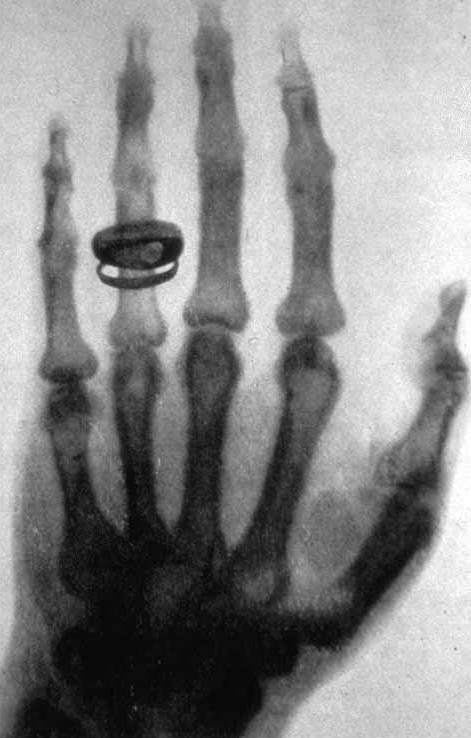
Credit: Wilhelm Röntgen; current version created by Old Moonraker. · Public domain
An X-ray is a kind of invisible energy that can pass through many solid objects. X-rays are a form of radiation, similar to light but with much more energy. Doctors use them to take pictures of the inside of the body. Airport workers use them to see inside bags. Scientists use them to study everything from broken bones to distant stars.
X-rays were discovered by accident in 1895. A German scientist named Wilhelm Röntgen was experimenting with electricity in a glass tube. He noticed that a screen across the room started to glow, even though it was covered up. Something invisible was passing through the cover. Röntgen did not know what the new rays were, so he called them X-rays. The letter X stands for "unknown" in math.
A few weeks later, Röntgen took the first X-ray picture of a human body. It showed the bones inside his wife's hand, along with her wedding ring. When she saw the image, she said, "I have seen my death." People had never looked inside a living body before.
X-rays work because different materials block them by different amounts. Soft things like skin and muscle let most X-rays pass through. Hard things like bone and metal block them. When an X-ray machine shoots rays at your arm and a detector catches them on the other side, bones show up as bright white shapes and soft tissue looks gray. A broken bone shows up as a clear crack in the white.
X-rays carry a lot of energy, and too much of that energy can harm living cells. That is why a technician covers parts of your body with a heavy lead apron and steps behind a wall before taking the picture. A single medical X-ray uses a very small dose, about the same amount of natural radiation you get from the environment in a few days.
X-rays are not only for medicine. Astronomers use special telescopes in space to catch X-rays coming from black holes and exploding stars. Airports use X-ray scanners to spot weapons or hidden objects in luggage. Factories use them to check welds and machine parts for tiny cracks.
Marie Curie, who studied radiation, helped save thousands of lives in World War I by driving mobile X-ray vans to battlefield hospitals. Soldiers called them "little Curies." Röntgen won the first Nobel Prize in Physics in 1901 for his strange, glowing rays.
Related
Last updated 2026-04-23