
Marie Curie
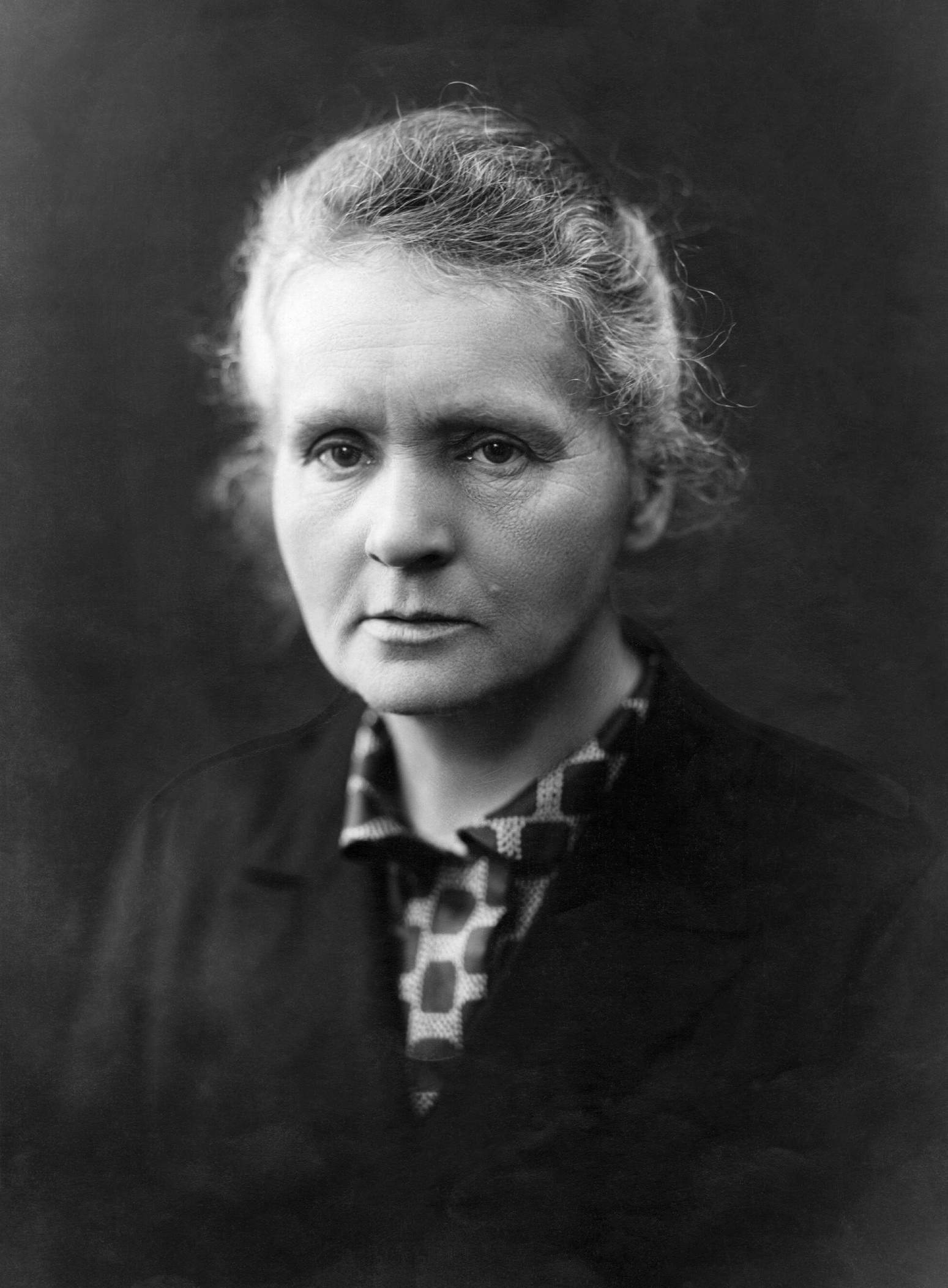
Credit: Henri Manuel · Public domain
Marie Curie was a Polish-French scientist who studied radioactivity. She lived from 1867 to 1934. Her work helped scientists understand atoms, and it led to new ways to treat diseases like cancer. She was the first woman to win a Nobel Prize. She is still the only person ever to win Nobel Prizes in two different sciences.
She was born Maria Sklodowska in Warsaw, Poland. At the time, Poland was ruled by Russia, and girls were not allowed to attend university there. Maria studied in secret at a hidden school called the "Flying University." When she was 24, she moved to Paris to study at the Sorbonne. She was so poor that she sometimes fainted from hunger in class. She still graduated at the top of her physics program.
In Paris, she met a French scientist named Pierre Curie. They married in 1895 and began working together. A few years earlier, another scientist had noticed that a metal called uranium gave off a strange invisible energy. Marie wanted to know what caused it. She invented the word "radioactivity" to describe it.
The Curies worked in a leaky old shed with a dirt floor. For four years, they boiled and stirred tons of a heavy black rock called pitchblende. They were searching for tiny amounts of new elements hidden inside. They found two. Marie named the first one polonium, after her home country. She named the second one radium because it glowed in the dark.
In 1903, Marie, Pierre, and another scientist named Henri Becquerel shared the Nobel Prize in Physics. Marie became the first woman ever to win one. Pierre died in a street accident in 1906. Marie kept working alone. In 1911, she won a second Nobel Prize, this time in chemistry, for discovering polonium and radium.
During World War I, Curie wanted to help wounded soldiers. She built small X-ray machines on the backs of trucks and drove them to the battlefields. Doctors used the machines to find bullets and broken bones inside soldiers' bodies. Her vans were nicknamed "Little Curies." More than a million soldiers were treated with them.
At the time, nobody knew that radioactivity was dangerous. Curie carried glowing test tubes in her pockets. She kept jars of radium on her desk because she liked the soft blue light. The radiation slowly damaged her body, and she died of a blood disease in 1934. Her discoveries opened the door to nuclear power, modern medicine, and our entire understanding of what atoms are made of.
Related
Last updated 2026-04-26