
Galaxy
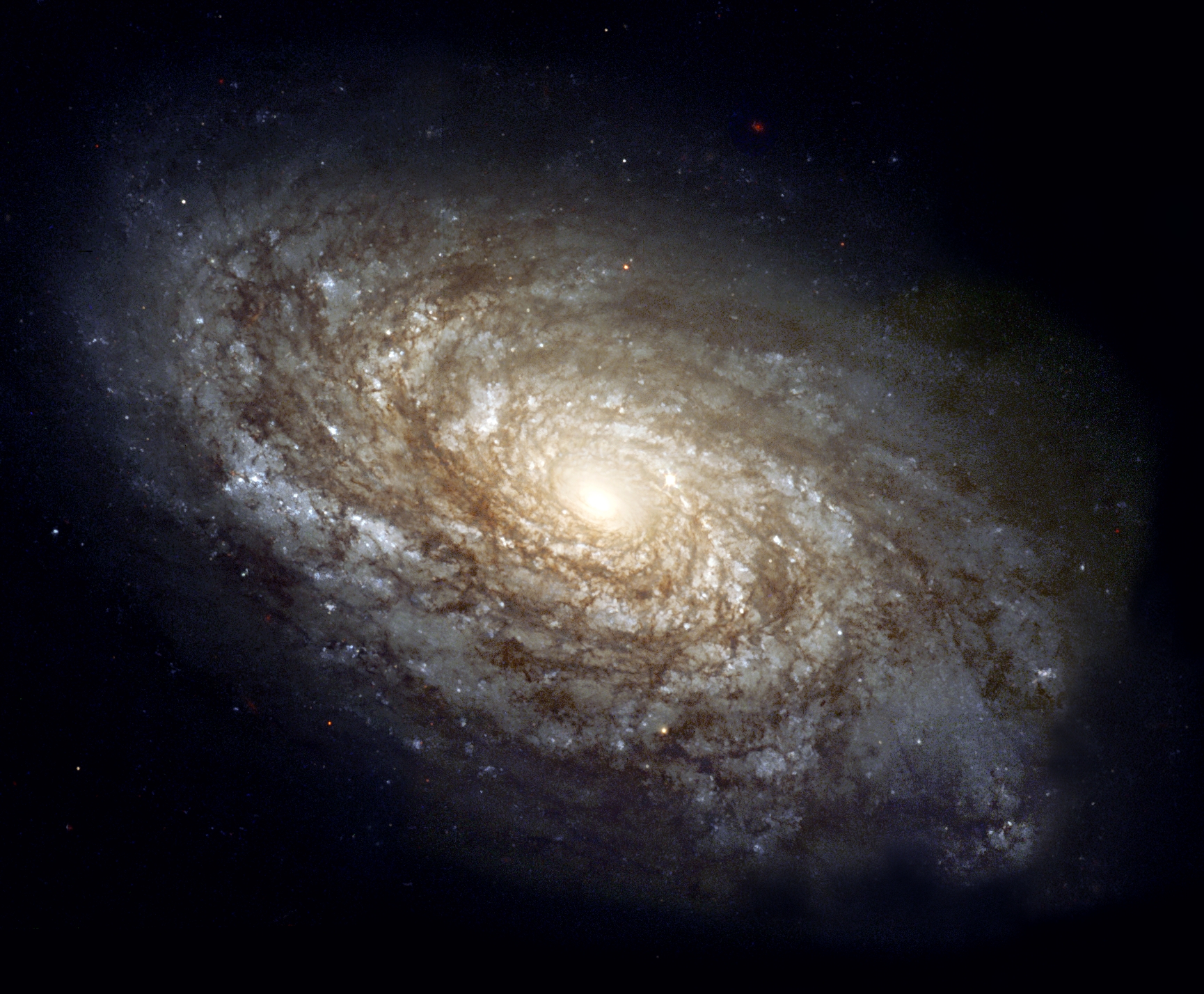
Credit: The Hubble Heritage Team (AURA/STScI/NASA)NASA Headquarters - Greatest Images of NASA (NASA-HQ-GRIN) · Public domain
A galaxy is a huge group of stars, gas, dust, and dark matter held together by gravity. The smallest galaxies have a few million stars. The biggest have trillions. Our Sun is just one star in a galaxy called the Milky Way, which contains more than 100 billion other stars. Astronomers think the universe holds at least two trillion galaxies in total.
Galaxies come in a few main shapes. Spiral galaxies look like giant pinwheels, with curving arms of bright stars wrapping around a glowing center. The Milky Way is a spiral. Elliptical galaxies are shaped like footballs or round blobs, and most of their stars are old. Irregular galaxies have no clear shape at all. They often look messy because another galaxy passed close by and pulled them out of shape.
Galaxies are enormous. The Milky Way is about 100,000 light-years across. That means light, which moves faster than anything else in the universe, takes 100,000 years to cross it. Galaxies are also far apart. The next big galaxy, Andromeda, is 2.5 million light-years away. When you see Andromeda through a telescope, the light hitting your eye left that galaxy before modern humans existed.
Most galaxies have a supermassive black hole at their center. The Milky Way's black hole is called Sagittarius A*. It has the mass of about 4 million Suns squeezed into a space smaller than our solar system. Scientists took the first real photo of a black hole in 2019, and another picture of Sagittarius A* in 2022. Nobody knows exactly how these giant black holes got so big, or whether they formed before the galaxies around them or after.
Galaxies are not spread evenly through space. Gravity pulls them into clusters, and clusters gather into even bigger groups called superclusters. The Milky Way belongs to a small cluster called the Local Group, which has about 80 galaxies in it. Between the clusters are huge, almost empty spaces called voids.
Galaxies also change over time. They grow by pulling in gas to form new stars. They collide and merge with other galaxies, sometimes blending into a single bigger one. Our own Milky Way has swallowed smaller galaxies in the past, and it is already starting to tug on Andromeda. When you look up at a dark sky and see a faint, milky band stretching overhead, you are looking edge-on through the flat disk of our galaxy from the inside.
Last updated 2026-04-22