
Universe
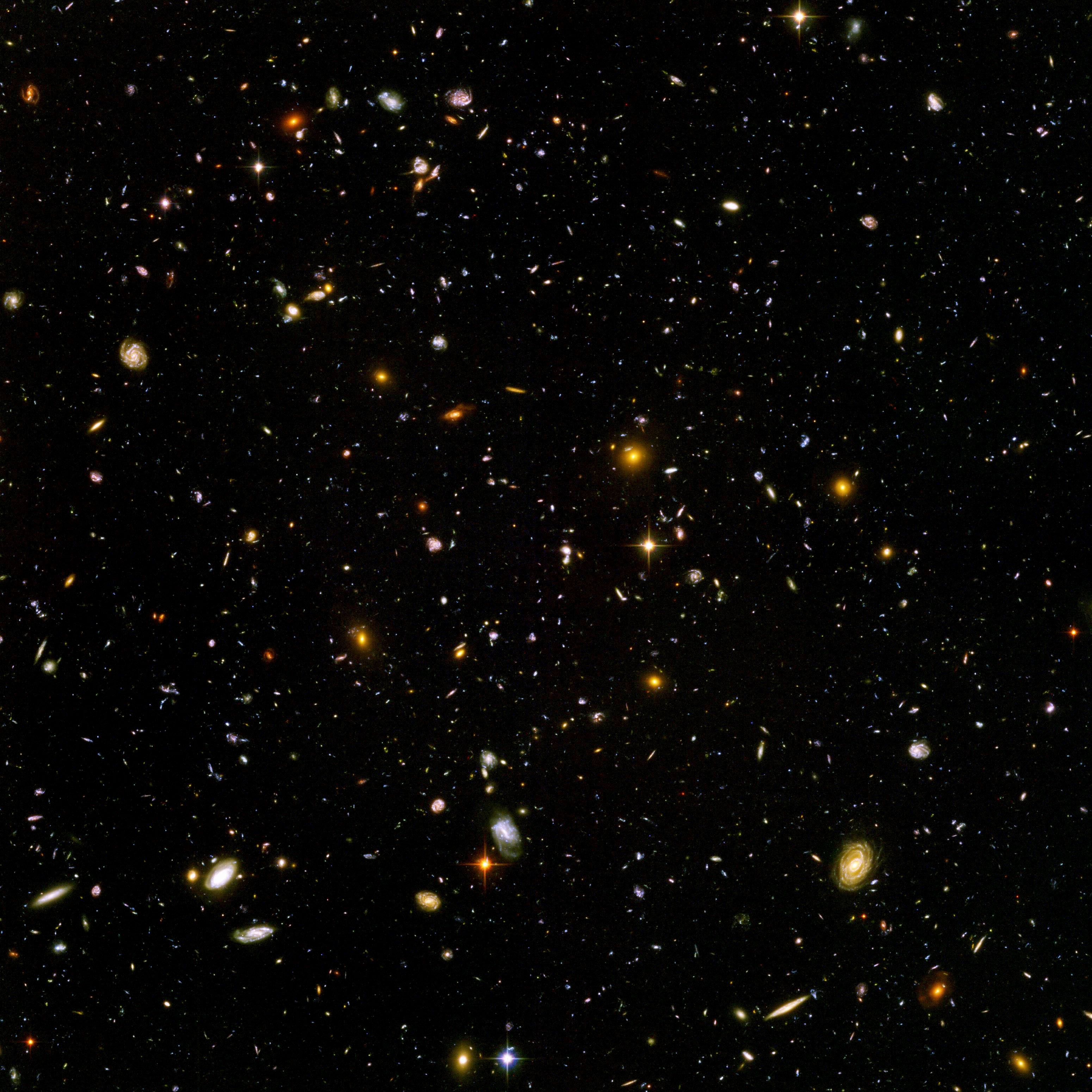
Credit: NASA and the European Space Agency. · Public domain
The universe is everything that exists. That includes all of space, all of time, all the stars and planets, all the galaxies, all the gas and dust, all the light, and all the matter and energy we know about. It also includes things we cannot see or fully understand yet. The study of the universe is called cosmology.
How big is it?
The universe is huge in a way that is hard to picture. Scientists measure space in light-years. One light-year is the distance light travels in a year, about six trillion miles. The nearest star to our Sun is about four light-years away. Our galaxy, the Milky Way, is about 100,000 light-years across.
And the Milky Way is just one galaxy. Scientists think the universe holds at least two trillion galaxies. Each galaxy can have hundreds of billions of stars. The part of the universe we can see, called the observable universe, stretches about 93 billion light-years from end to end.
Why can we only see part of it? Because light takes time to travel. When we look at a distant star, we see light that left it long ago. Light from the most distant things we can see has been traveling toward us for more than 13 billion years. Anything farther away than that has not had time to reach us yet. The universe beyond what we can see might be much bigger, or even endless. Scientists do not know.
How did it begin?
Most scientists agree the universe began about 13.8 billion years ago in an event called the Big Bang. The Big Bang was not really an explosion in space. It was space itself starting to stretch outward from an incredibly hot, dense point. In the first tiny fraction of a second, the universe grew from smaller than an atom to bigger than a galaxy.
At first the universe was too hot for atoms to form. After about 380,000 years, it cooled enough for the first atoms of hydrogen and helium to appear. Gravity slowly pulled this gas into huge clouds. Inside those clouds, the first stars lit up. Over billions of years, stars grouped into galaxies, and galaxies grouped into larger structures called clusters.
Our solar system formed about 4.6 billion years ago, from a cloud of gas and dust left behind by older stars. That means the atoms in your body, the iron in your blood, the calcium in your bones, were made inside stars that died long before the Sun was born.
What is it made of?
Here is one of the strangest parts. Everything you can see, every star, every planet, every person, every atom, adds up to only about five percent of the universe. The rest is made of two mysterious things.
About 27 percent is dark matter. Dark matter does not give off light, so we cannot see it. But we know it is there because galaxies spin in ways that would fling them apart without extra gravity holding them together. Something invisible is providing that gravity.
The other 68 percent is even stranger. It is called dark energy. Dark energy seems to be pushing the universe to expand faster and faster over time. Scientists discovered this in 1998 and were shocked. They had expected the universe to be slowing down, not speeding up.
So what are dark matter and dark energy, really? We do not know yet. This is one of the biggest open questions in science.
Is it still changing?
Yes. The universe is still expanding. Galaxies are moving away from each other, like dots on a balloon that is being blown up. Stars are still being born in clouds of gas, and old stars are still exploding as supernovas. New planets are still forming.
Our own Milky Way is on a slow collision course with a nearby galaxy called Andromeda. In about four billion years, the two will crash and merge into a single larger galaxy. By then, the Sun will be near the end of its life too.
What we still do not know
The universe keeps raising questions scientists cannot answer. Is there only one universe, or are there many? Some scientists think there may be a "multiverse" of other universes we cannot reach. Others say there is no way to test that idea, so it is not really science. The debate is active.
Will the universe expand forever, or eventually stop? What is inside a black hole? Is there life on other planets? These questions drive astronomers, physicists, and space missions every day.
When you look up at a dark sky and see stars, you are seeing a tiny corner of the biggest thing that exists. And most of it is still a mystery.
Last updated 2026-04-22