
Holocaust
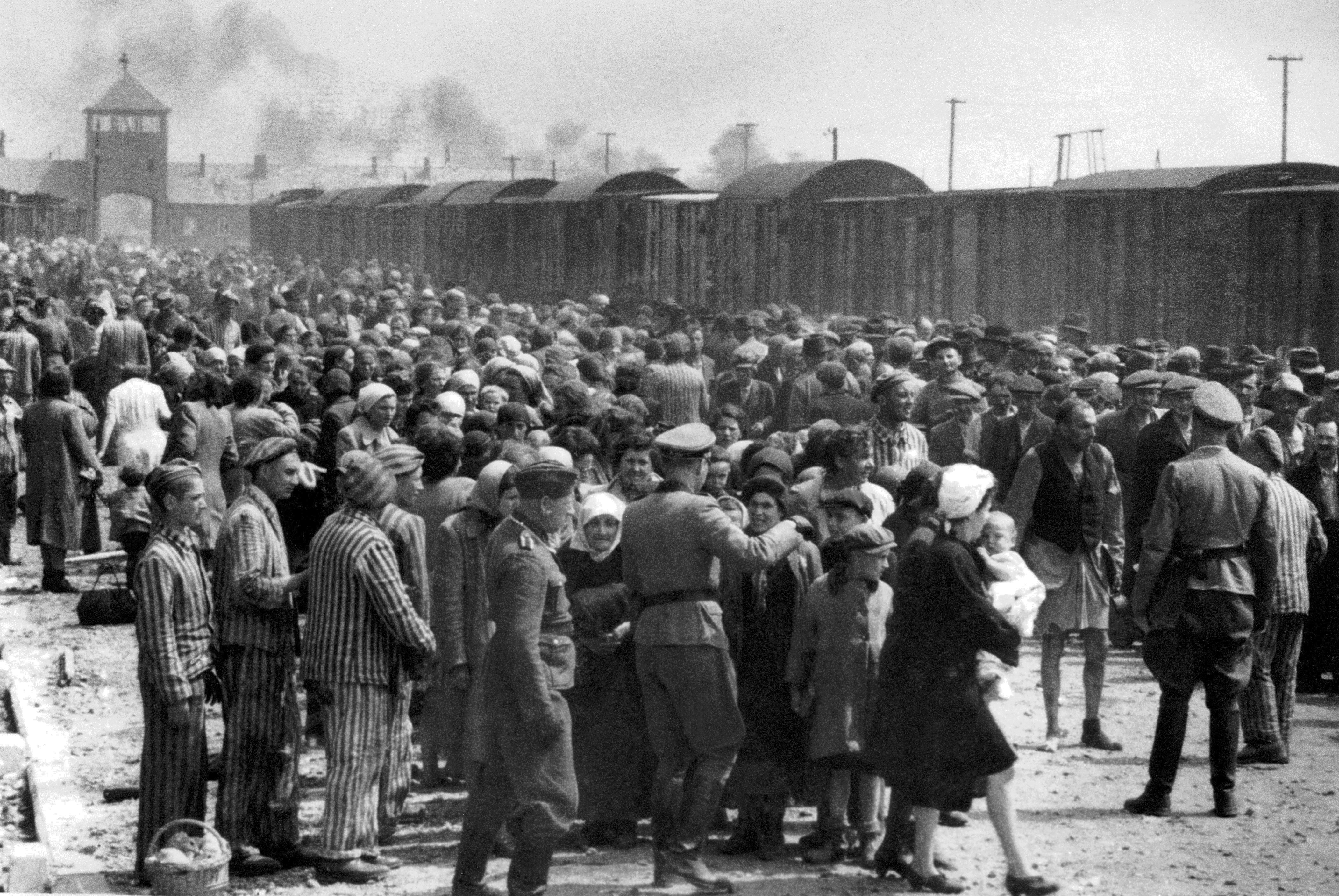
Credit: Bernhard Walter · Public domain
The Holocaust was the planned murder of about six million Jewish people by Nazi Germany and its partners during World War II. It happened between 1933 and 1945, mostly in Europe. The Nazis also killed millions of other people they considered enemies or "less than human." These groups included Roma people, disabled people, gay people, Polish and Soviet civilians, and political prisoners. The Holocaust is one of the worst crimes in human history.
How it began
In 1933, a political party called the Nazis took power in Germany. Their leader was Adolf Hitler. The Nazis blamed Jewish people for Germany's problems, including the country's loss in World War I and its money troubles. This kind of hatred against Jewish people is called antisemitism, and it had existed in Europe for hundreds of years before the Nazis. Hitler made it the center of his government.
Soon after taking power, the Nazis passed laws against Jewish people. Jews lost their jobs, their businesses, and their citizenship. Jewish kids were thrown out of public schools. In 1938, on a night called Kristallnacht, Nazi groups burned hundreds of synagogues and smashed Jewish-owned shops across Germany. Many Jewish families tried to leave the country, but most other countries would not let them in.
Ghettos
When World War II began in 1939, Germany invaded Poland, where millions of Jewish people lived. The Nazis forced Jewish families into small, walled-off parts of cities called ghettos. The biggest was the Warsaw Ghetto. More than 400,000 people were packed into an area of about 1.3 square miles, smaller than New York City's Central Park. There was almost no food. Disease spread quickly. Tens of thousands died of hunger and sickness inside the ghetto walls.
The camps
Starting in 1941, the Nazis decided to murder every Jewish person in Europe. They called this plan the "Final Solution." They built a system of camps across the lands they controlled. Some were work camps where prisoners were forced to do hard labor with little food. Others were death camps built only to kill people.
The largest death camp was Auschwitz, in occupied Poland. About 1.1 million people were murdered there, almost all of them Jewish. When trains arrived, guards split families apart on the spot. Most people were sent straight to gas chambers, rooms made to look like showers but filled with poison gas. Their bodies were burned in giant ovens. Other major killing centers included Treblinka, Sobibor, and Belzec.
In other places, Nazi soldiers shot Jewish people in mass killings. At Babi Yar, a ravine in Ukraine, more than 33,000 Jewish people were shot in just two days in 1941.
Resistance and rescue
Even in the worst conditions, people fought back. In 1943, Jewish fighters in the Warsaw Ghetto held off the German army for almost a month with a few smuggled guns. Prisoners broke out of Sobibor and Treblinka. Underground groups across Europe hid Jewish families, forged fake papers, and smuggled children to safety.
Some non-Jewish people risked their lives to help. A German businessman named Oskar Schindler saved more than 1,000 Jewish workers by claiming he needed them for his factory. The country of Denmark secretly moved almost its entire Jewish population to safety in Sweden. A Dutch family hid the Frank family in a small attic in Amsterdam for two years. Anne Frank, a teenage girl, kept a diary there. The diary was found after the war and is now read in classrooms around the world.
The end and what came after
The camps were freed one by one as Allied armies pushed into Nazi territory in 1944 and 1945. Soldiers were shocked by what they found. Survivors were starving, sick, and often the only ones left from their entire family.
After the war, Allied courts put Nazi leaders on trial in the German city of Nuremberg. Some were executed. Others spent the rest of their lives in prison. The trials set a new rule for the world: leaders could be punished for "crimes against humanity," even if their own country's laws had allowed those crimes.
Today, Holocaust museums, memorials, and survivor testimonies exist across the world to make sure people remember. Survivors and their families often repeat two words about what happened: "Never again." Historians keep studying how a modern country with schools, hospitals, and universities came to murder millions of its own neighbors. The question is not fully answered, and it is one reason the Holocaust is still taught everywhere.
Last updated 2026-04-26