
Neolithic Revolution
Credit: Bjoertvedt · CC BY-SA 3.0
The Neolithic Revolution was the slow change from hunting and gathering to farming. It happened in different parts of the world starting about 12,000 years ago. "Neolithic" means "New Stone Age." The word "revolution" makes it sound fast, but the change actually took thousands of years. Still, it may be the most important shift in human history.
For most of human history, people were hunter-gatherers. They moved from place to place, hunting wild animals and picking wild plants. Then, after the last Ice Age ended, the climate grew warmer and steadier. People in a few different regions began to plant seeds on purpose. They also began to keep animals like sheep, goats, and pigs near their camps. Over many generations, the plants and animals changed. They became what we call domesticated, which means shaped by humans for human use.
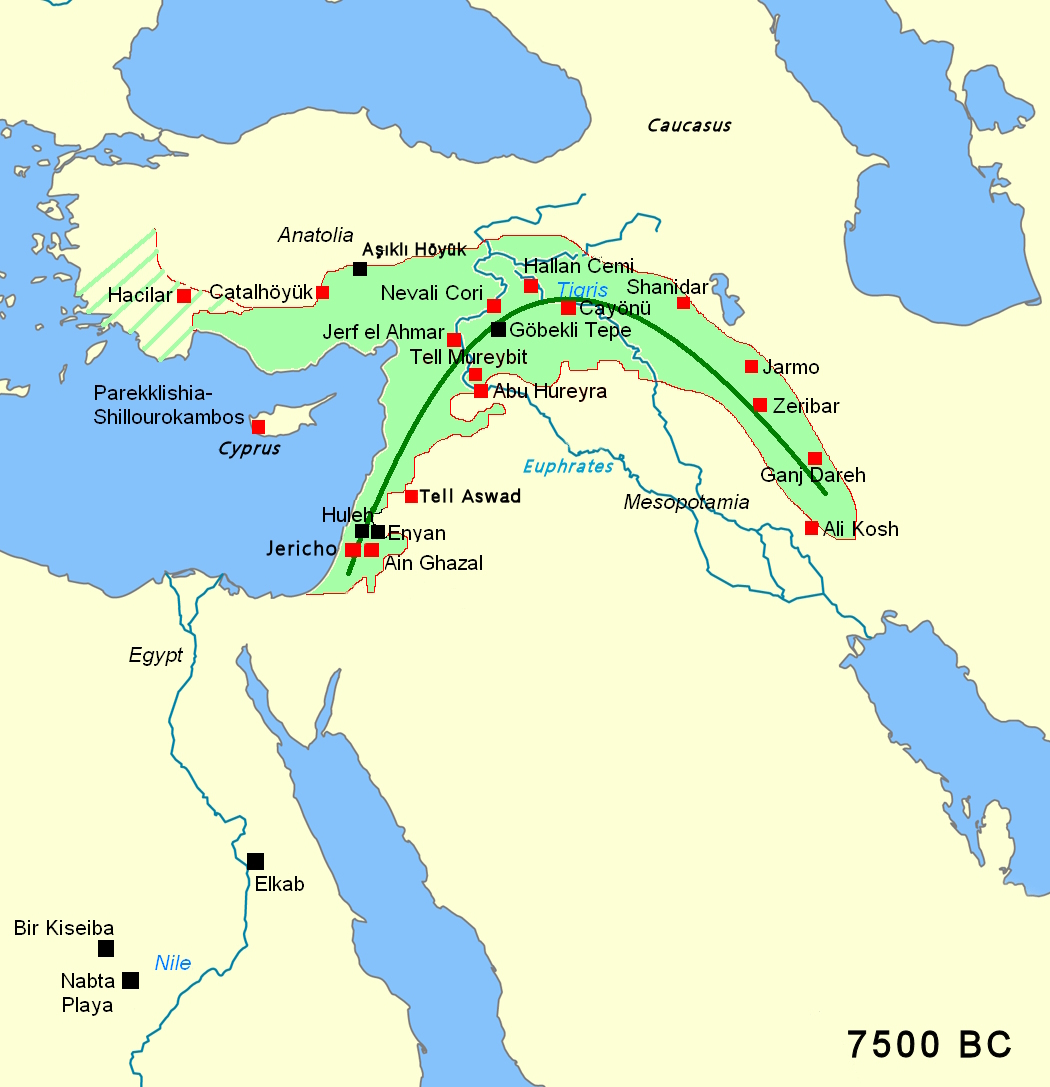
This change happened in several places without people copying each other. Wheat and barley were first farmed in the Middle East, in a region called the Fertile Crescent. Rice was farmed in China. Corn, beans, and squash were farmed in Mexico. Potatoes came from the Andes Mountains in South America. Each region grew its own crops based on the wild plants nearby.
Farming changed almost everything about daily life. Once people grew their own food, they could stay in one place. Small camps grew into villages, and villages grew into towns. People built permanent houses out of mud brick, wood, and stone. They made pottery to store grain. They wove cloth. They had more children, because babies no longer had to be carried long distances. The world's population began to climb.
But farming was not all good news. Hunter-gatherers ate many different foods and usually worked fewer hours each day. Early farmers depended on just a few crops, so a bad harvest meant hunger. Living close to animals brought new diseases. Some scientists call farming "the worst mistake in human history" for these reasons. Others point out that without farming, cities, writing, and modern science could never have happened.
Over time, settled farming villages grew into the first cities, like Uruk in Mesopotamia and Çatalhöyük in what is now Turkey. People stored extra food, which meant some workers could do other jobs, like making tools, leading prayers, or keeping records. Writing, kings, armies, and trade all followed. Almost every part of the world you live in today, from your school to your dinner plate, traces back to a small group of people who first decided to plant a seed and wait.
Related
Last updated 2026-04-26