
Cobra
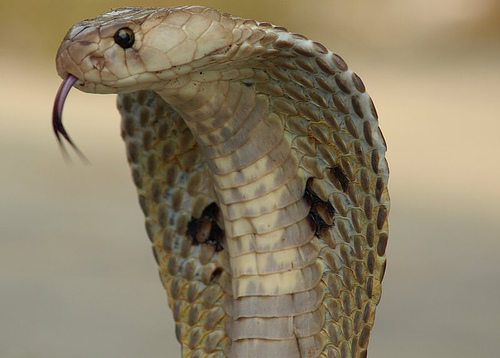
Credit: Kamalnv · CC BY 3.0
A cobra is a type of venomous snake known for the wide hood of skin it spreads behind its head. Cobras live in Africa and across parts of Asia, from India to Southeast Asia. There are more than 30 species. The most famous are the Indian cobra and the king cobra.
The hood is what makes a cobra look like a cobra. When a cobra feels scared or wants to warn a predator, it lifts the front part of its body off the ground. Then it spreads long ribs in its neck outward, stretching the skin into a flat, flared shape. Many cobras have markings on the back of the hood that look like eyes. These fake eyes help scare away animals that might attack from behind.
Cobras are hunters. They eat rodents, lizards, frogs, birds, and sometimes other snakes. They use venom to kill their food. The venom travels through two sharp fangs at the front of the mouth. In humans, a cobra bite is dangerous and can be deadly without medical treatment. Doctors use a medicine called antivenom to save people who have been bitten.
The king cobra is the longest venomous snake in the world. It can grow up to 18 feet long, which is longer than most cars. Unlike most snakes, the king cobra builds a nest. The female gathers leaves into a pile and lays her eggs inside, then guards them until they hatch. No other snake is known to build a nest like this.
One cobra species has a different trick. The spitting cobra can shoot venom out of its fangs, aiming for a predator's eyes from several feet away. The venom can cause pain and even blindness if it is not washed out quickly.
Cobras appear in stories and art all over the places they live. In ancient Egypt, a rearing cobra called the uraeus sat on the forehead of the pharaoh's crown as a symbol of royal power. In Hindu tradition, the god Shiva is often shown with a cobra wrapped around his neck. In parts of India, snake charmers became famous for seeming to hypnotize cobras with music. Scientists now know that cobras cannot actually hear the flute. They are following the movement of it and swaying to keep it in sight.
Even with this long history alongside people, many cobra populations are shrinking. Habitat loss and fear-driven killing are the main reasons. The king cobra is now listed as a vulnerable species.
Last updated 2026-04-22