
India
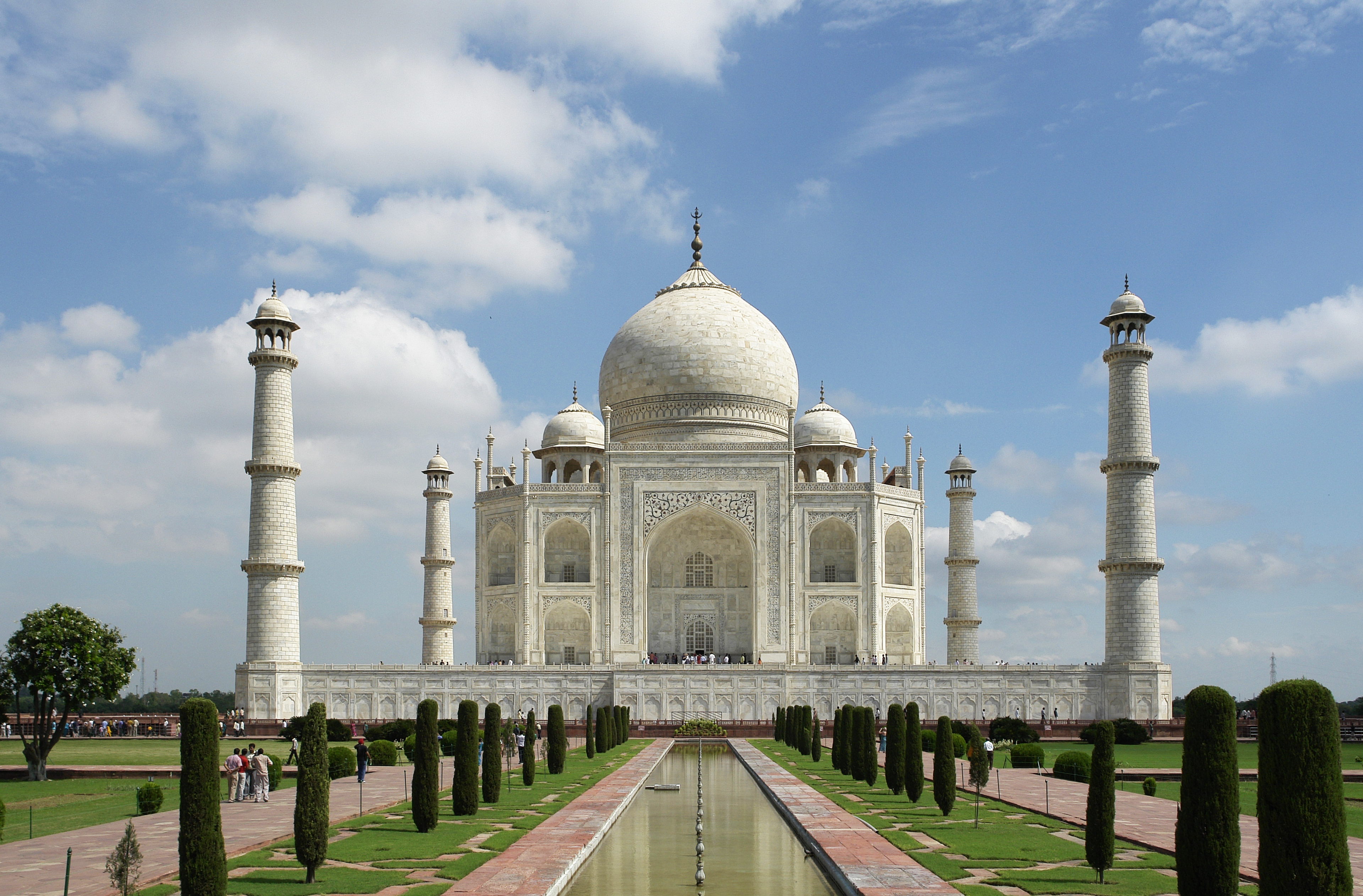
Credit: Yann; edited by Jim Carter · CC BY-SA 4.0
India is a country in South Asia. It is the seventh largest country in the world by land area. It is also the most populated country on Earth, with more than 1.4 billion people. That is more than four times the population of the United States. About one of every six people alive today lives in India.
The land
India is shaped like a giant triangle pointing into the Indian Ocean. The Himalayas, the tallest mountain range in the world, run along its northern border. Below the mountains lies a huge flat area called the Indo-Gangetic Plain. Hundreds of millions of people farm and live there. Farther south is a rocky highland called the Deccan Plateau. The country also has deserts in the west, rainforests in the east, and long beaches on two coasts.
The Ganges River flows across northern India. Hindus consider the Ganges a sacred river. Millions of people travel to its banks every year to pray, bathe, and honor relatives who have died. The river starts high in the Himalayas and flows about 1,560 miles to the Bay of Bengal.
Weather and wildlife
India has a special kind of weather called the monsoon. For most of the year, the country is hot and dry. Then, starting around June, winds from the ocean bring heavy rain for about three months. Farmers depend on these rains. If the monsoon is late or weak, crops can fail.
India is home to animals found almost nowhere else. Bengal tigers, Asian elephants, and one-horned rhinoceroses all live there. India has more wild tigers than any other country. The peacock, with its huge fan of blue and green feathers, is the national bird.
A very old history
People have lived in India for a very long time. One of the world's first great civilizations, the Indus Valley Civilization, grew up there more than 4,500 years ago. Its cities had straight streets, brick houses, and some of the earliest indoor plumbing in the world.
Over thousands of years, many kingdoms and empires rose and fell in India. The Maurya Empire united much of the land around 300 BCE. Later, the Mughal Empire built famous buildings, including the Taj Mahal. The Taj Mahal is a white marble tomb finished in 1653. A Mughal emperor named Shah Jahan built it for his wife after she died.
Starting in the 1600s, traders from Britain came to India. Over time, Britain took control of the whole country. India was ruled by Britain for almost 200 years. Many Indians fought to be free. A leader named Mahatma Gandhi led a movement against British rule without using violence. In 1947, India finally became independent. That same year, the country was split into two: India and Pakistan. Millions of people had to move, and many died in the fighting that followed. Historians still debate whether the split could have been done differently.
People and languages
India is one of the most varied countries on Earth. It has 22 official languages, and people speak hundreds more. Hindi and English are the two main languages used by the national government. A child in one part of India may not understand the language spoken in another part.
India is also the birthplace of four major religions: Hinduism, Buddhism, Jainism, and Sikhism. Most people in India are Hindu, but millions are Muslim, Christian, Sikh, Buddhist, or Jain. Festivals are a huge part of life. Diwali, the festival of lights, fills cities with lamps and fireworks each fall. Holi, the spring festival, fills the streets with people throwing bright colored powder at each other.
Modern India
Today India is a democracy. Its citizens vote to choose their leaders. Indian elections are the largest in the world. About 900 million people are allowed to vote.
India is a center for technology, movies, and science. The Indian film industry, often called Bollywood, makes more movies each year than any other country. India has also sent spacecraft to the Moon and Mars. In 2023, India became the first country to land a spacecraft near the Moon's south pole.
India still faces big challenges. Many people are very poor, and cities like Mumbai and Delhi deal with crowding and pollution. But India is changing fast. It has one of the biggest economies in the world and a young population full of new ideas. The mix of ancient traditions and modern life is part of what makes India unlike any other country.
Related
Last updated 2026-04-23