
Crocodile
Credit: Leigh Bedford · CC BY 2.0
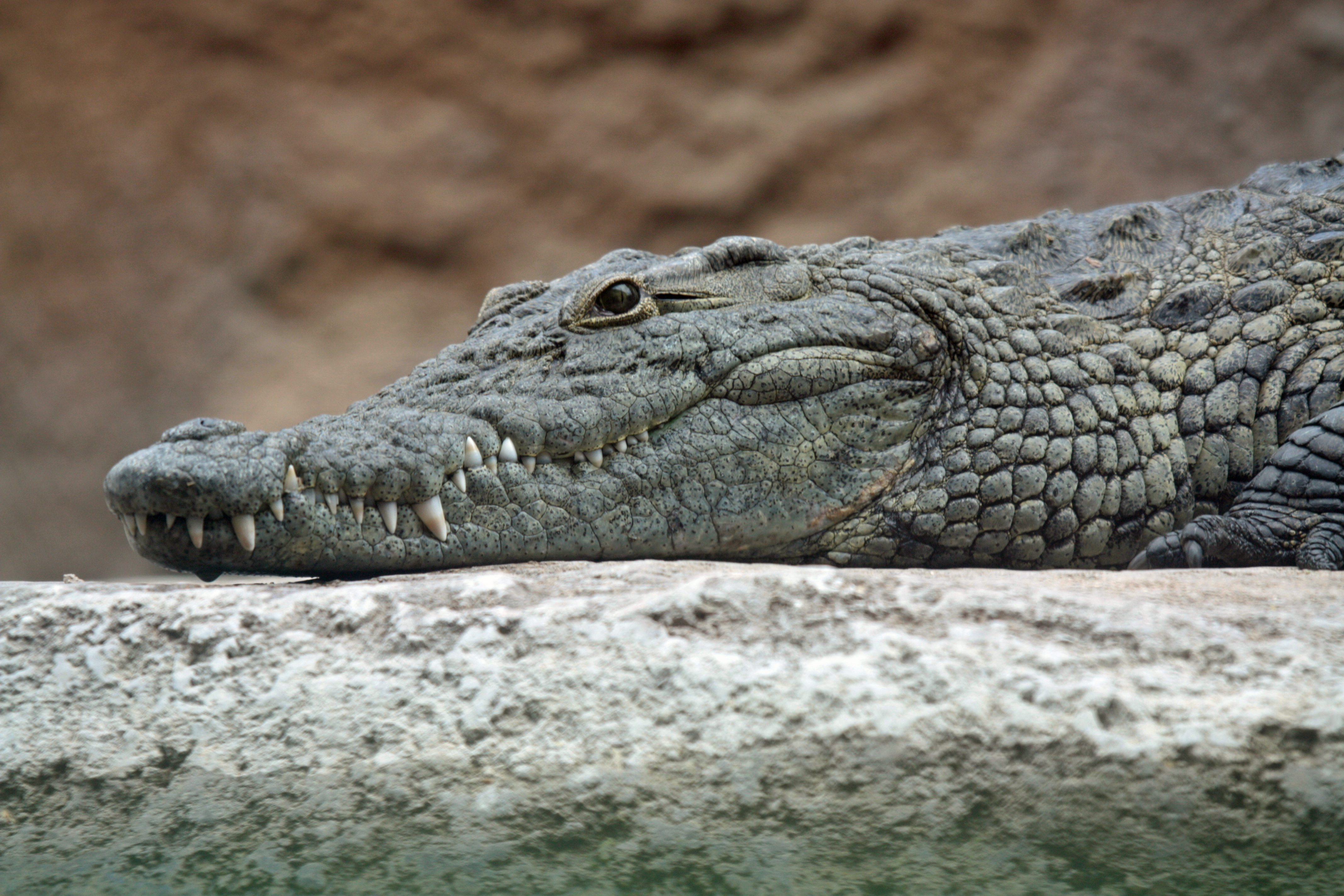
A crocodile is a large reptile that lives in warm rivers, lakes, and swamps. Crocodiles are found in parts of Africa, Asia, Australia, and the Americas. They have long bodies, short legs, thick scaly skin, and powerful tails. Their jaws are packed with sharp teeth for gripping prey. There are 14 different species of crocodile, and the biggest is the saltwater crocodile of Australia and Southeast Asia. A large male saltwater crocodile can grow over 20 feet long and weigh more than a ton, about as heavy as a small car.
Crocodiles spend most of their time in the water. They float quietly with only their eyes and nostrils above the surface. Special flaps seal their throats so they can open their mouths underwater without drowning. When prey comes close to the water, such as a fish, bird, or thirsty mammal, the crocodile lunges with surprising speed. It clamps down with its jaws and drags the prey under to drown it.
People often mix up crocodiles and alligators, but there are clear differences. A crocodile has a narrower, V-shaped snout. An alligator has a wider, U-shaped snout. When a crocodile closes its mouth, some of its lower teeth still show. An alligator's lower teeth stay hidden. Crocodiles also handle salt water better, while alligators stick to fresh water.
Crocodiles are cold-blooded, which means they cannot make their own body heat. They warm up by lying in the sun and cool down by slipping into the water. On hot days, you may see one resting with its mouth wide open. This is how a crocodile sweats.
Mother crocodiles are careful parents, which surprises many people. A female digs a nest and lays 20 to 80 eggs. She guards the nest for about three months. When the babies hatch, they squeak, and the mother digs them out. Then she gently carries them to the water in her huge mouth.
Crocodiles are sometimes called living fossils. Their ancestors appeared more than 200 million years ago, back when dinosaurs ruled the Earth. Crocodiles watched the dinosaurs rise, and they watched them disappear. Their basic body plan has barely changed since then. Scientists think the design simply works too well to need updating.
Today, some kinds of crocodiles are doing fine, but others are in serious trouble. The Philippine crocodile and the Cuban crocodile are critically endangered, with only a few hundred left in the wild. Hunting, pollution, and loss of habitat are the main threats. Protecting wetlands is the best way to protect these ancient survivors.
Last updated 2026-04-22