
Manatee
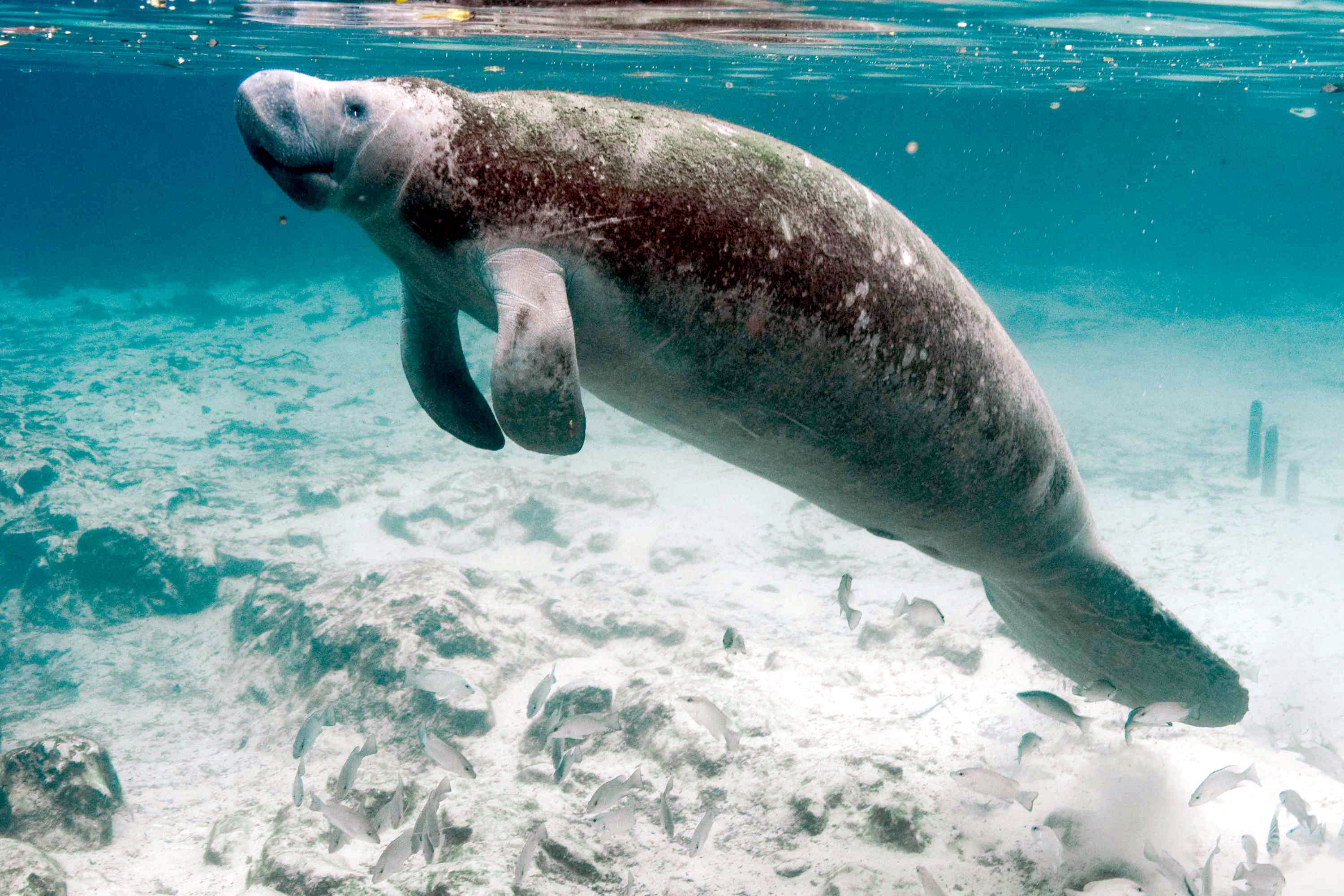
Credit: Ramos Keith, U.S. Fish and Wildlife Service · Public domain
The manatee is a large, slow-moving mammal that lives in warm, shallow water. It is sometimes called a "sea cow" because it grazes on underwater plants all day. An adult manatee is usually 9 to 13 feet long and weighs about 1,000 pounds, as much as a small horse. Manatees have round gray bodies, wrinkled faces, two front flippers, and a wide, flat tail shaped like a paddle.
There are three kinds of manatees. The West Indian manatee lives along the coasts of Florida and the Caribbean. The Amazonian manatee lives in the rivers of South America. The African manatee lives in rivers and coastal waters of West Africa. All three kinds need warm water to survive. If the water drops below about 68 degrees Fahrenheit for too long, a manatee can get sick.
Manatees are vegetarians. They spend six to eight hours a day eating sea grass, water lettuce, and other water plants. An adult manatee can eat 100 to 200 pounds of plants in a single day. All that chewing wears their teeth down. To solve this, manatees grow new teeth in the back of the mouth, which slowly move forward and push out the old worn teeth. They are one of the only mammals that replace teeth this way.
Manatees are mammals, so they breathe air. A resting manatee comes up for a breath every few minutes. When it is swimming hard, it breathes more often. Manatees can hold their breath for up to 20 minutes if they need to.
Sailors long ago sometimes mistook manatees for mermaids. Christopher Columbus wrote in his journal in 1493 that he had seen three "mermaids" near what is now the Dominican Republic. He said they were "not so beautiful as they are painted." Scientists today are pretty sure he was looking at manatees.
Manatees face serious dangers from humans. Boats are the biggest problem. Fast boat propellers can cut a manatee's back, and many manatees in Florida have scars from past hits. Water pollution also kills the sea grass they need to eat. In 2021 and 2022, hundreds of Florida manatees starved when pollution wiped out the sea grass in one of their main feeding areas. Wildlife workers had to feed them lettuce by hand to keep them alive.
Manatees are protected by law in the United States and many other countries. Boats must slow down in manatee zones, and harming a manatee can bring a large fine. The animals are slowly recovering, but their future still depends on clean, warm water and careful boaters.
Related
Last updated 2026-04-22