
Owl
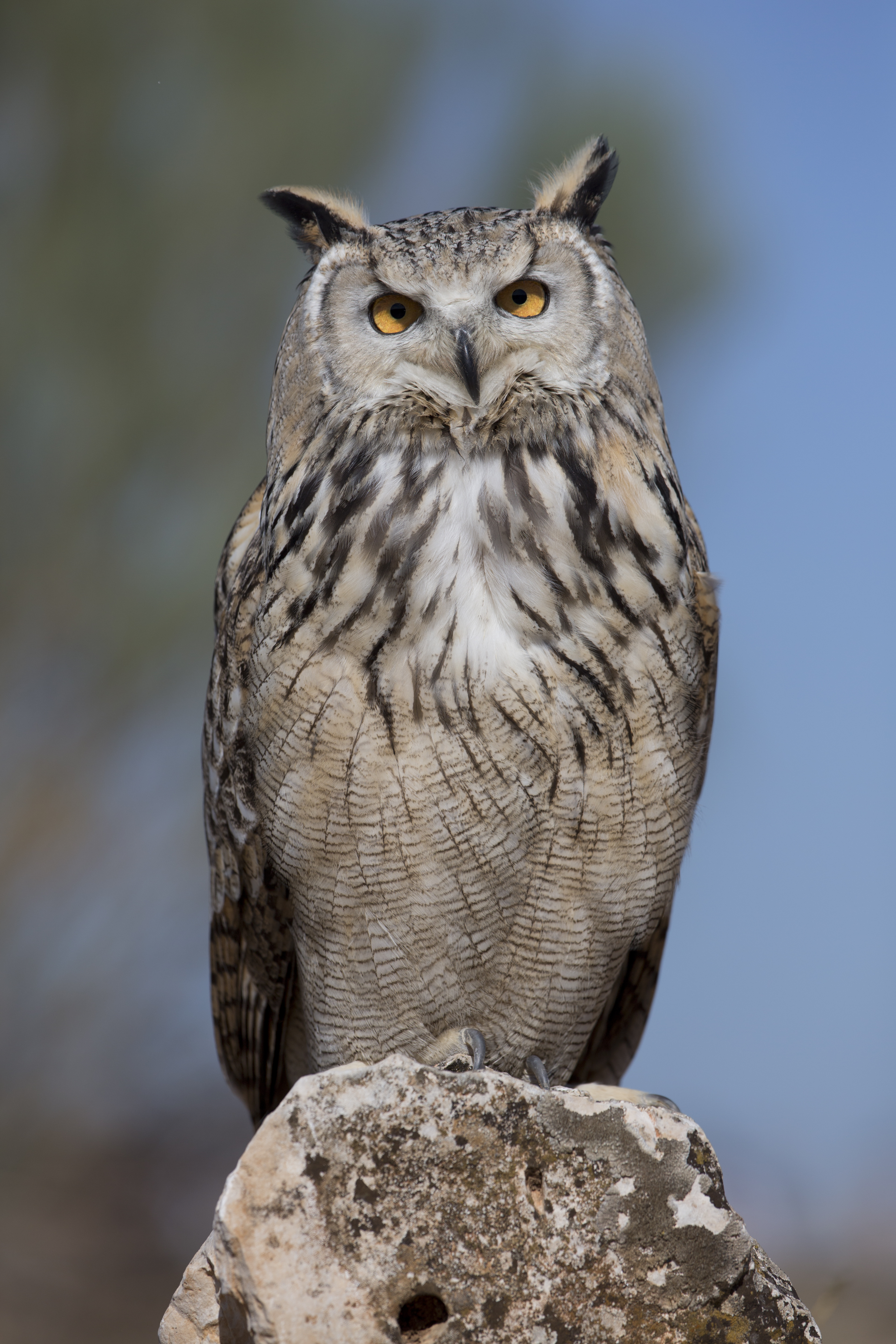
Credit: Carlos Delgado · CC BY-SA 4.0
The owl is a bird of prey that hunts mostly at night. There are more than 200 kinds of owls, and they live on every continent except Antarctica. Owls come in many sizes. The elf owl is about the size of a sparrow and weighs less than a golf ball. The great grey owl stands more than two feet tall and has a wingspan of nearly five feet.
Owls are built for hunting in the dark. Their large eyes soak up tiny amounts of light, letting them see on nights when humans would be almost blind. But owl eyes are not really balls. They are shaped like tubes, locked into the skull so they cannot move. To look around, an owl turns its whole head. It can twist its neck so far that it seems to be looking straight backward.
Their hearing is just as impressive. An owl's flat, round face works like a dish that funnels sound toward its ears. In many owl species, one ear sits higher on the head than the other. This uneven setup helps the owl figure out exactly where a sound is coming from, even in total darkness. A barn owl can catch a mouse it cannot see, guided by hearing alone.
Owls are also silent in flight. The front edges of their wing feathers have soft, comb-like fringes that break up the air instead of slapping it. This means no whooshing sound. Mice and voles often never hear the owl coming.
Owls swallow small prey whole. They cannot digest bones, fur, or feathers, so their stomachs squeeze these parts into a tight lump called a pellet. The owl coughs the pellet back up a few hours later. Scientists and kids often pull pellets apart to see exactly what the owl ate, bone by tiny bone.
Humans have told stories about owls for thousands of years. In ancient Greece, the owl was the symbol of Athena, the goddess of wisdom, which is why people still call someone smart "wise as an owl." Many Native American traditions see owls as messengers or spirit guides. In parts of Africa, Mexico, and Europe, though, people once feared owls as signs of bad luck or death. The same bird is treated as wise in one place and scary in another.
Most owl species are doing well, but some are in trouble because forests are being cut down. The northern spotted owl of the Pacific Northwest needs old, tall trees to nest in, and those trees are harder to find each year.
Last updated 2026-04-22