
Tuna
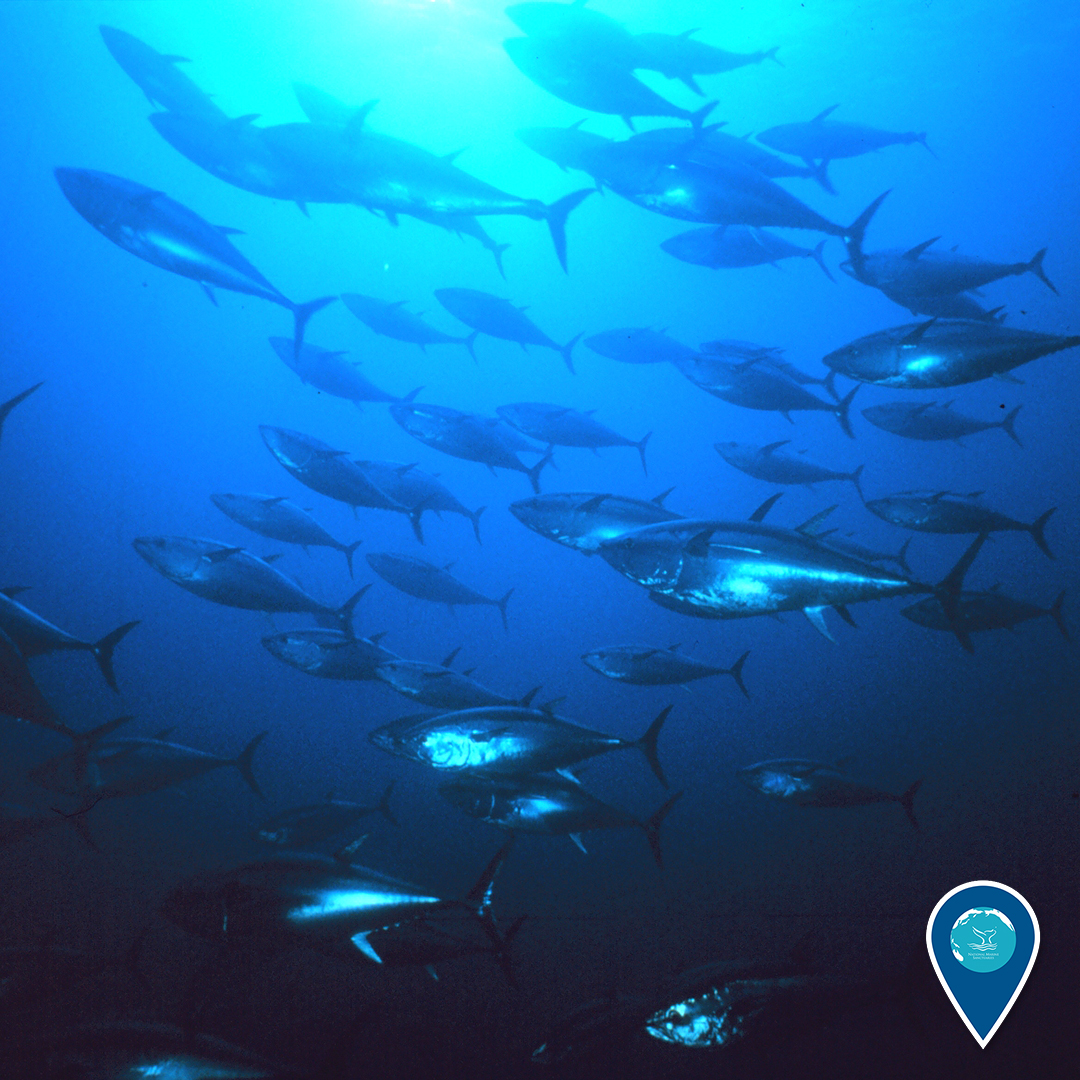
Credit: National Marine Sanctuaries · Public domain
Tuna are large saltwater fish that live in oceans around the world. There are about 15 species, including bluefin, yellowfin, albacore, and skipjack. Tuna are built for speed. They have smooth, torpedo-shaped bodies, strong tails, and fins that fold into slots to reduce drag. Most tuna live in warm and temperate seas, but they travel huge distances to find food.
The biggest type is the Atlantic bluefin. A full-grown bluefin can weigh more than 1,000 pounds and stretch over 10 feet long. That is about as long as a small car. The smallest tuna, the bullet tuna, grows to only about a foot and a half.
Tuna are unusual among fish because they are partly warm-blooded. Most fish are the same temperature as the water around them. Tuna can keep their muscles warmer than the ocean. This warm blood lets them swim faster and chase prey in cold deep water. It also lets them migrate across entire oceans. Scientists have tracked bluefin tuna swimming from waters near North America all the way to the Mediterranean Sea.
Tuna are predators. They hunt in groups called schools, often working together to trap smaller fish near the surface. They eat herring, mackerel, sardines, squid, and shrimp. A tuna can swallow a fish half its own length in one gulp.
Tuna never really stop moving. They have to keep swimming to breathe. Water has to flow over their gills for them to get oxygen, so a tuna that stops swimming will suffocate. Scientists think tuna may even swim while they sleep, letting only part of the brain rest at a time.
People have fished for tuna for thousands of years. Today tuna is one of the most valuable seafoods in the world. Skipjack and albacore fill most cans of tuna on grocery store shelves. Bluefin is served as sushi and sashimi, mostly in Japan. A single prize bluefin sold at a Tokyo auction in 2019 for more than 3 million dollars.
All this fishing has caused problems. Atlantic bluefin populations dropped sharply in the 1900s because too many were caught. Pacific bluefin numbers also fell. Countries now set limits on how many tuna can be caught each year, and some populations are slowly recovering. Conservation groups still argue about whether the limits are strict enough.
The next time you see a can of tuna in a kitchen cabinet, picture the fish it came from: a fast, warm-blooded hunter that may have crossed an entire ocean before it was caught.
Related
Last updated 2026-04-22