
Pacific Ocean
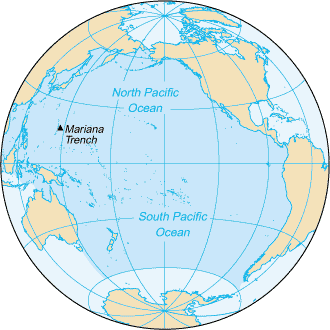
Credit: CIA World Factbook · Public domain
The Pacific Ocean is the largest and deepest ocean on Earth. It sits between Asia and Australia on one side and North and South America on the other. It stretches from the Arctic Ocean in the north to the Southern Ocean near Antarctica. The Pacific covers about 63 million square miles. That is bigger than all the land on Earth put together.
The ocean got its name from the Portuguese explorer Ferdinand Magellan in 1520. When he sailed into it, the water was calm. He called it Mar Pacífico, which means "peaceful sea" in Portuguese. The name stuck, even though the Pacific is not always peaceful. It has some of the strongest storms and biggest waves on the planet.
The Pacific is also the deepest ocean. Its deepest known spot is the Challenger Deep, in a trench near the island of Guam. The bottom of the Challenger Deep is almost 36,000 feet below the surface. If you dropped Mount Everest into it, the top of the mountain would still sit more than a mile underwater.
A huge ring of volcanoes and earthquake zones circles the Pacific. Scientists call it the Ring of Fire. About three out of every four active volcanoes on Earth are found along this ring. Most of the world's biggest earthquakes happen here too. When the seafloor shifts suddenly, it can push up giant waves called tsunamis that race across the ocean at hundreds of miles per hour.
The Pacific holds more than 25,000 islands. That is more than all the other oceans combined. Some, like Hawaii and Iceland's cousins in the South Pacific, were built by underwater volcanoes. Others are coral islands, built slowly by tiny sea animals. People have lived on Pacific islands for thousands of years. Ancient Polynesian sailors crossed thousands of miles of open water in wooden canoes, using the stars, waves, and birds to find their way.
Life in the Pacific is amazing. Blue whales, the largest animals ever to live, swim through its cold waters. Giant squid hunt in its dark depths. Coral reefs near Australia and Indonesia hold more kinds of fish than almost anywhere else on Earth. The Pacific also has a darker side today. A huge area of floating trash, called the Great Pacific Garbage Patch, has collected between Hawaii and California. Much of it is plastic. Cleaning it up is one of the biggest challenges facing the world's oceans.
Related
Last updated 2026-04-22