
Animation
Credit: Eadweard Muybridge · Public domain
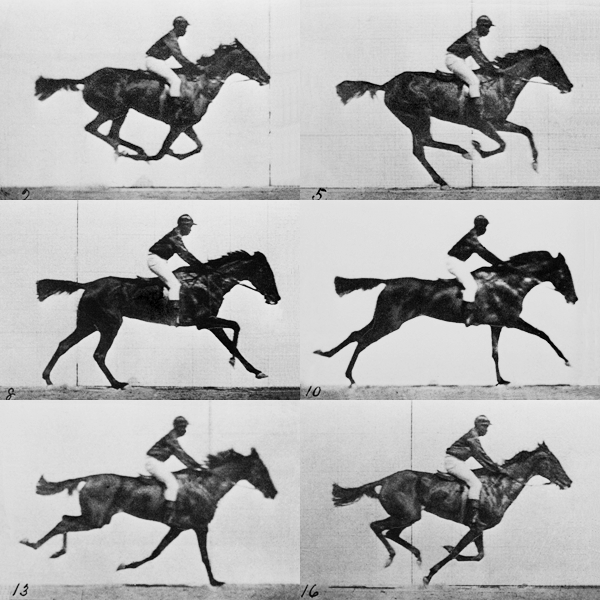
Animation is a kind of moving picture made by showing many still images one after another very quickly. Each image is a tiny bit different from the one before it. When the images flash by fast enough, your eyes and brain blend them together. The drawings seem to move. Most animation shows about 24 separate pictures every second.
This trick works because of how human vision handles fast changes. Your brain holds onto each image for a split second after it disappears. The next image arrives before the last one fades. The result feels like smooth motion, even though nothing on the screen is actually moving.
People made simple animations long before movies existed. In the 1830s, toys called zoetropes spun a strip of pictures inside a drum with slits. Looking through the slits, you saw a horse gallop or a clown juggle. The first animated cartoon shown in a movie theater was made in 1908 by a French artist named Émile Cohl. Walt Disney's studio released the first feature-length animated film, Snow White and the Seven Dwarfs, in 1937.
For most of the twentieth century, animation meant hand-drawing. Artists drew each picture on a clear sheet of plastic called a cel. They placed the cel over a painted background and snapped a photo. Then they swapped the cel for a slightly different one and snapped another photo. A ten-minute cartoon needed about 14,400 separate drawings.
Today most animation is made on computers. Movies like Toy Story, Frozen, and Spider-Man: Into the Spider-Verse are built from digital models. Artists pose these models, light them, and let the computer render each frame. Stop-motion is another style. Animators move tiny puppets or clay figures a little at a time, taking a photo after every move. Films like Coraline and Wallace and Gromit are made this way. A single second of stop-motion can take a full day to shoot.
Animation is not just for kids. Engineers use it to test how bridges might shake in earthquakes. Doctors use it to show how blood flows through the heart. Scientists use it to picture things too small or too far away to film, like atoms bouncing or galaxies colliding. Wherever something needs to be seen in motion that cannot be filmed in real life, an animator can draw it.
Related
Last updated 2026-04-26