
Earthquake
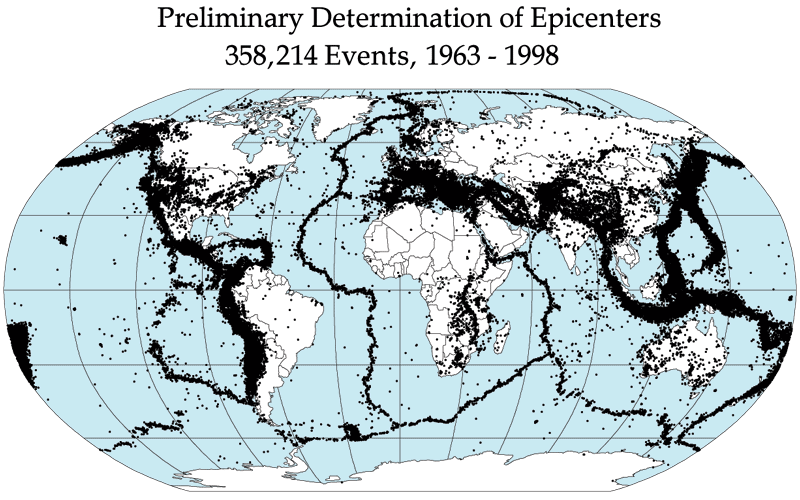
Credit: NASA, DTAM project team · Public domain
An earthquake is a sudden shaking of the ground caused by movement deep inside the Earth. Most earthquakes happen when huge slabs of rock under the surface slip past each other. The shaking can last a few seconds or several minutes. Small earthquakes happen somewhere on Earth every few minutes. Big ones are much rarer, but they can knock down buildings and reshape coastlines.
To understand earthquakes, it helps to picture the Earth's outer shell. That shell is broken into giant pieces called tectonic plates. The plates float on hotter, softer rock below. They move very slowly, about as fast as your fingernails grow. Where two plates meet, they often get stuck against each other. Pressure builds up for years or even centuries. When the rock finally snaps, the stored energy bursts out as an earthquake.
The exact spot where the rock breaks is called the focus. It is usually several miles underground. The point on the surface right above the focus is called the epicenter. Shaking is strongest there and weaker the farther away you go. The energy travels outward in waves, like ripples on a pond.
Scientists measure earthquakes with a tool called a seismograph. The size of an earthquake is given as a magnitude, often using the Richter scale or a newer scale called the moment magnitude scale. Each step up the scale means about 32 times more energy. So a magnitude 7 quake releases roughly 1,000 times more energy than a magnitude 5.
Most earthquakes happen along the edges of tectonic plates. The Ring of Fire, which loops around the Pacific Ocean, has about 80 percent of the world's biggest quakes. Japan, Indonesia, Chile, and the western United States all sit on this ring. Earthquakes can also trigger other disasters. An undersea quake can push up a wall of water called a tsunami. Quakes in mountains can set off landslides.
Can scientists predict earthquakes? Not yet. They can map dangerous fault lines and say which areas are likely to shake someday. But they cannot tell you the day, the hour, or the exact size in advance. This is one of the biggest open problems in earth science.
People in earthquake zones plan ahead instead. Engineers design buildings with flexible frames and deep foundations that can sway without breaking. Schools practice "drop, cover, and hold on" drills. Some countries, like Japan and Mexico, send warning alerts to phones a few seconds before the strongest shaking arrives.
Related
Last updated 2026-04-25