
Igneous Rock
Credit: Hawaii Volcano Observatory (DAS) · Public domain
Igneous rock is rock that forms when hot, melted rock cools down and hardens. The word "igneous" comes from a Latin word that means fire. Igneous rock is one of the three main types of rock on Earth, along with sedimentary rock and metamorphic rock. Most of the rock in Earth's crust started out as igneous rock.
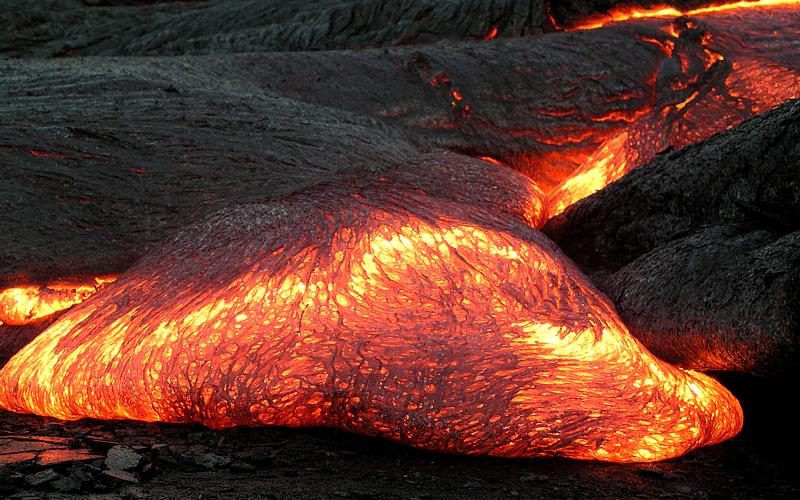
Deep inside Earth, rock gets so hot that it melts. Melted rock underground is called magma. When magma reaches the surface through a volcano, it is called lava. Both magma and lava cool over time. As they cool, tiny crystals start to grow and lock together. Once the rock is solid, it is igneous rock.
There are two main kinds of igneous rock. The difference is where the rock cooled.
The first kind cools slowly underground. Magma trapped deep below the surface can take thousands or even millions of years to fully harden. The slow cooling gives crystals lots of time to grow. So the rock ends up with large crystals you can see without a magnifying glass. Granite is the most common example. Most of the rock under the continents is granite. The walls of Yosemite Valley in California are giant slabs of it.
The second kind cools quickly above ground. When lava pours out of a volcano and meets the air or water, it hardens fast. Crystals do not have time to grow big. So the rock has very tiny crystals or no crystals at all. Basalt is the most common example. Most of the ocean floor is made of basalt. The Hawaiian Islands are basalt too, built up by lava flows over millions of years.
Some igneous rocks are very strange. Obsidian is volcanic glass. It cools so fast that no crystals form, and it breaks into sharp edges. Ancient people used obsidian to make knives and arrowheads. Pumice is full of holes left by gas bubbles trapped in the lava as it hardened.
Igneous rock does not stay igneous forever. Wind, water, and ice slowly break it down into tiny pieces. Those pieces wash into rivers and oceans, where they pile up and squeeze together to form sedimentary rock. Heat and pressure deep underground can change rock into metamorphic rock. And if any rock sinks deep enough, it melts back into magma and starts the journey again. Scientists call this slow loop the rock cycle. It has been turning for billions of years.
Related
Last updated 2026-04-25