
Australia (continent)
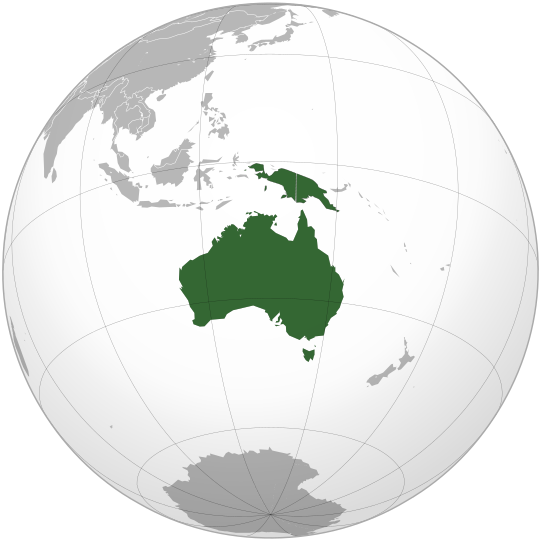
Credit: Australia_(orthographic_projection).svg: Ssolbergj derivative work (colouring in New Guinea, same shade as Australia): Avenue (talk) · CC BY-SA 3.0
Australia is the smallest of the seven continents. It lies between the Indian Ocean and the Pacific Ocean, south of Asia. The continent is about 2.97 million square miles, which is a little smaller than the lower 48 states of the United States. It is also the only continent that holds just one country, also called Australia. The island of Tasmania, just south of the mainland, is part of the continent too.
A very old and very flat land
Australia is the flattest continent on Earth. It is also one of the oldest. Some rocks in Western Australia are more than four billion years old, nearly as old as the planet itself. For most of that time, the land has been slowly worn down by wind and water. There are no young, jagged mountain ranges like the Himalayas. The highest peak, Mount Kosciuszko, is only 7,310 feet tall. That is shorter than many ski resorts in Colorado.
The middle of the continent is called the Outback. It is a huge, dry area of red soil, rocky plains, and tough grasses. Rain rarely falls there. In the center stands Uluru, a giant red sandstone rock that rises 1,142 feet above the desert. Uluru is sacred to the Anangu people, who have lived in the area for tens of thousands of years.
Weather and water
Most of Australia is very dry. About 70 percent of the continent is either desert or almost desert. The Great Victoria Desert, the Great Sandy Desert, and the Gibson Desert cover large parts of the middle and west. Because Australia sits south of the equator, the seasons are flipped from those in the United States. Christmas falls in the middle of summer, and July is the coldest month.
The edges of the continent are much wetter than the center. Tropical rainforests grow in the northeast, and grassy farmland covers much of the southeast. The longest river is the Murray, which flows about 1,560 miles through the southeast. Off the northeast coast lies the Great Barrier Reef, the biggest coral reef system on Earth. It stretches more than 1,400 miles, longer than the distance from New York City to Miami.
Animals found nowhere else
Australia broke away from the other continents about 50 million years ago. Its plants and animals then evolved on their own for a very long time. Because of this, many Australian animals are found nowhere else in the world. Kangaroos, koalas, wombats, and Tasmanian devils are marsupials, which means mothers carry their babies in pouches. The platypus and the echidna are even stranger. They are mammals that lay eggs.
Australia is also home to many of the world's most dangerous creatures. The box jellyfish, the inland taipan snake, and the saltwater crocodile all live there. Eucalyptus trees, which koalas eat, cover huge areas of the continent. Their oily leaves burn easily, which is one reason wildfires are a serious problem in Australia.
The First Peoples
People have lived in Australia for a very long time. Aboriginal Australians and Torres Strait Islanders arrived at least 65,000 years ago, probably by boat from what is now Indonesia. That makes their cultures some of the oldest living cultures on Earth. Before Europeans arrived, hundreds of different Aboriginal nations lived across the continent. They spoke more than 250 different languages and had deep knowledge of the land, the seasons, and the stars. Many carved rock paintings still exist today, some of them tens of thousands of years old.
In 1770, a British explorer named James Cook landed on the east coast and claimed the land for Britain. Eighteen years later, Britain began sending prisoners to a colony at what is now Sydney. Over the next 200 years, European settlers took over most of the continent. This was terrible for Aboriginal people, who lost much of their land and suffered from new diseases and violence. Today, Aboriginal and Torres Strait Islander peoples make up about 3.8 percent of Australia's population and are working to protect their languages and traditions.
Modern Australia
Today about 27 million people live on the continent. Most of them live near the coast, especially in the southeast. Sydney and Melbourne are the biggest cities, and Canberra is the capital. The middle of the continent, though huge, has very few people. You can drive for hours in the Outback without seeing another car. Scientists now worry about how climate change will affect Australia, because hotter weather is making droughts, wildfires, and coral bleaching worse every year.
Last updated 2026-04-22