
Cuba
Credit: Fraganda https://fragandaphoto.mypixieset.com · CC BY-SA 4.0
Cuba is an island country in the Caribbean Sea, south of Florida. It is the largest island in the Caribbean and stretches about 780 miles from end to end. More than 11 million people live there. The capital city is Havana, on the island's northern coast.
Cuba's shape is long and narrow, a bit like a sleeping crocodile. People even call it "el cocodrilo" for that reason. The land has rolling hills, flat plains, and three small mountain ranges. The biggest range, the Sierra Maestra, rises in the southeast. Cuba's climate is warm all year, with a rainy season in summer and a dry season in winter. Hurricanes sometimes sweep across the island between June and November.
The first people of Cuba were the Taíno and the Ciboney. Christopher Columbus arrived in 1492 and claimed the island for Spain. Spanish rule lasted almost 400 years. During that time, Spain brought enslaved Africans to Cuba to work on sugar plantations. Sugar became the heart of the economy, and it still is today. Cuba also grows coffee, tobacco, and tropical fruit.
In 1898, after a short war between Spain and the United States, Spain gave up control of Cuba. The island became fully independent in 1902. For the next 50 years, Cuba was closely tied to the United States. Then, in 1959, a group of rebels led by Fidel Castro took over the government. Castro turned Cuba into a communist country and became close allies with the Soviet Union.
The change made Cuba a flashpoint in the Cold War. In 1962, the Soviet Union started setting up nuclear missiles on the island. For 13 tense days, the world worried that a nuclear war might begin. The crisis ended when the Soviets agreed to remove the missiles. The United States kept a trade ban, called an embargo, on Cuba. Parts of that ban are still in place today.
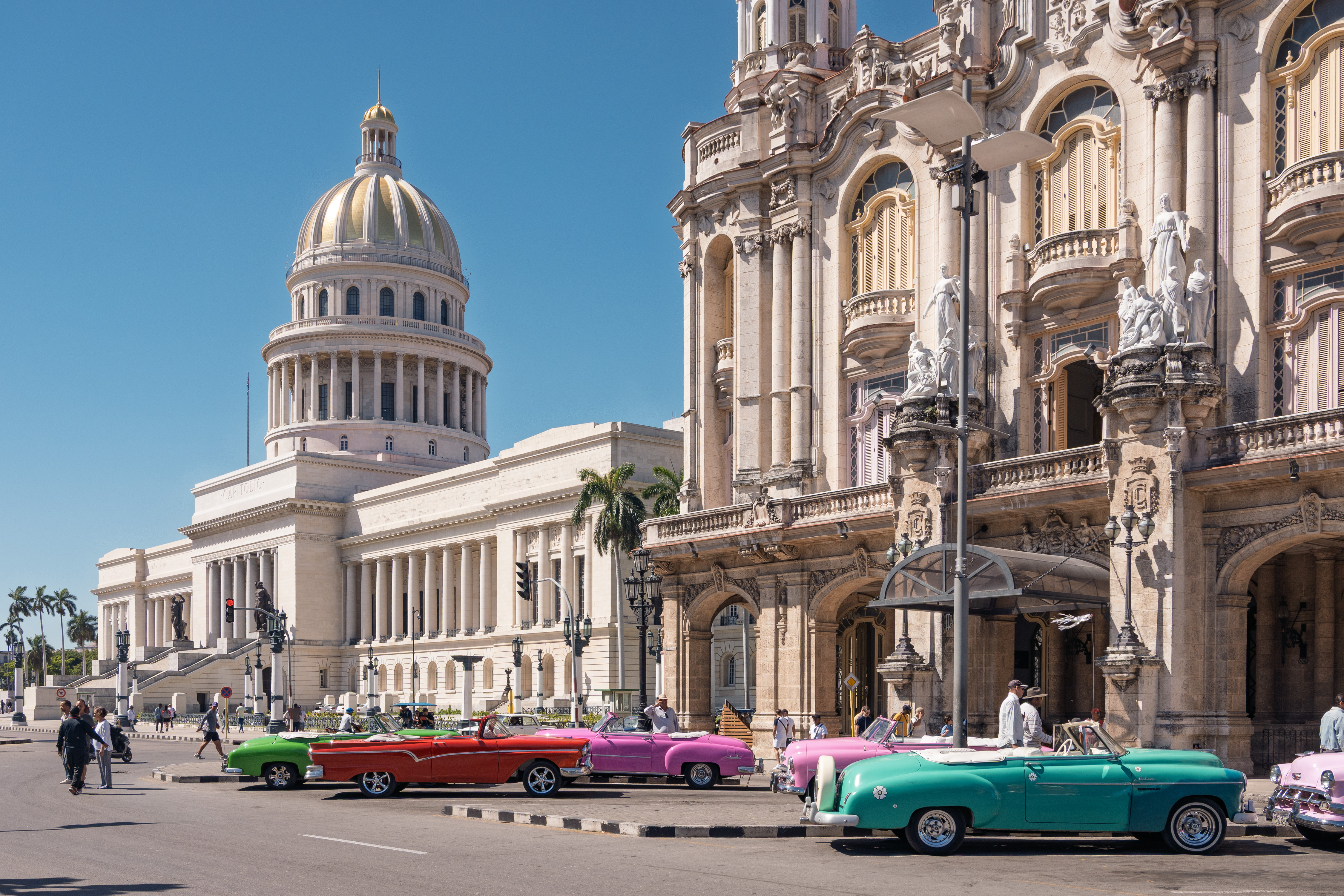
Cuban culture is famous around the world. Music styles like son, mambo, salsa, and rumba were born on the island. Baseball is the most popular sport, and Cuban players have become stars in the major leagues. Classic American cars from the 1950s still rumble through Havana's streets, because the trade embargo made new cars hard to get. Cubans have kept those old cars running for more than 60 years by fixing and rebuilding every part by hand.
Related
Last updated 2026-04-23