
Great Lakes
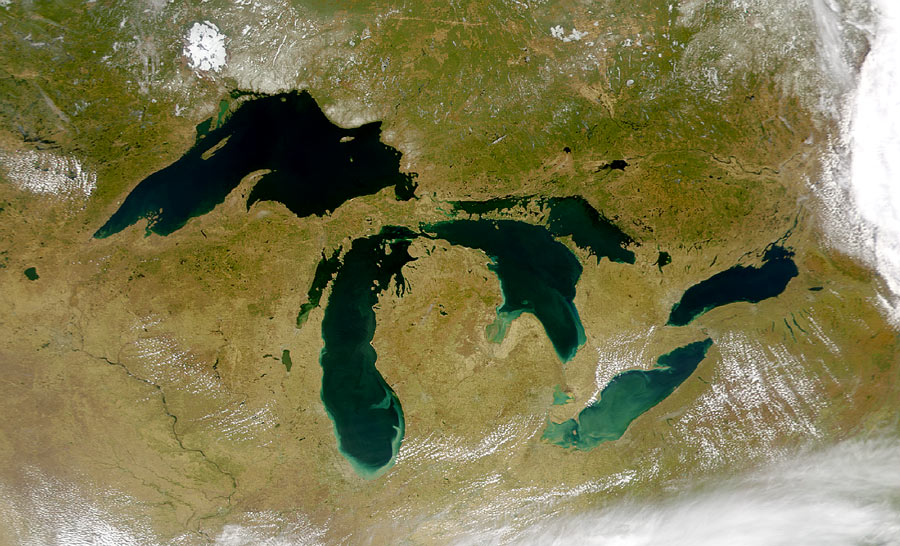
Credit: SeaWiFS Project, NASA/Goddard Space Flight Center, and ORBIMAGE. · Public domain
The Great Lakes are a chain of five huge freshwater lakes in central North America. They sit on the border between the United States and Canada. From west to east, they are Lake Superior, Lake Michigan, Lake Huron, Lake Erie, and Lake Ontario. Together they form the largest group of freshwater lakes in the world by surface area.
The lakes were carved out by glaciers during the last Ice Age. Around 14,000 years ago, giant sheets of ice more than a mile thick slid across the land. They scraped out deep basins in the rock. When the ice melted, water filled the basins, and the Great Lakes were born.
The size of these lakes is hard to picture. Lake Superior alone covers about 31,700 square miles. That is bigger than the state of South Carolina. Its deepest point is more than 1,300 feet down, deep enough to swallow the Empire State Building with room to spare. If you stood on one shore of Lake Superior, you could not see the other side. The water stretches past the horizon like an ocean.
A handy way to remember the lakes is the word HOMES: Huron, Ontario, Michigan, Erie, Superior. Only Lake Michigan sits entirely in the United States. The other four are shared with Canada.
The lakes are all connected. Water flows from Superior down through Huron, Michigan, Erie, and finally Ontario. From there it pours over Niagara Falls and out through the St. Lawrence River to the Atlantic Ocean. A drop of water that starts in Lake Superior can take almost 200 years to finish the trip.
People have lived around the Great Lakes for thousands of years. Many Native nations, including the Ojibwe, Odawa, Potawatomi, Huron, and Haudenosaunee, have deep ties to these waters. Today, more than 30 million people get their drinking water from the lakes. Big cities like Chicago, Detroit, Toronto, Cleveland, and Milwaukee all grew up on their shores.
The lakes are not just pretty. They are also busy. Giant cargo ships called lakers carry iron ore, grain, and coal across the water. Fishing, boating, and swimming draw millions of visitors every summer.
The Great Lakes face real problems. Pollution, invasive species like zebra mussels, and warming temperatures all threaten the water. Asian carp, a fish that eats huge amounts of food other fish need, has been creeping closer to the lakes for years. Scientists and governments on both sides of the border are working together to protect one of the planet's most important freshwater treasures.
Related
Last updated 2026-04-23