
Ancient India
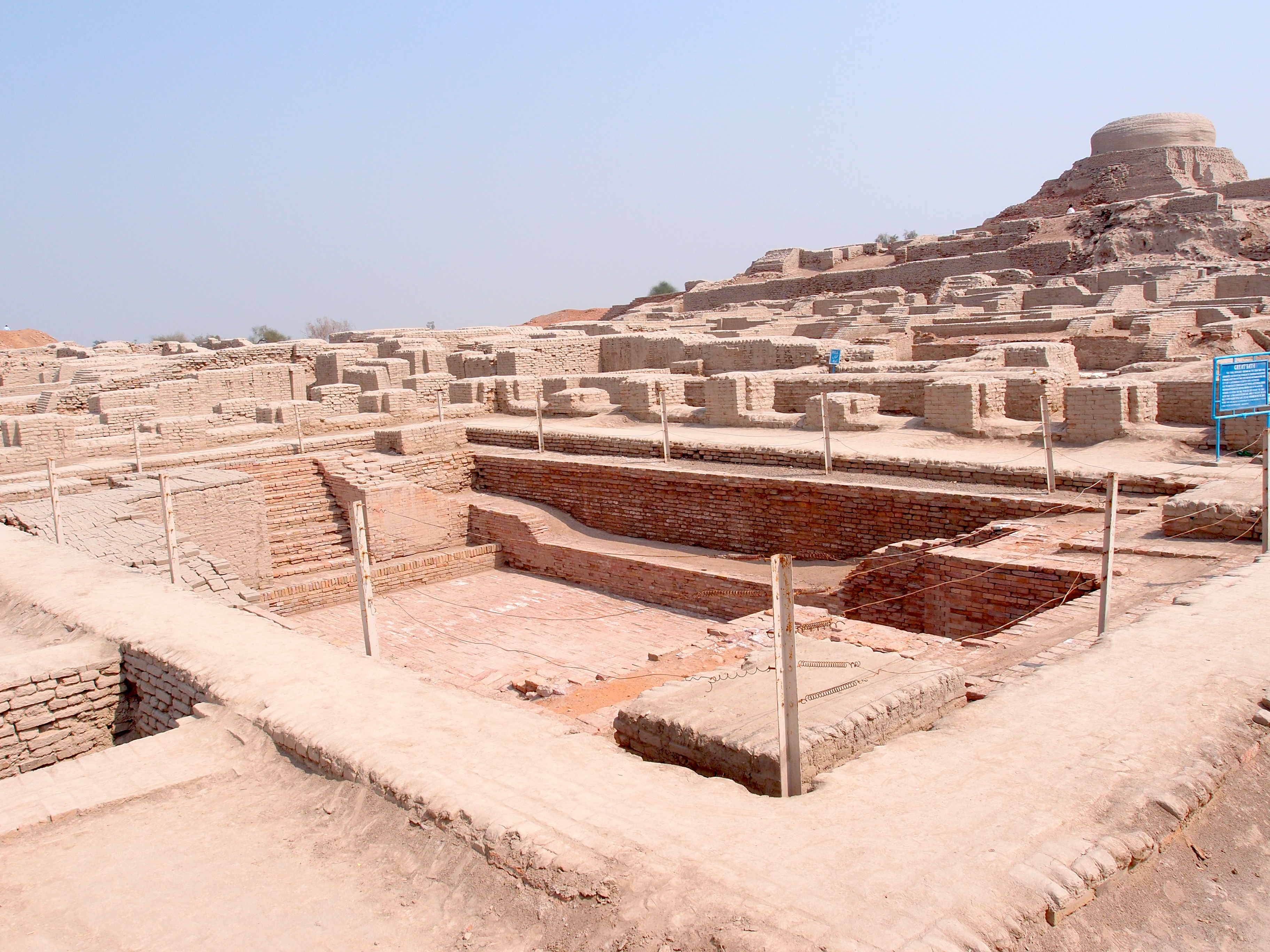
Credit: Saqib Qayyum · CC BY-SA 3.0
Ancient India was one of the world's oldest civilizations. It grew up on the land that is now India, Pakistan, and Bangladesh. The story of ancient India stretches back more than 5,000 years. It includes some of the first big cities ever built, two major world religions, and inventions that still shape modern life.
The first great culture there was the Indus Valley Civilization. It began around 3300 BCE along the Indus River. At its peak, it was as large as ancient Egypt and Mesopotamia combined. Its biggest cities, Mohenjo-daro and Harappa, had straight streets laid out in a grid. They had brick houses, public wells, and indoor bathrooms connected to covered sewers. Few cities in the world would have plumbing this good again for thousands of years.
Around 1900 BCE, the Indus Valley cities were slowly abandoned. Nobody knows exactly why. Some scientists think the rivers changed course. Others think the climate dried out, or that disease spread through the cities. The people of the Indus Valley also left behind a written script. Experts have never been able to read it. It is one of the great unsolved mysteries of history.
After the Indus Valley faded, new groups settled across northern India. They wrote long poems and prayers called the Vedas. The Vedas became the foundation of Hinduism, which is still one of the largest religions in the world today. Hinduism teaches about many gods and goddesses, and about a soul that is reborn into new lives.
Around 500 BCE, a prince named Siddhartha Gautama gave up his palace to search for the meaning of suffering. He became known as the Buddha, which means "the awakened one." His teachings became Buddhism, a religion that spread from India across most of Asia.
Ancient India was also home to powerful empires. The Maurya Empire, founded around 322 BCE, controlled most of the subcontinent. Its most famous ruler, Ashoka, fought a brutal war and was so horrified by the deaths that he gave up violence. He carved messages about peace and kindness into stone pillars across his empire. Some of those pillars still stand today.
Later, the Gupta Empire ruled from about 320 to 550 CE. Many people call this period India's "Golden Age." Gupta scholars made huge advances in math and science. They invented the digit zero and the number system the whole world uses now. They also figured out that Earth is round and orbits the Sun, more than a thousand years before European astronomers reached the same idea. The next time you write the number 0, you are using a gift from ancient India.
Related
Last updated 2026-04-26