
Mount Kilimanjaro
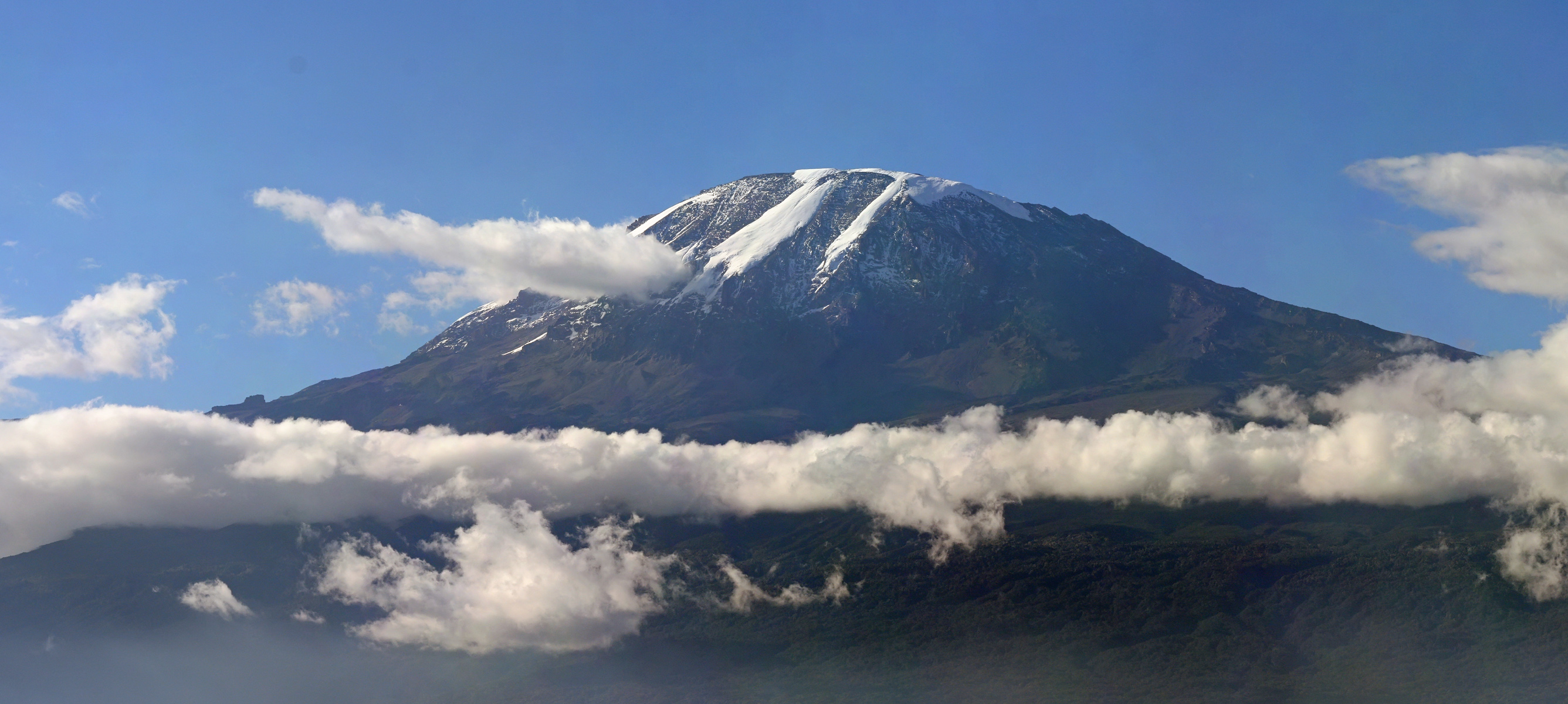
Credit: Muhammad Mahdi Karim · GFDL 1.2
Mount Kilimanjaro is the tallest mountain in Africa. It stands in the country of Tanzania, near the border with Kenya. Its highest point, called Uhuru Peak, reaches 19,341 feet above sea level. That is almost four miles straight up. Unlike most big mountains, Kilimanjaro is not part of a mountain range. It rises alone out of the flat plains of East Africa, which makes it look even more dramatic from a distance.
Kilimanjaro is a volcano. It actually has three volcanic cones: Kibo, Mawenzi, and Shira. Kibo is the tallest and holds Uhuru Peak. Mawenzi and Shira are extinct, meaning they will never erupt again. Kibo is only dormant, which means it is sleeping. Its last big eruption was about 360,000 years ago, but small gas vents near the top still puff out sulfur today.
The mountain is famous for the snow and ice at its peak, right near the equator. Ernest Hemingway wrote a famous short story called "The Snows of Kilimanjaro" in 1936. The ice caps at the summit are ancient glaciers. Some of the ice is more than 10,000 years old. But the glaciers have been shrinking fast. Scientists say Kilimanjaro has lost more than 85 percent of its ice since 1912. Most researchers blame a mix of climate change and drier weather in the region. Some studies predict the glaciers could be gone completely by the 2040s.
About 30,000 people try to climb Kilimanjaro each year. It is one of the few tall peaks that a regular person can summit without ropes or climbing gear. The real challenge is not rock or ice. It is the thin air. At the top, there is only about half as much oxygen as at sea level. Many climbers get altitude sickness, which causes headaches, dizziness, and upset stomachs. A typical climb takes five to nine days, and guides recommend going slowly so the body can adjust.
The Chagga people have lived on the slopes of Kilimanjaro for hundreds of years. They farm bananas and coffee in the rich volcanic soil. The name "Kilimanjaro" may come from their language or from Swahili, but its exact origin is debated. One popular idea is that it means "mountain of greatness." Another suggests "mountain of water," since rivers flow down from its melting snow to feed farms and villages below.
The first people known to reach the summit were a German geographer named Hans Meyer and an Austrian climber named Ludwig Purtscheller, in 1889. Local guide Yohani Kinyala Lauwo climbed it with them and later guided many others into his nineties.
Related
Last updated 2026-04-23