
Africa
Credit: Martin23230 · CC BY-SA 3.0
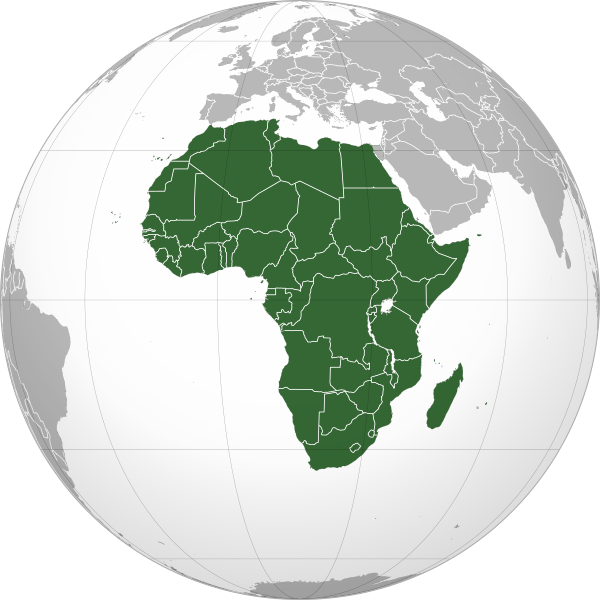
Africa is the second-largest continent on Earth. It sits south of Europe, across the Mediterranean Sea, and east of the Atlantic Ocean. It covers about 11.7 million square miles. That is more than three times the size of the United States. Africa holds 54 countries, more than any other continent. About 1.4 billion people live there, roughly one out of every six people on Earth.
The land
Africa has more kinds of land than almost anywhere else. The Sahara Desert stretches across the north. It is the largest hot desert in the world. The Sahara is about the size of the whole United States. In the middle of the continent are thick rainforests, mostly along the Congo River. Farther east and south are wide grasslands called savannas. These are the places where lions, zebras, and elephants roam.
Africa also has tall mountains. Mount Kilimanjaro in Tanzania rises more than 19,000 feet above sea level. It is the tallest mountain in Africa, and it has snow on top even though it sits near the equator. The Great Rift Valley runs down the eastern side of the continent. It was made by two pieces of Earth's crust slowly pulling apart. The pulling is still happening. In millions of years, part of East Africa may split off and become a new island.
The Nile River, the longest river in the world, flows more than 4,100 miles through northeast Africa. Ancient Egypt grew up along its banks. The Congo River, in the center of the continent, is the second-largest river in the world by how much water it carries.
Where humans began
Africa is where the human story started. Scientists have found the oldest known human fossils in East Africa, in countries like Ethiopia, Kenya, and Tanzania. One famous fossil, nicknamed "Lucy," was found in Ethiopia in 1974. Lucy lived about 3.2 million years ago. She walked on two legs, like we do, but she was shorter and had a much smaller brain.
Modern humans, the kind of people alive today, also first appeared in Africa. Most scientists believe every person on Earth is descended from small groups who left Africa about 60,000 to 70,000 years ago. Those groups slowly spread to every other continent except Antarctica.
Ancient history
Some of the world's earliest great civilizations grew up in Africa. Ancient Egypt, along the Nile, lasted about 3,000 years. Its pyramids, pharaohs, and writing system still amaze people today. Farther south, the kingdom of Kush ruled for centuries. It once conquered Egypt and built its own pyramids, which are smaller but more numerous.
In West Africa, the empires of Ghana, Mali, and Songhai grew rich from trading gold and salt. A Malian king named Mansa Musa, who lived in the 1300s, is often called the richest person in human history. He gave away so much gold on a trip to Egypt that prices in Cairo dropped for years afterward. In East Africa, the city of Great Zimbabwe was built of huge stone walls without using any mortar.
Hard history and today
Starting in the 1400s, European traders began capturing and buying enslaved Africans. Over about 400 years, at least 12 million people were forced onto ships and carried to the Americas. This was the Trans-Atlantic Slave Trade. It tore families apart and shaped the world in ways we still live with today.
In the late 1800s, European countries claimed almost all of Africa for themselves. They drew borders on maps without asking the people who lived there. This was called colonialism. After World War II, African countries began winning back their independence. Most became free countries in the 1950s and 1960s. South Africa had its own long struggle against a system called apartheid, which separated people by race. The system ended in 1994, when Nelson Mandela became the country's first Black president.
Animals and wild places
Africa is famous for its wildlife. The savannas are home to the "big five": lions, leopards, elephants, rhinos, and Cape buffalo. Giraffes, zebras, hippos, cheetahs, and wildebeest also live there. Every year, about 1.5 million wildebeest migrate in a huge circle across Kenya and Tanzania, followed by lions and crocodiles waiting to hunt them. The rainforests are home to gorillas, chimpanzees, and okapis. Madagascar, a large island off the southeast coast, has lemurs and other animals found nowhere else on Earth.
Africa is changing fast. Its cities are growing quickly, and it has the youngest population of any continent. More than 40 percent of Africans are under the age of 15. The future of Africa will be shaped by those young people.
Related
Last updated 2026-04-22